
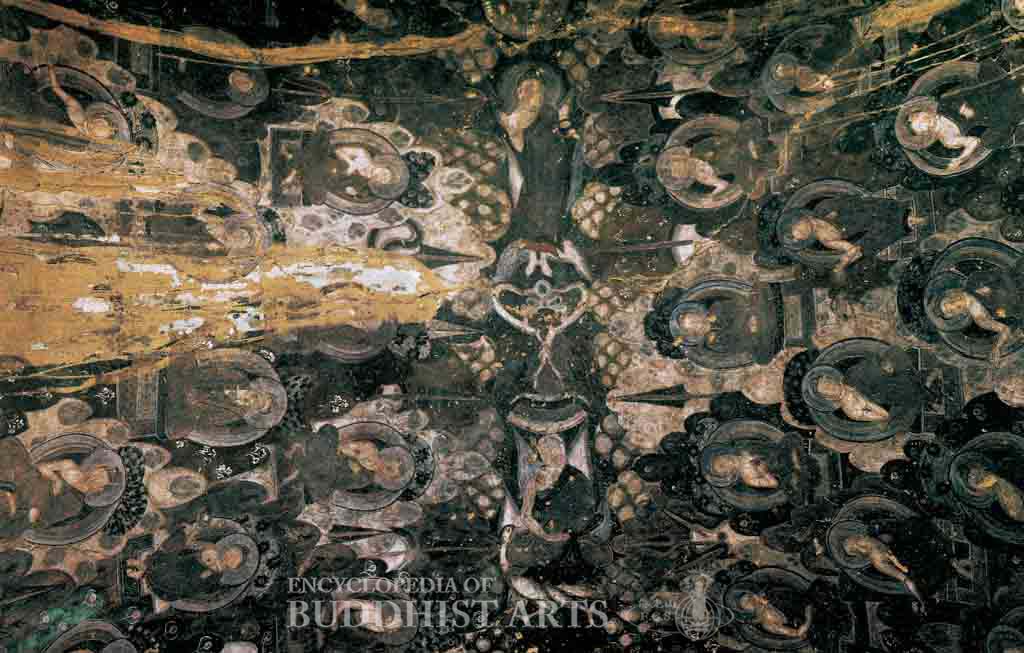
Simsen Cave 48: Main Chamber - Ceiling
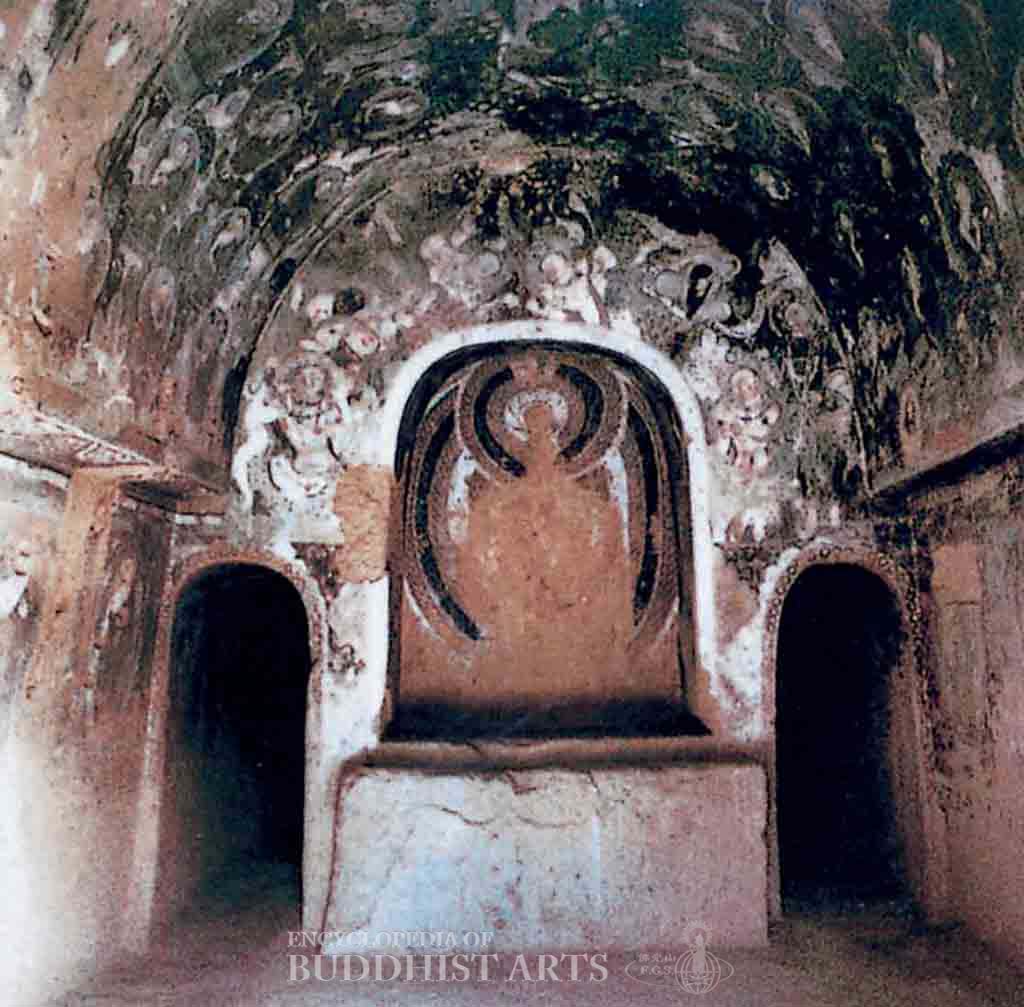
Simsen Cave 48
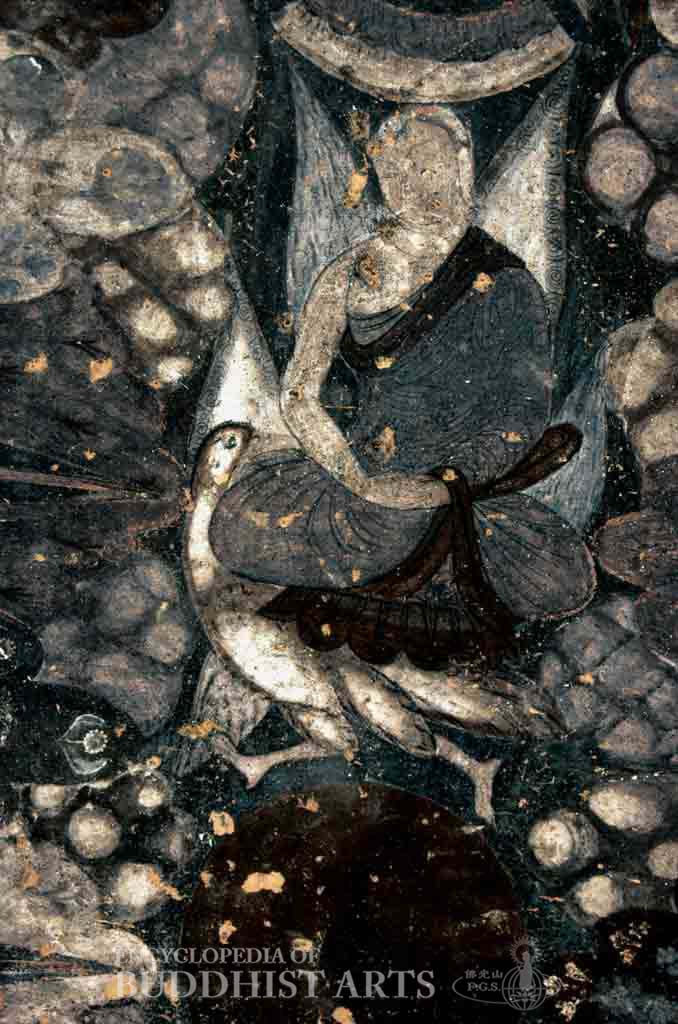
Simsen Cave 48: Main Chamber - Meditating Monk
Simsen Cave 48
CHINA, Xinjiang, Aksu
Located in the east area of the Simsen Caves site, Cave 48 was built between the 6th and 7th centuries, and is typical of central pillar caves constructed during this period, marking the height of Kuchean cave art. Most of the antechamber has collapsed, together with a doorway in the center of the back (west) wall that leads to the main chamber. The main chamber has a rectangular layout, and is 3.9 m wide, 4.05 m high, and 3.95 m deep. It has a barrel-vaulted ceiling, and side corridors leading to the rear corridor are on the left and right sides of the back wall.
A niche, now bereft of a statue, is found in the center of the back wall. The painted nimbus and aureole remain on the wall, and there is a barrel-vaulted ceiling. A canopy is painted on the niche ceiling, and on both sides there are diamond-shaped illustrations of landscapes and animals. An illustration of gandharva playing a harp is depicted to the left of the niche on the back wall of the main chamber, and on the right is Sakra and his family listening to the Dharma. Four apsaras are painted on the upper wall.
Illustrations of astrological signs are painted on the central ridge of the ceiling within the main chamber, including Candra with a rabbit on the moon; a standing Buddha holding a bowl; a garuda; a meditating monk on a goose; and Surya in a wagon. Four rows of seated Buddhas in diamond-shaped motifs, and scenes from the Life of the Buddha in triangular shapes can be found on both sides of the ceiling. The Buddhas all assume different positions: some recline with their heads to one side; while others are seated in full lotus position or cross-legged; some form mudras, while others hold bowls. Their robes cover either both or only the left shoulder.
Both side walls of the main chamber feature a standing Buddha at the center surrounded by donors in Kuchean attire. The illustrations on the left and right corridors are similar, with five round lotuses on the central ridge of the barrel-vaulted ceilings, and donors painted on the inner walls. An illustration of the Buddha’s parinirvana is portrayed on the outer wall of the rear corridor, the cremation on the inner wall, and nine round lotuses are found on the barrel-vaulted ceiling.
The cave is characterized by a symmetrical and balanced design, and is rich in decorative elements. The lively figures are depicted in detail, and the washes on the murals form highlights and shadings. Cold colors, such as mineral blue, mineral green, and white are widely used, increasing the charm of the murals. This is one of the most representative caves in the Kuchean style.
For more details, go to the Encyclopedia of Buddhist Arts: Caves Mo-S, page 1413.
Cite this article:
author = Hsingyun and Youheng and Johnson, Peter and Mankuang and Huntington, Susan and Edson, Gary and Neather, Robert,
booktitle = {Encyclopedia of Buddhist Arts: Caves Mo-S},
pages = 1413,
title = {{Simsen Cave 48}},
volume = 8,
year = {2016}}