
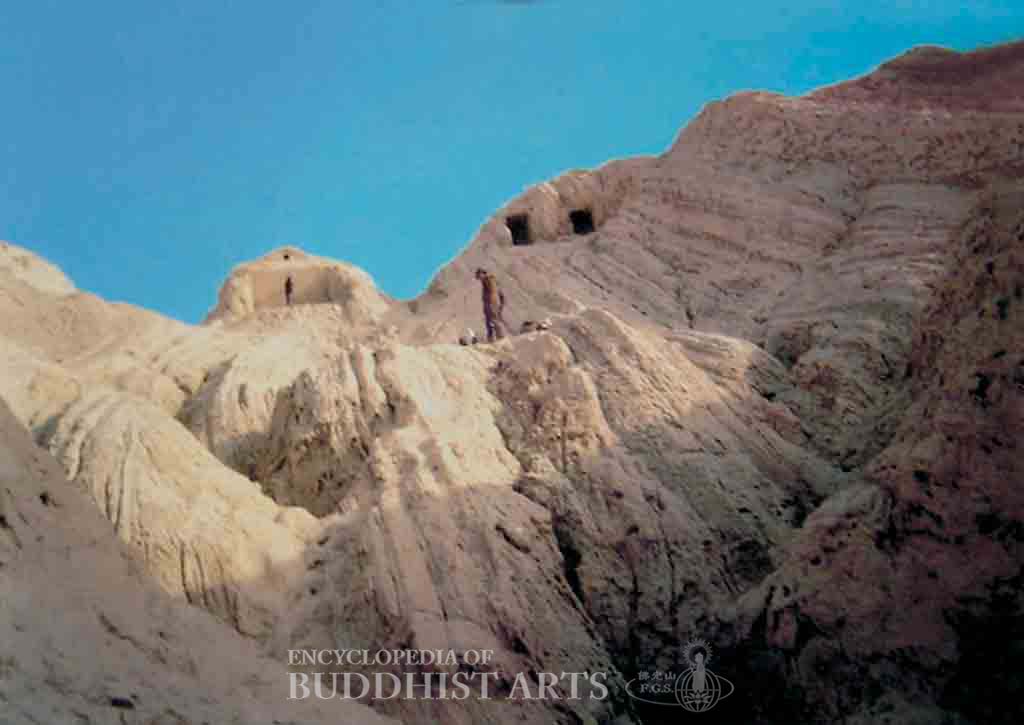
Toghrakeken Caves
Toghrakeken Caves
CHINA, Xinjiang, Aksu
These caves are situated in Toghrakeken Valley, approximately 40 km southwest of Xinhe, Aksu. Built between the 7th and 9th centuries, they occupy the western extremity of the ancient Kucha territory. As part of the Kumtura Caves, the caves were listed as a National Cultural Heritage Site in 2006.
There are currently 14 numbered caves, most of which are central pillar caves. Several others are square caves with vaulted ceilings. Caves 1, 3, 4, 6, and 8 are all central pillar caves. The general layout and the themes depicted in the murals are similar to those found in other Kuchean caves. These caves consist of a main chamber, with corridors to the left and right connected by a rear corridor.
Cave 3 has a niche on the back wall and the barrel-vaulted ceiling is covered with karma stories in diamond motifs. At the center of each diamond a Buddha is seated within a hall, with characters on either side that denote a story. The illustrations are accompanied by written descriptions, such as “Offering a Light” and “Offering Auspicious Jewels.” The left and right walls display four scenes from the Life of the Buddha. The outer wall of the rear corridor depicts scenes from the Parinirvana Sutra, while the inner wall displays the cremation scene with a burning coffin. Colored predominantly in red ocher and accented with malachite, the murals have a warmth and liveliness about them.
Cave 5 has a square layout with a vaulted ceiling. The ceiling contains a lotus in the center and is divided by radial lines into eight sections. The sections display large and small bead strings alternating with ring-bearing birds, a unique feature among the caves.
For more details, go to the Encyclopedia of Buddhist Arts: Caves T-Z, page 1462.
Cite this article:
author = Hsingyun and Youheng and Johnson, Peter and Mankuang and Huntington, Susan and Edson, Gary and Neather, Robert,
booktitle = {Encyclopedia of Buddhist Arts: Caves T-Z},
pages = 1462,
title = {{Toghrakeken Caves}},
volume = 9,
year = {2016}}