
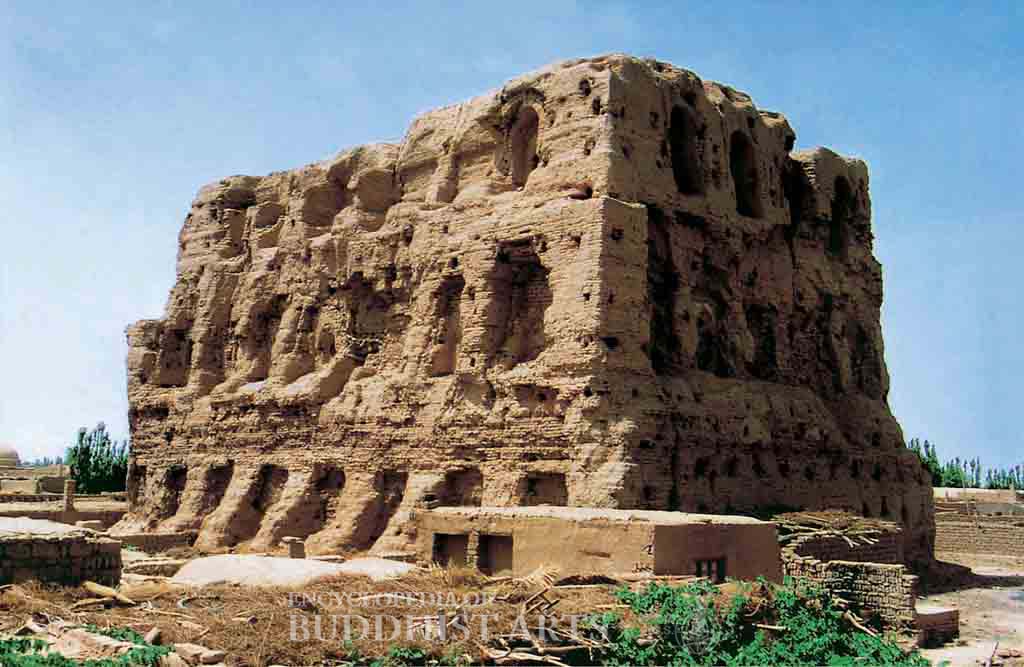
Taizang Stupa
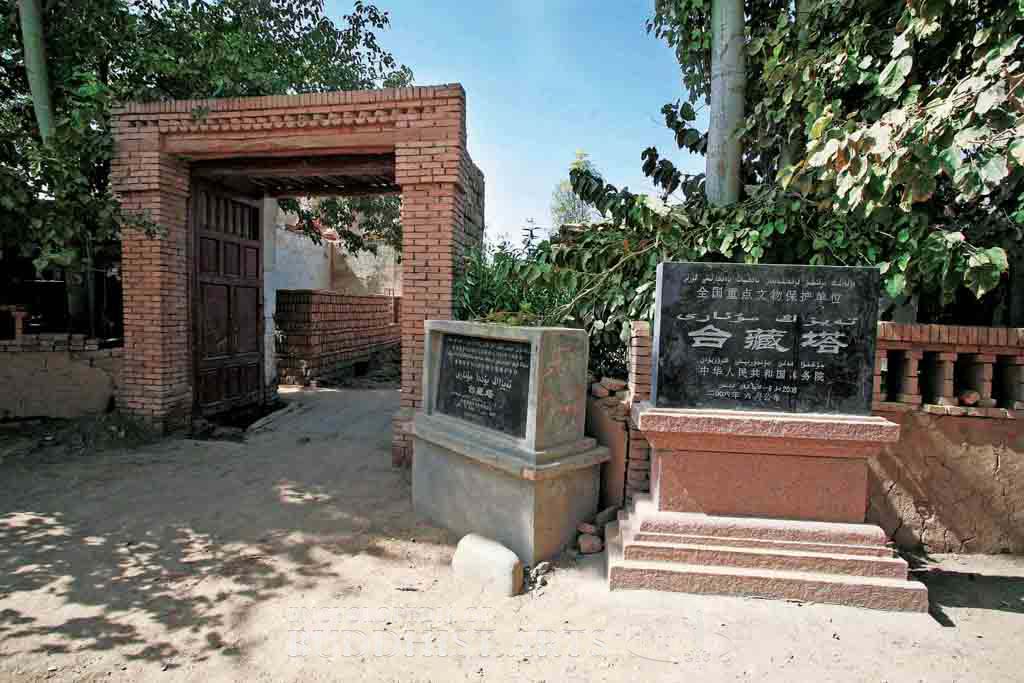
Taizang Stupa: Steles
Taizang Stupa
CHINA, Xinjiang, Turpan
The stupa was constructed during the Gaochang Kingdom (499–640). The stupa ruins were listed as a National Cultural Heritage Site in 2001.
The square stupa is constructed with rammed earth using loess. The present stupa is 20 m high. The base of the stupa is 40 m long on the north and south sides, while it is 30 m long on the east and west side. It has a stepped profile which tapers upwards. There used to be a passage leading into the stupa, which housed a large Buddha statue. However, it was destroyed at the beginning of the 20th century. The eastern, northern, and southern facades of the stupa body have arched Buddha niches. On the eastern facade, the first level contains eight niches, the second level has seven niches, and the third level has six niches. Each niche contains a seated Buddha statue and is painted with a nimbus and mandorla.
For more details, go to the Encyclopedia of Buddhist Arts: Architecture T-Z, page 1085.
Cite this article:
author = Hsingyun and Youheng and Johnson, Peter and Mankuang and Lancaster, Lewis,
booktitle = {Encyclopedia of Buddhist Arts: Architecture T-Z},
pages = 1085,
title = {{Taizang Stupa}},
volume = 4,
year = {2016}}