
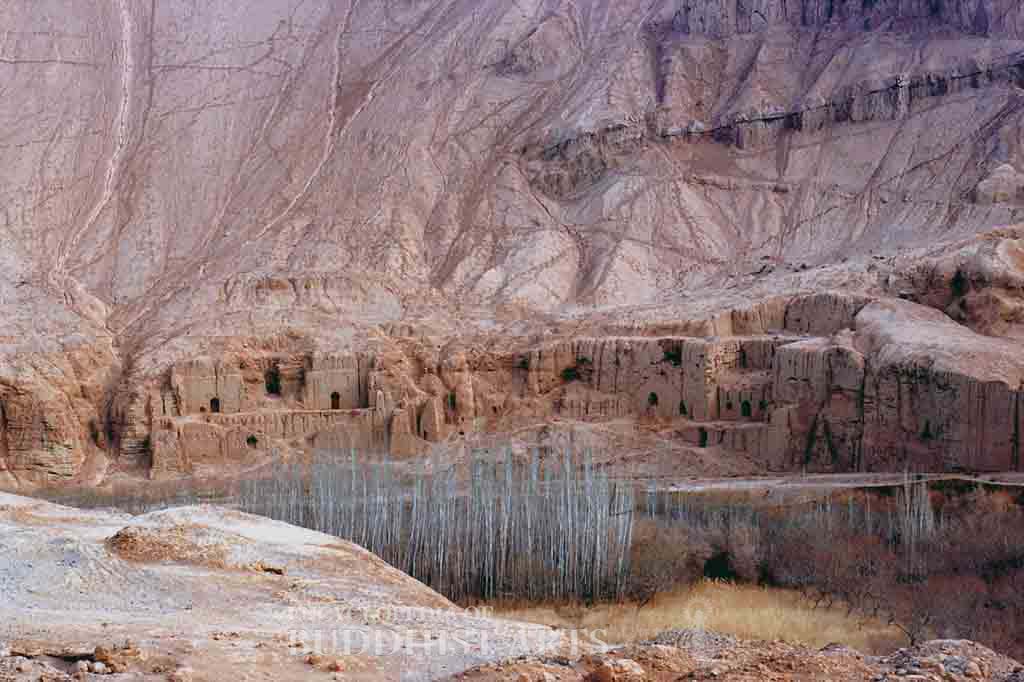
Shengjinkou Caves
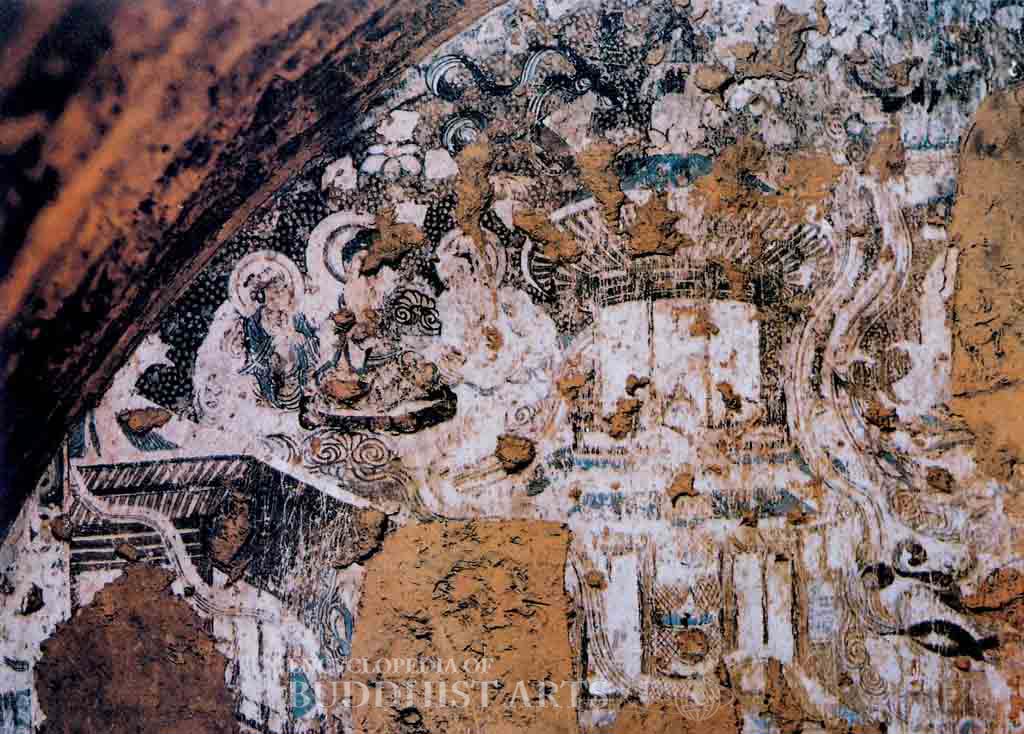
Shengjinkou Caves: Cave 3 - Sutra Illustration; Tang dynasty
Shengjinkou Caves
CHINA, Xinjiang, Turpan
These caves are located 20 km northeast of Turpan and to the south of Huoyanshan (Flaming Mountain), where the Mutougou (Wood Channel) emerges from a mountain valley. The ten caves date from as early as the Northern Dynasties (386–581). They are built into the eastern cliff face of a mountain, and are accompanied by Buddhist structures both on the slope and at the foot of the mountain.
The caves are divided into the north and south areas. Among the six caves in the north area, Cave 3 is a central pillar cave, and was thus probably used for worship. The statues that were in the cave niches are now gone, and the only remaining items are sutra illustrations. Caves 2 and 4 are thought to be memorial caves for eminent monks, and date to the Tang dynasty (618–907). Caves 7 to 9 in the south area were probably excavated in the Uighur period (9th century–1209). Among them, only Cave 9 still shows traces of a mural, which portray an apsara and two children holding lotuses and making offerings.
For more details, go to the Encyclopedia of Buddhist Arts: Caves Mo-S, page 1360.
Cite this article:
author = Hsingyun and Youheng and Johnson, Peter and Mankuang and Huntington, Susan and Edson, Gary and Neather, Robert,
booktitle = {Encyclopedia of Buddhist Arts: Caves Mo-S},
pages = 1360,
title = {{Shengjinkou Caves}},
volume = 8,
year = {2016}}