
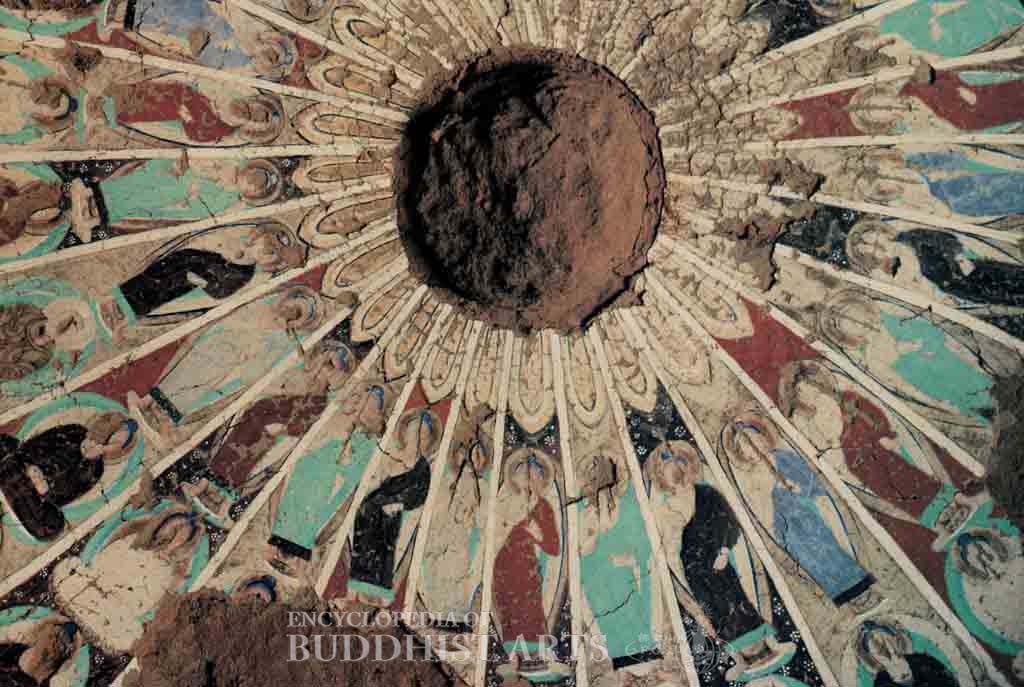
Tuyoq Cave 44: Ceiling
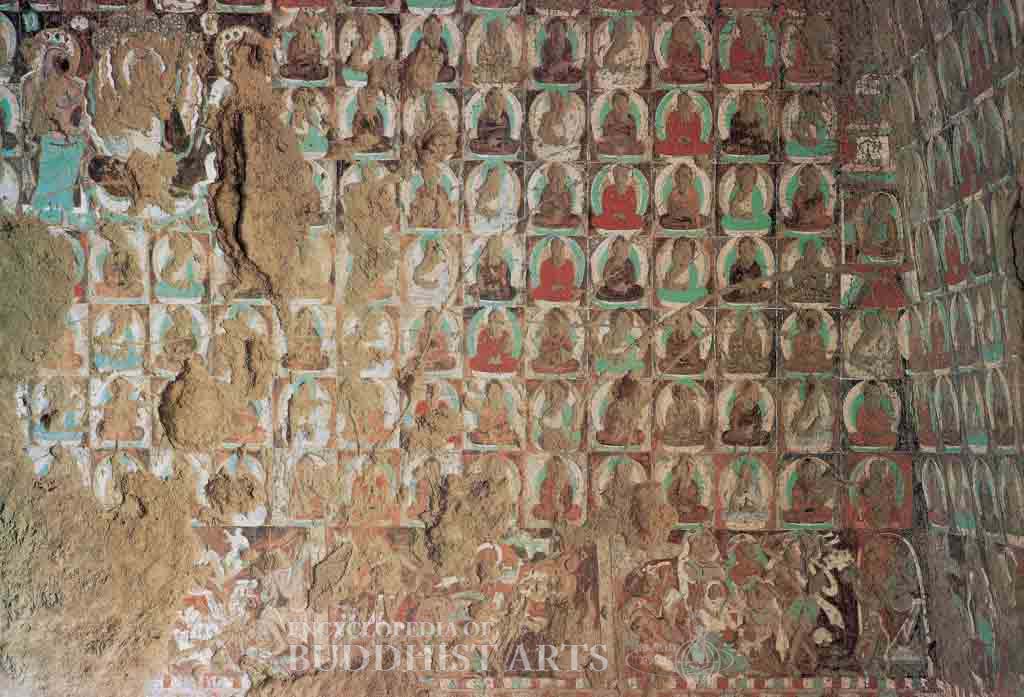
Tuyoq Cave 44: Thousand Buddhas (back wall)
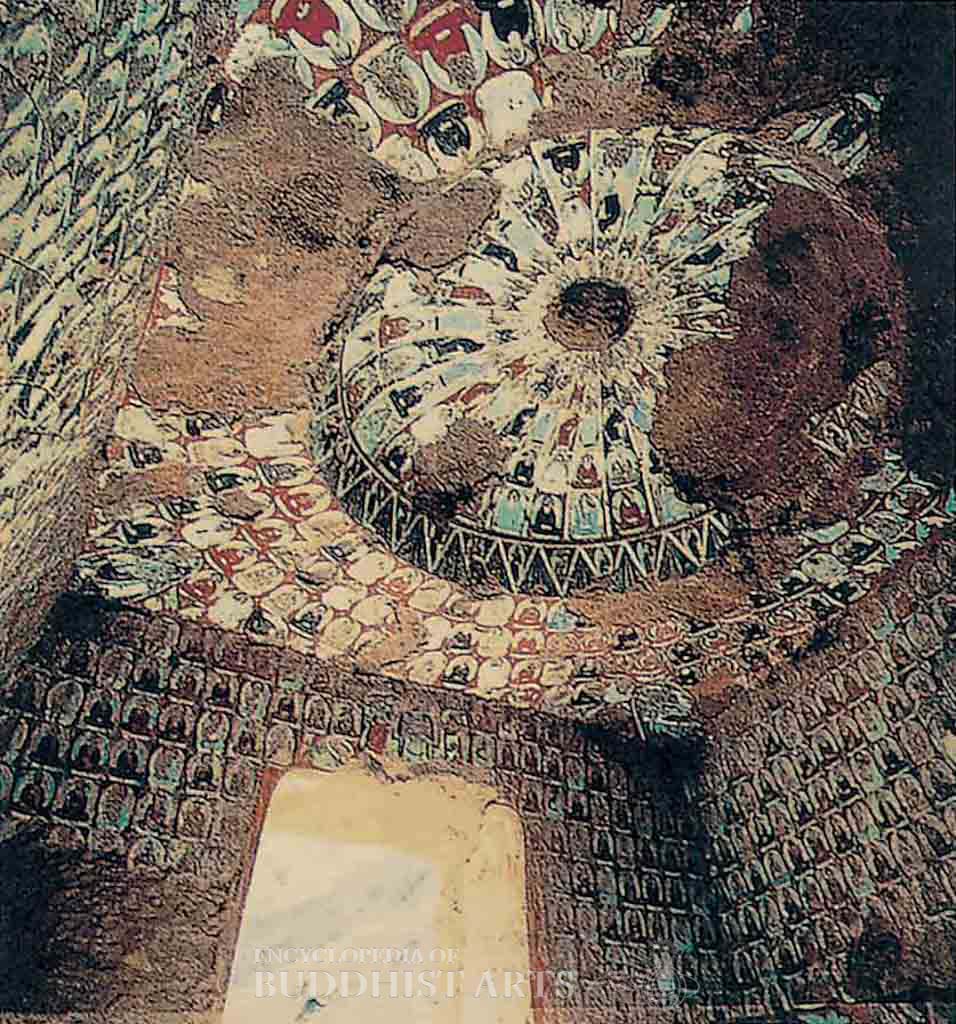
Tuyoq Cave 44
Tuyoq Cave 44
CHINA, Xinjiang, Turpan
Located on the east side of the Tuyoq ravine, this cave was developed in the 4th and 5th centuries. There is a square altar in the center of the cave. The cave has a flat ceiling with a sunken dome-shaped plafond in the center. A lotus is found in the center of the plafond with radial images of standing and seated Buddhas. The flat ceiling outside the plafond displays a ring of Thousand Buddha images, while at each corner is one of the Four Heavenly Kings.
The Thousand Buddhas motif, painted in alternating patterns of color that form six-colored bands, adorns the four walls of the cave. Teaching scenes in the center of each wall display the Buddha with two attendant Bodhisattvas. Jataka illustrations are painted below this, separated by square frames, with one scene per frame and seven per wall. Chinese script is written on the right side of each picture to describe the theme, though many of these are no longer discernible. Among the images are Prince Mahasattva Jataka and the King Sibi Jataka. A Bodhisattva above the entrance is seated with ankles crossed and wearing a headdress. Tall square stupas, each with a seated Buddha inside, are painted in the four corners of the cave. The murals in this cave have a base color of red ocher.
For more details, go to the Encyclopedia of Buddhist Arts: Caves T-Z, page 1475.
Cite this article:
author = Hsingyun and Youheng and Johnson, Peter and Mankuang and Huntington, Susan and Edson, Gary and Neather, Robert,
booktitle = {Encyclopedia of Buddhist Arts: Caves T-Z},
pages = 1475,
title = {{Tuyoq Cave 44}},
volume = 9,
year = {2016}}