
Tuyoq Cave 41

Tuyoq Cave 41: Ceiling Slope
Tuyoq Cave 41
CHINA, Xinjiang, Turpan
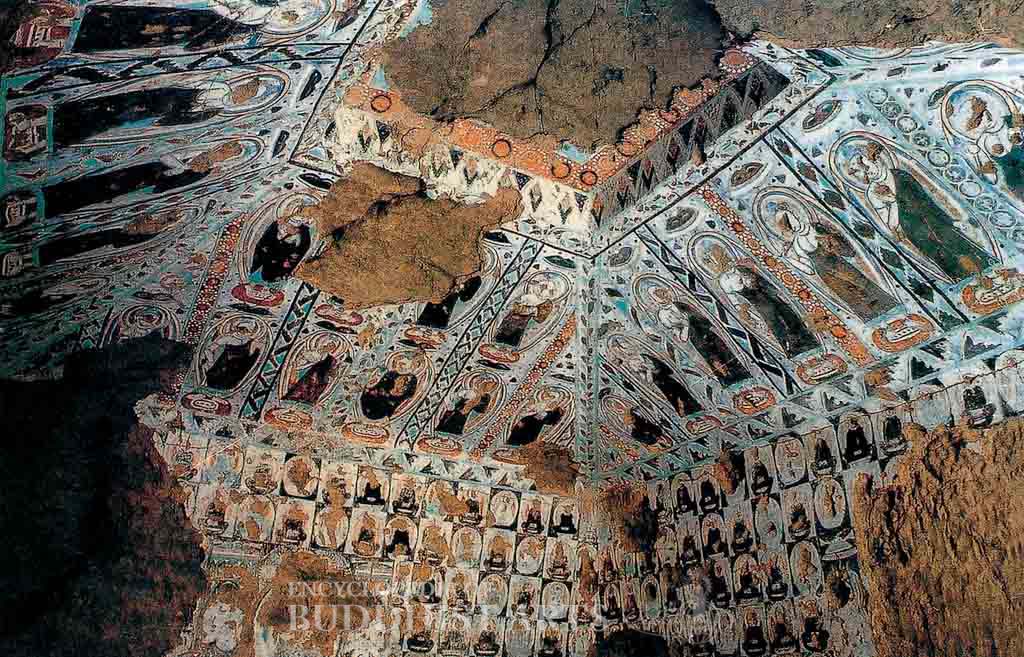
This rectangular cave, located on the eastern side of the Tuyoq ravine, was developed in the 4th and 5th centuries. The central portion of the truncated pyramidal ceiling features an impressive square caisson. A row of similar-looking standing Buddhas is painted on the left and right sides, and three rows of standing Buddhas also adorn the front and back. Each has a canopy suspended above, a nimbus encircling the head, an aureole around the body, and lotus pedestals beneath the feet. They wear robes that cross their left shoulders. Surrounding the Buddhas are patterns of jewels, ribbons, and flowers.
The four walls below are covered with rows of Thousand Buddha motifs in alternating red, green, and white. The image of the Buddha teaching the Dharma and flanked by attendant Bodhisattvas is depicted in the center of each wall. This cave is one of the earliest examples of caves in Gaochang.
For more details, go to the Encyclopedia of Buddhist Arts: Caves T-Z, page 1474.
Cite this article:
author = Hsingyun and Youheng and Johnson, Peter and Mankuang and Huntington, Susan and Edson, Gary and Neather, Robert,
booktitle = {Encyclopedia of Buddhist Arts: Caves T-Z},
pages = 1474,
title = {{Tuyoq Cave 41}},
volume = 9,
year = {2016}}