
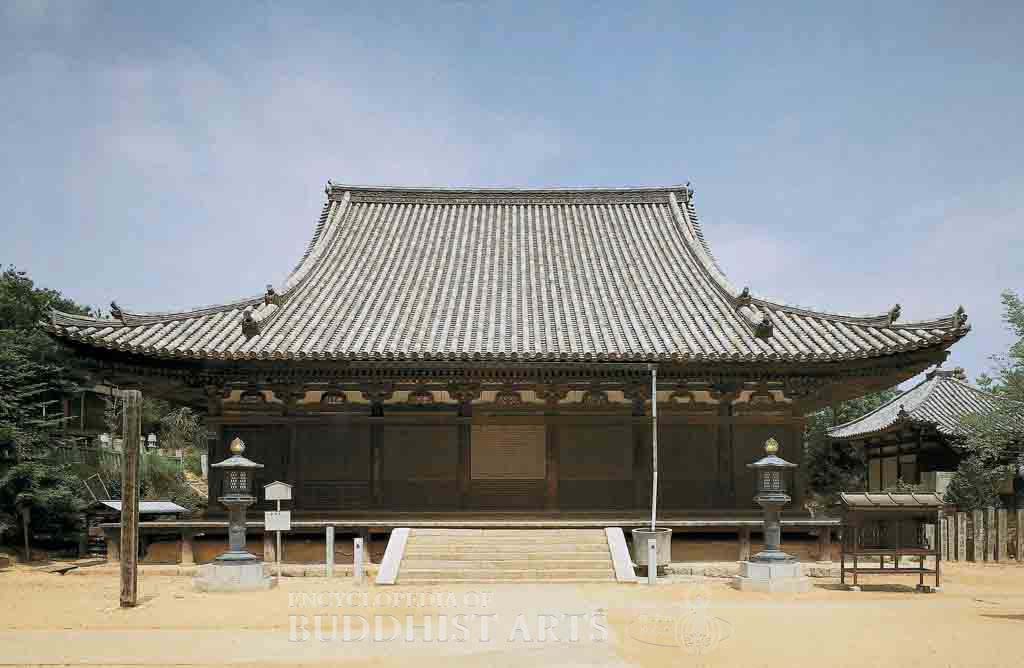
Taisanji Temple Main Hall
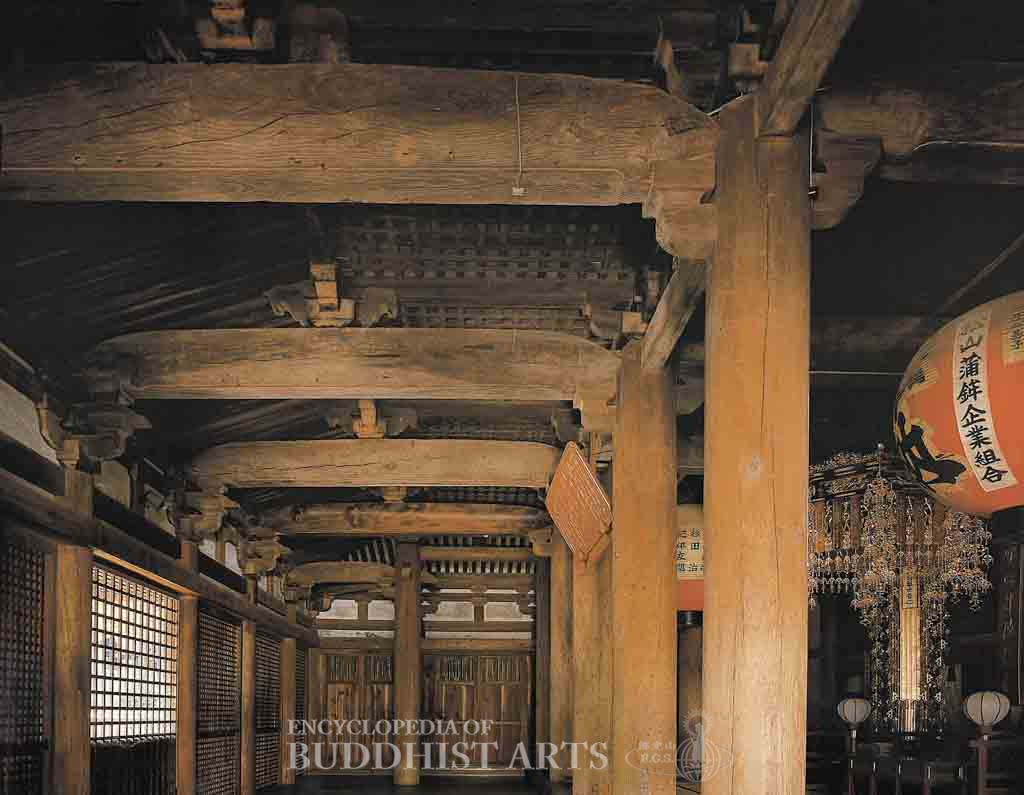
Taisanji Temple Main Hall (interior)
Taisanji Temple Main Hall
JAPAN, Ehime, Matsuyama
The temple is believed to have been established during the Nara period. It belongs to the Shingon school of Japanese Buddhism. According to the records, the main hall was built in 1305 during the Kamakura period. However, research shows two layers of soil with burnt wood under the main hall, which were presumably from the Heian period (794–1185). The current main hall was rebuilt for the third time during the Kamakura period (1185–1333) and is one of the finest Buddhist halls in western Japan. The hall was listed as a National Treasure in 1956.
The seven-by-nine bay hall has a single-eave hip-and-gable roof covered in cylindrical tiles. The eaves are supported by single-tier bracket sets. Other structural components include camel humps, king posts, and rafters. The two worshipping areas at the front of the building are the only existing examples of Medieval Japanese (1185–1573) structures. The exposed roof frame above the inner hall space appears magnificent with horizontal beams, struts and thick circular columns densely arranged. The seven standing Eleven-Headed Avalokitesvara statues enshrined within the hall were listed as Important Cultural Properties.
For more details, go to the Encyclopedia of Buddhist Arts: Architecture T-Z, page 1081.
Cite this article:
author = Hsingyun and Youheng and Johnson, Peter and Mankuang and Lancaster, Lewis,
booktitle = {Encyclopedia of Buddhist Arts: Architecture T-Z},
pages = 1081,
title = {{Taisanji Temple Main Hall}},
volume = 4,
year = {2016}}