
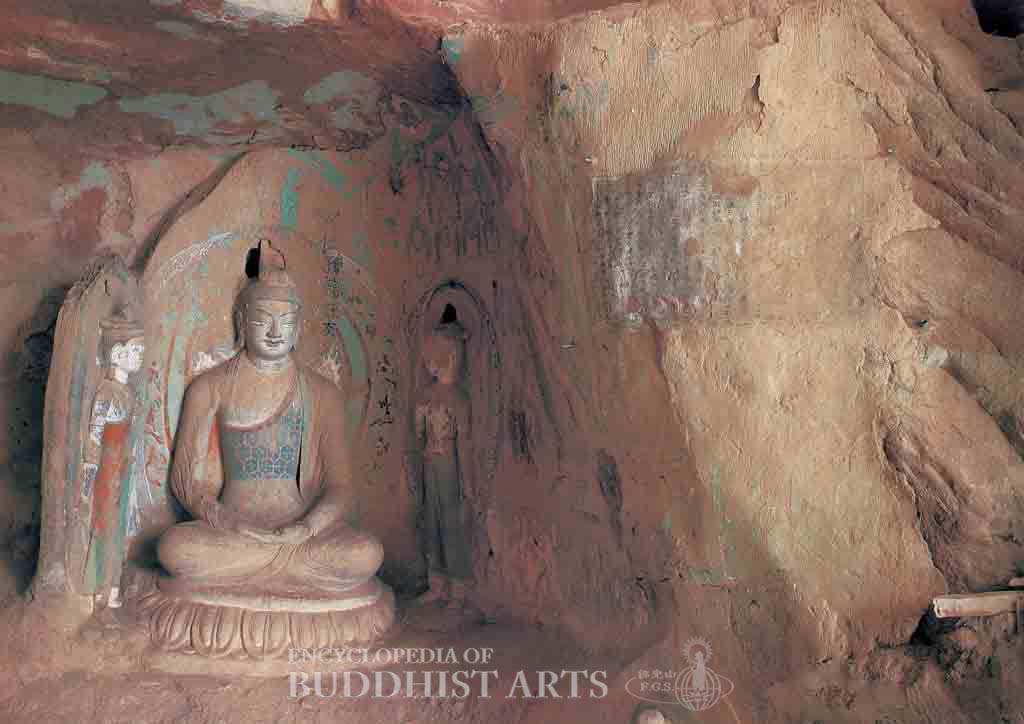
Bingling Temple Cave 169: Amitabha Buddha Triad
Stone-core clay
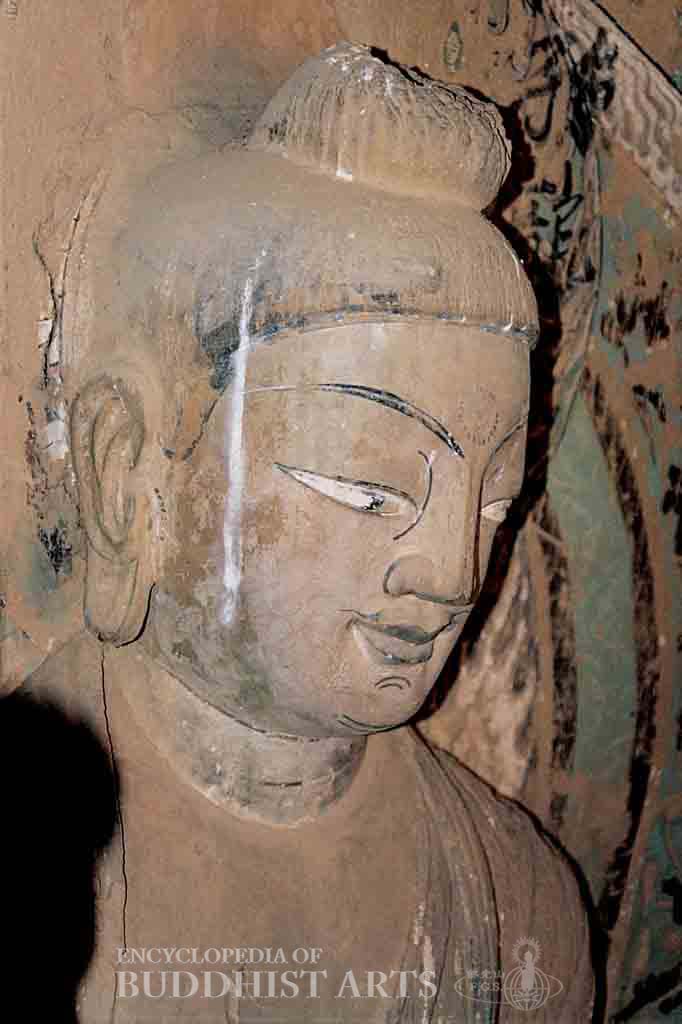
Bingling Temple Cave 169: Amitabha Buddha Triad - Amitabha Buddha (detail)
Bingling Temple Cave 169: Amitabha Buddha Triad
CHINA, Gansu, Linxia; Western Qin Kingdom
These figures are located within Niche 6, near the center of the north wall of Cave 169. The Buddha is a painted clay statue, and is accompanied by two Bodhisattvas. Behind them is a petal-shaped mandorla, also formed from clay. Beside the mandorla of each figure is a cartouche in ink stating the figure’s name: Amitabha Buddha in the center, flanked by Avalokitesvara and Mahasthamaprapta Bodhisattva.
The total height of the Buddha is 1.55 m. Amitabha has a round white face, long eyebrows with an urna between them, thin eyes, and a slightly upturned mouth. He sits in full lotus position on a lotus throne, with both hands forming the dhyana (meditation) mudra. Amitabha wears a monastic robe painted with a hexagonal pattern and another thin robe draped over the shoulders. The large mandorla behind him is adorned with flames, honeysuckle patterns, and apsaras. Avalokitesvara measures 1.18 m high and Mahasthamaprapta is 1.11 m in height. Both Bodhisattvas stand barefoot upon lotus platforms, wearing brightly colored garments.
The murals on the wall surrounding these figures depict the Buddhas of the Ten Directions, other Buddhas, and donor figures making offerings. There is an inscription in ink in the upper right corner of the niche, dating the carving to the year 420 during the late Western Qin Kingdom. This is the only cave found anywhere in China with a clear record of a year during the Sixteen Kingdoms period (303–439).
For more details, go to the Encyclopedia of Buddhist Arts: Caves A-E, page 175.
Cite this article:
author = Hsingyun and Youheng and Johnson, Peter and Mankuang and Huntington, Susan and Edson, Gary and Neather, Robert,
booktitle = {Encyclopedia of Buddhist Arts: Caves A-E},
pages = 175,
title = {{Bingling Temple Cave 169: Amitabha Buddha Triad}},
volume = 5,
year = {2016}}