
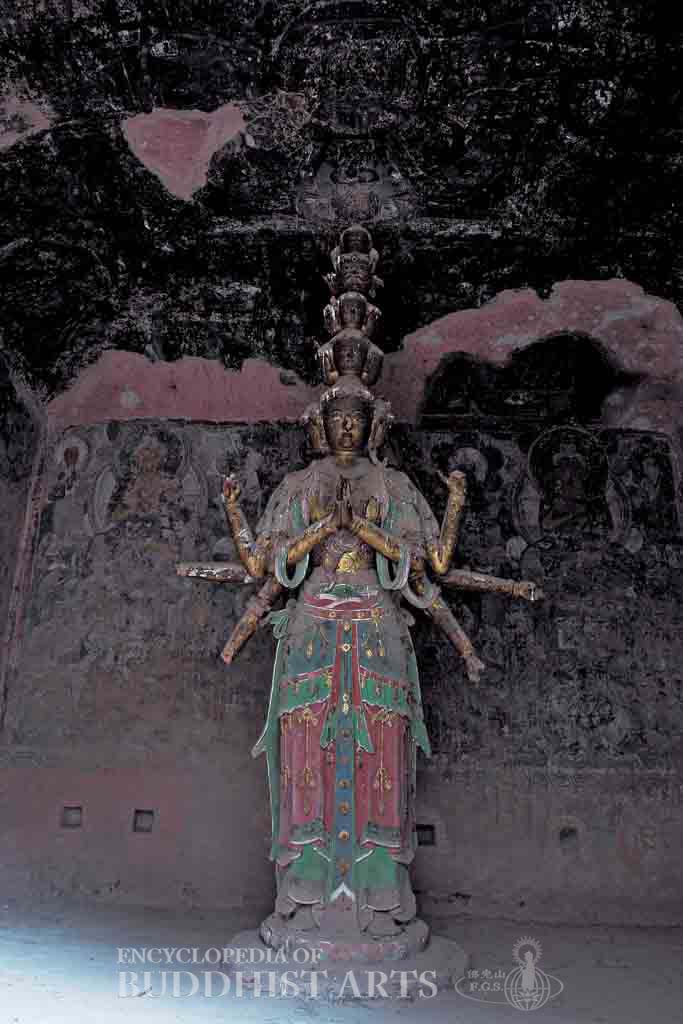
Bingling Temple Cave 70: Eleven-Headed Avalokitesvara
Clay
Bingling Temple Cave 70: Eleven-Headed Avalokitesvara
CHINA, Gansu, Linxia; Ming dynasty
This figure is located on a platform at the center of the back wall of Cave 70. It is the only surviving Tibetan-style sculpture dating to the Ming dynasty (1368–1644) within the Bingling Temple Caves.
The eleven heads of Avalokitesvara Bodhisattva are divided into five levels, with three heads on each of the lower three levels, and one on each of the upper two levels. The uppermost head has the characteristics of a Buddha, such as a coiled topknot and a nimbus. The second head has three bulging eyes and sharp teeth. The lower three levels of heads are all similar, with gentle expressions and delicate features. The figure’s clothing is painted with bright colors and decorated with numerous hanging ornaments. The Bodhisattva wears a necklace, armlets, bracelets, and chest ornaments, as well as a long stole draped over the shoulders and arms. The eight arms of the Bodhisattva perform different actions, although most of the hands have been broken off. The two arms in front of the figure join palms at the chest, while the remaining six arms are spread out symmetrically around the figure.
For more details, go to the Encyclopedia of Buddhist Arts: Caves A-E, page 165.
Cite this article:
author = Hsingyun and Youheng and Johnson, Peter and Mankuang and Huntington, Susan and Edson, Gary and Neather, Robert,
booktitle = {Encyclopedia of Buddhist Arts: Caves A-E},
pages = 165,
title = {{Bingling Temple Cave 70: Eleven-Headed Avalokitesvara}},
volume = 5,
year = {2016}}