
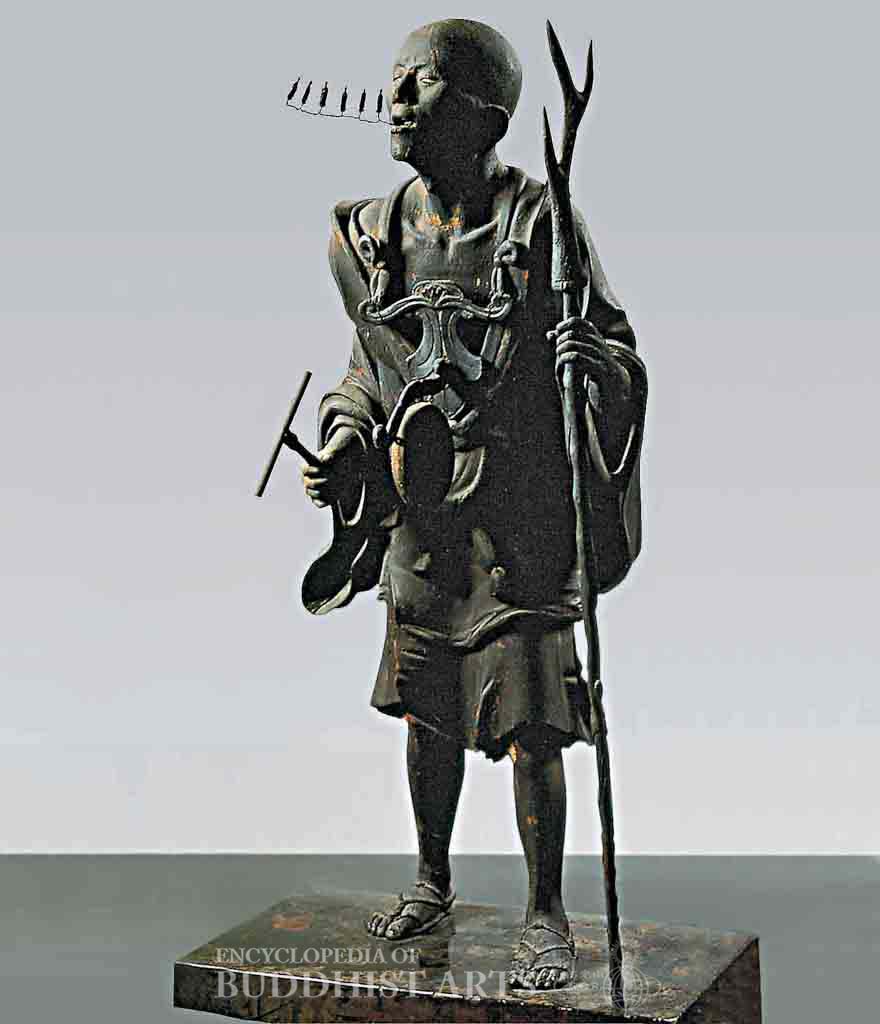
Rokuharamitsuji Temple: Master Kuya
Wood
Rokuharamitsuji Temple: Master Kuya
JAPAN, Kyoto; Kamakura period
This 13th century statue was sculpted by Unkei’s fourth son, Kosho, according to an inscription. The statue is listed as an Important Cultural Property.
The wandering monk, Kuya, is dressed in a short peasant coat and wears straw sandals. There is a gong about Kuya’s neck and he carries a T-shaped wooden stick used to strike it. The figure holds a walking stick with an antler attached to one end in his left hand. Six figurines of Amitabha emerge from the figure’s mouth, representing the recitation of the Buddha’s name. The piece graphically portrays Kuya’s lifestyle and the vivid expression on the figure’s face is typical of sculptures from the Kamakura period (1185–1333).
For more details, go to the Encyclopedia of Buddhist Arts: Sculpture N-Sr, page 881.
Cite this article:
author = Hsingyun and Youheng and Lovelock, Yann and Chou, Yuan and Huntington, Susan and Edson, Gary and Neather, Robert,
booktitle = {Encyclopedia of Buddhist Arts: Sculpture N-Sr},
pages = 881,
title = {{Rokuharamitsuji Temple: Master Kuya}},
volume = 12,
year = {2016}}