
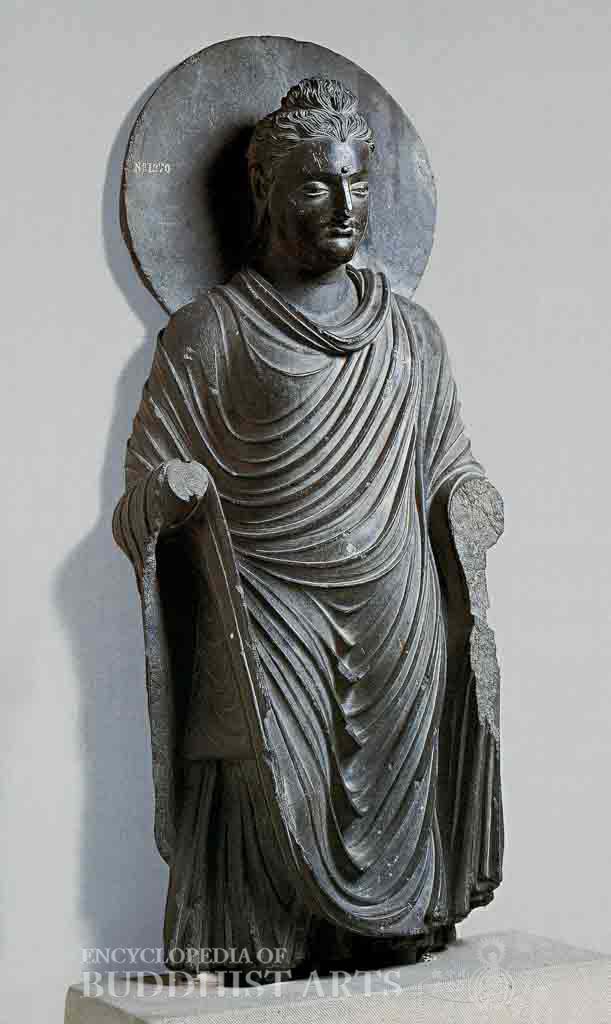
Mamane Dheri: Standing Buddha
Schist
Mamane Dheri: Standing Buddha
PAKISTAN, Khyber Pakhtunkhwa, Charsadda
The Buddha’s nimbus is plain and surrounds both the shoulders and head. The hair is wavy and mounded into a usnisa. There is an urna above the eyebrows and the face shows Aryan features, including hooded eyes, a pronounced nose, and an expressive mouth.
The clothing depicted on the statue identifies it as being from the Kushan period (circa 1st–3rd century). The Buddha wears a robe that covers both shoulders and molds itself to the shape of the body. The diverse folds are portrayed in a natural manner and Hellenic and Roman influence can be seen in the treatment of the clothes and head. The right knee is slightly bent with the weight of the body falling on the left leg, giving it a sense of movement.
For more details, go to the Encyclopedia of Buddhist Arts: Sculpture G-M, page 678.
Cite this article:
author = Hsingyun and Youheng and Lovelock, Yann and Chou, Yuan and Huntington, Susan and Edson, Gary and Neather, Robert,
booktitle = {Encyclopedia of Buddhist Arts: Sculpture G-M},
pages = 678,
title = {{Mamane Dheri: Standing Buddha}},
volume = 11,
year = {2016}}