
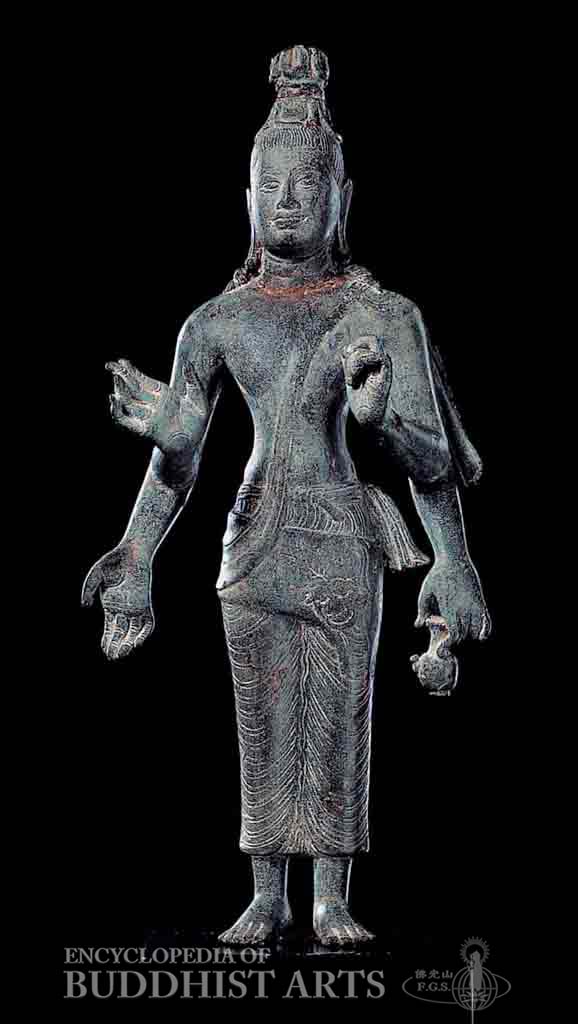
Four-armed Bodhisattva
Copper alloy
Four-Armed Bodhisattva
SRI LANKA
The four-armed Bodhisattva, created in the Anuradhapura Kingdom (circa 4th century BCE–10th century CE) style, shows traits characteristic of Sri Lankan statues, such as the long head, high topknot, elongated waist, short legs, and rigid stance. The upper body is unadorned apart from the diagonal sacred thread. A skirt decorated with numerous folds that ripple like waves is tied with a knot visible on the right. A tiger skin is also fastened about the waist, the presence of which represents ascetic practice. The two upper arms are held out before the body. The lower left hand holds a vase while the right makes the varada (wish-granting) mudra.
For more details, go to the Encyclopedia of Buddhist Arts: Sculpture A-F, page 351.
Cite this article:
Hsingyun, et al. "Four-Armed Bodhisattva." Encyclopedia of Buddhist Arts: Sculpture A-F, vol. 10, 2016, pp. 351.
Hsingyun, Youheng, Yann Lovelock, Yuan Chou, Susan Huntington, Gary Edson, and Robert Neather. 2016. "Four-Armed Bodhisattva" In Encyclopedia of Buddhist Arts: Sculpture A-F, 10:351.
Hsingyun, Youheng, Lovelock, Y., Chou, Y., Huntington, S., Edson, G., & Neather, R.. (2016). Four-Armed Bodhisattva. In Encyclopedia of Buddhist Arts: Sculpture A-F (Vol. 10, pp. 351).
@misc{Hsingyun2016,
author = Hsingyun and Youheng and Lovelock, Yann and Chou, Yuan and Huntington, Susan and Edson, Gary and Neather, Robert,
booktitle = {Encyclopedia of Buddhist Arts: Sculpture A-F},
pages = 351,
title = {{Four-Armed Bodhisattva}},
volume = 10,
year = {2016}}
author = Hsingyun and Youheng and Lovelock, Yann and Chou, Yuan and Huntington, Susan and Edson, Gary and Neather, Robert,
booktitle = {Encyclopedia of Buddhist Arts: Sculpture A-F},
pages = 351,
title = {{Four-Armed Bodhisattva}},
volume = 10,
year = {2016}}