
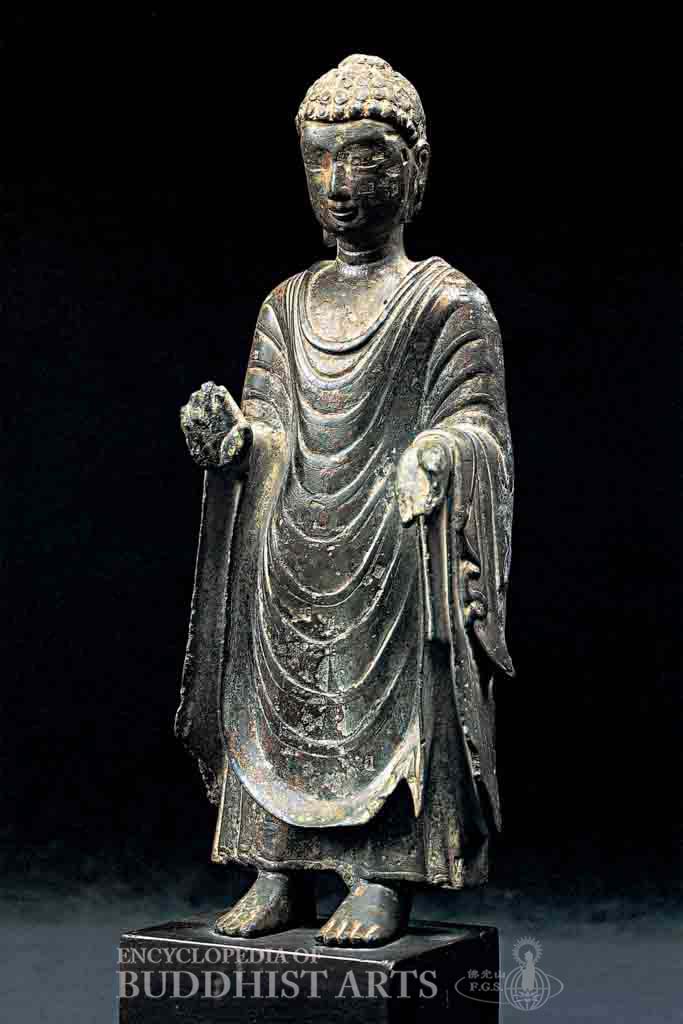
Oc Eo: Standing Buddha
Bronze
Oc Eo: Standing Buddha
VIETNAM, An Giang, Thoai Son
The statue was among the more important discoveries made by the French archaeologist Louis Malleret in 1994. The findings included gold coins used in transactions with the Romans, bronze mirrors from the Chinese Han dynasty (206 BCE–220 CE), Indian jewelry and Gandharan style Buddha statues. The diverse items found suggest that the area was once an important trading center in and around the ancient kingdom of Funan. The Buddha is stylistically akin to figures found in southern India. The low and indistinct usnisa and large curls are distinctive. The treatment of the monastic robes and their rippling fall is also similar. The right hand is in abhaya (fearlessness) mudra while the left is in varada (wish-granting) mudra. A tenon hole at the back of the head was meant for the installation of a nimbus.
For more details, go to the Encyclopedia of Buddhist Arts: Sculpture N-Sr, page 769.
Cite this article:
author = Hsingyun and Youheng and Lovelock, Yann and Chou, Yuan and Huntington, Susan and Edson, Gary and Neather, Robert,
booktitle = {Encyclopedia of Buddhist Arts: Sculpture N-Sr},
pages = 769,
title = {{Oc Eo: Standing Buddha}},
volume = 12,
year = {2016}}