
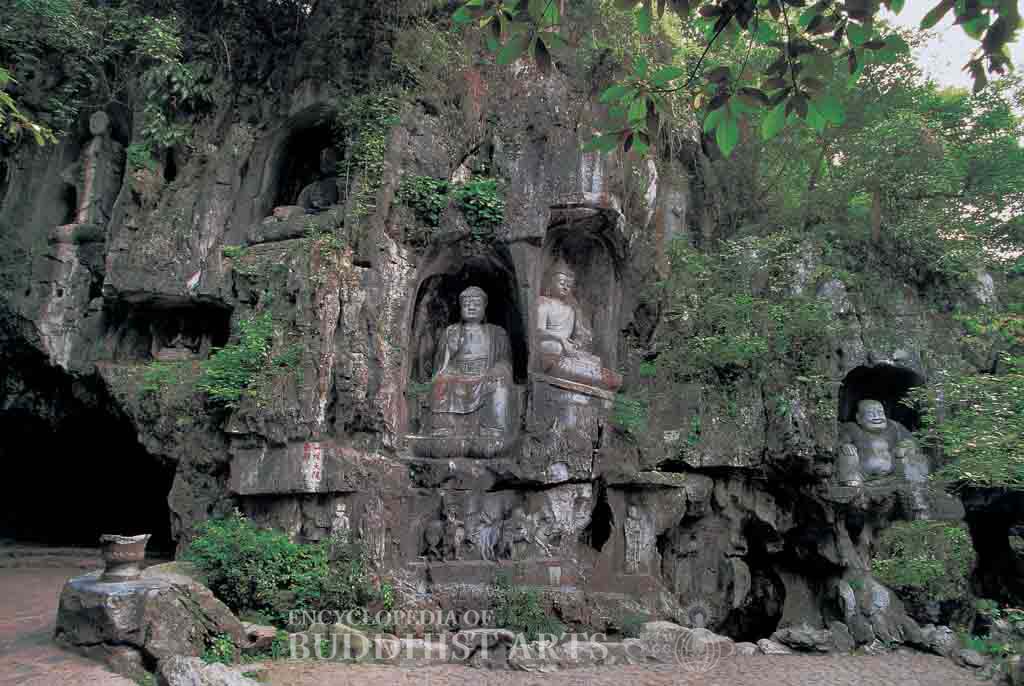
Feilai Peak Caves: Qinglin Cave - Niches (southern entrance)
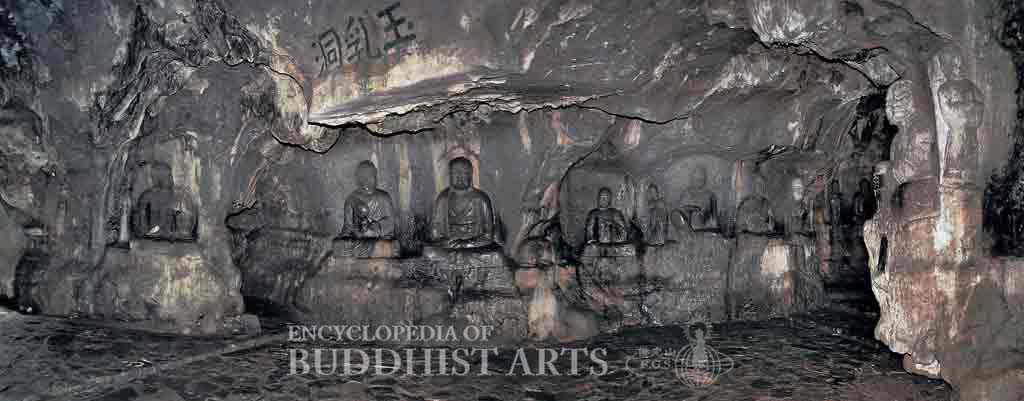
Feilai Peak Caves: Yuru Cave
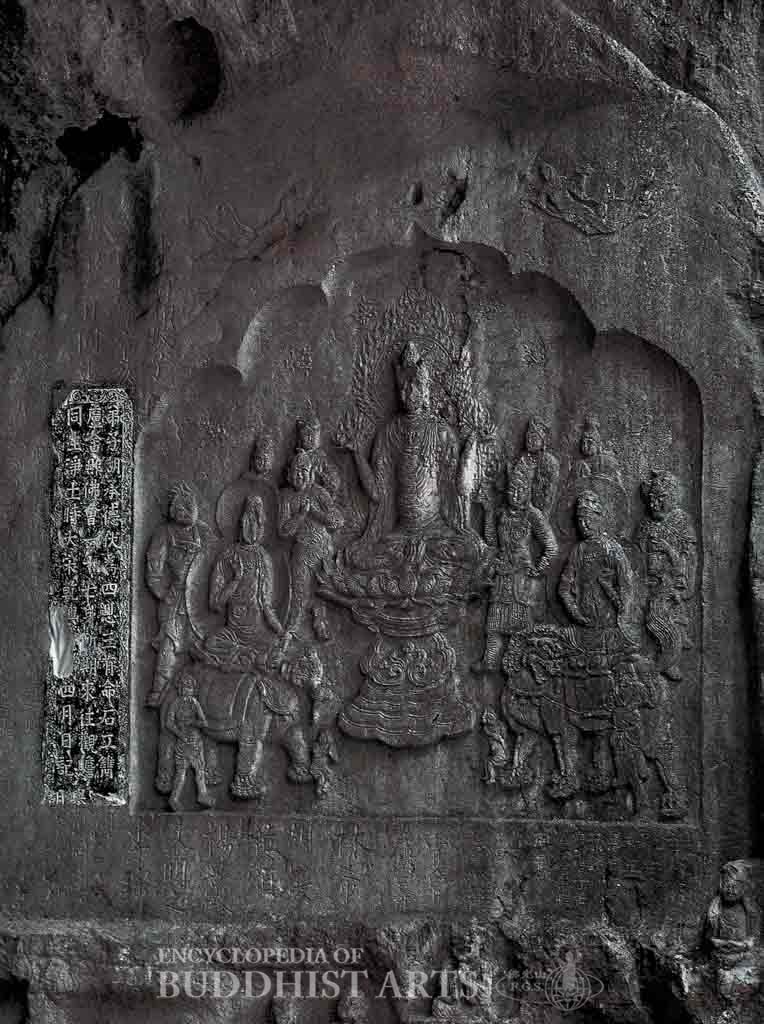
Feilai Peak Caves: Niche 5 - Vairocana Buddha Assembly
Feilai Peak Caves
CHINA, Zhejiang, Hangzhou
These caves are located in front of Lingyin Temple in Hangzhou, along the banks of Lengquan (Cold Fountain) Stream, on Feilai Peak. Some of the caves at this site were formed naturally through erosion from the rain and ground water, with excavation being done in harmony with the natural contours of the rock. The caves are located around the summit of the mountain, in the foothills to the east and north, or on the cliff faces. Some of the named caves at the site include Qinglin (Green Grove), Yuru (Jade Milk), Longhong (Dragon Water), Tongtian (Connect to the Heaven), Shexu (Shoot the Rising Sun), and Huyuan (Calling the Apes). In total, there are more than 380 sculptures at the site. Eleven were made during the Five Dynasties (907–960), and over 200 were sculpted in the Song dynasty (960–1279), and more than 100 from the Yuan dynasty (1271–1368). In addition to their artistic value, the carvings at Feilai Peak are of great significance for researching the religious history of the Central Plains in China. The Feilai Peak Caves have the highest density of cave statues along the southeast coast of China, and were listed as a National Cultural Heritage Site in 1982.
Sculptures built during the Five Dynasties are found around the summit of the mountain and in Qinglin Cave on the east side of the peak. They include an Amitabha Buddha Triad and a single Amitabha Buddha. The oldest dated carving is the Amitabha Buddha Triad in Niche 10, made in 951. The three figures are seated on a high Sumeru throne with flame-patterned mandorlas engraved on the wall behind them.
The majority of the Song dynasty sculptures display a high level of sculptural and artistic skill. Of particular note are carvings dating from the Northern Song dynasty (960–1127), including a relief of Master Xuanzang’s Journey to Obtain the Sutras found in the Longhong Cave. Dating between 998 and 1003, it is the earliest known bas-relief depicting this famous story. Other sculptures from the Song dynasty are found in the Qinglin Cave, which displays a number of Arhat statues made between the years 1000 and 1003. In Niche 5, on the south cliff beside the Qinglin Cave entrance, there is a vivid depiction of the Vairocana Buddha Assembly made by Hu Chengde in 1022. Yuru Cave features carvings of the Eighteen Arhats, as well as the Sixth Patriarch dated to 1026. Carvings dating to the Southern Song dynasty (1127–1279), including a depiction of the monk Budai, the largest carving at Feilai Peak, are located in Niche 68 on the southern bank of Lengquan Stream.
The sculptures dating to the Yuan dynasty are accompanied by inscriptions that are generally indistinct, and only 19 of the figures can be identified. Most of these carvings appear on the southern bank of Lengquan Stream and the cliff faces surrounding Qinglin Cave, Yuru Cave, Longhong Cave, and Huyuan Cave. The scale of the sculptures is generally larger, and they display a high level of artistic skill. Most of them feature Vajrayana Buddhist themes. They are generally better preserved than the other artworks at the site, leading them to function as the focal points of the Feilai Peak carvings. Some general characteristics of the Yuan dynasty Buddha figures include: a two-fold spiral usnisa, wide forehead, broad shoulders, and a narrow waist; hands displaying mudras; intricately carved headdresses featuring five Buddha images; light, chiffon-like monastic robes that cover the left shoulder and drape across the chest; and numerous adornments such as earrings and armlets. One example is the Three-Headed, Eight-Armed Usnisavijaya image in Niche 84, located on the southern bank of Lengquan Stream. This skillfully made carving features smooth lines and accurate detailing; it is considered to be a masterpiece of Yuan dynasty sculpture.
For more details, go to the Encyclopedia of Buddhist Arts: Caves R-L, page 361.
Cite this article:
author = Hsingyun and Youheng and Johnson, Peter and Mankuang and Huntington, Susan and Edson, Gary and Neather, Robert,
booktitle = {Encyclopedia of Buddhist Arts: Caves R-L},
pages = 361,
title = {{Feilai Peak Caves}},
volume = 6,
year = {2016}}