
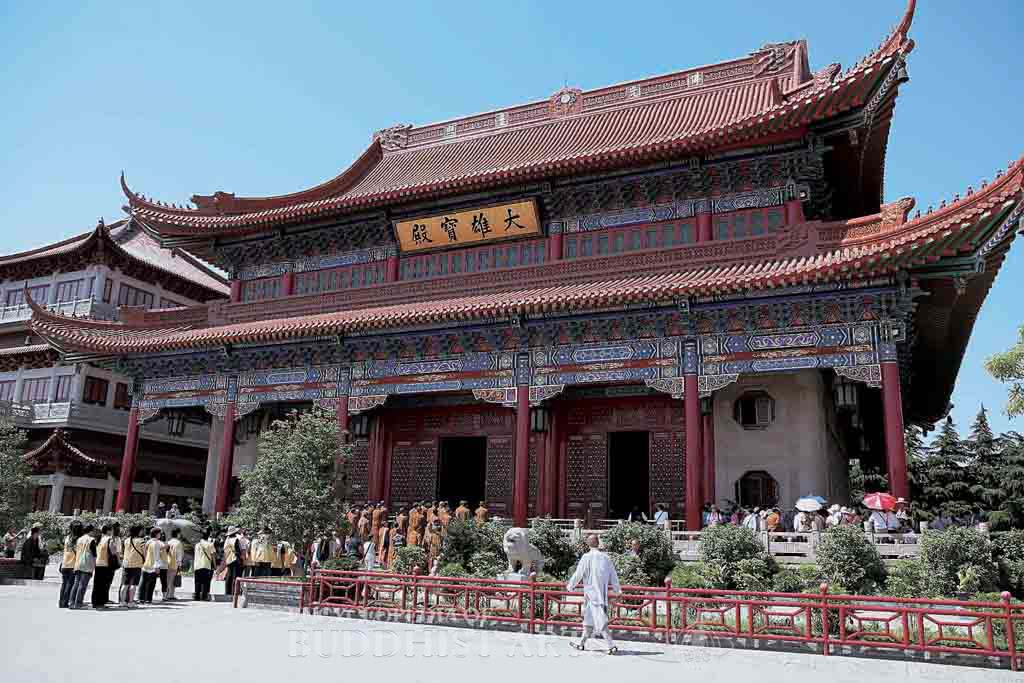
Gaomin Temple: Great Hero Hall
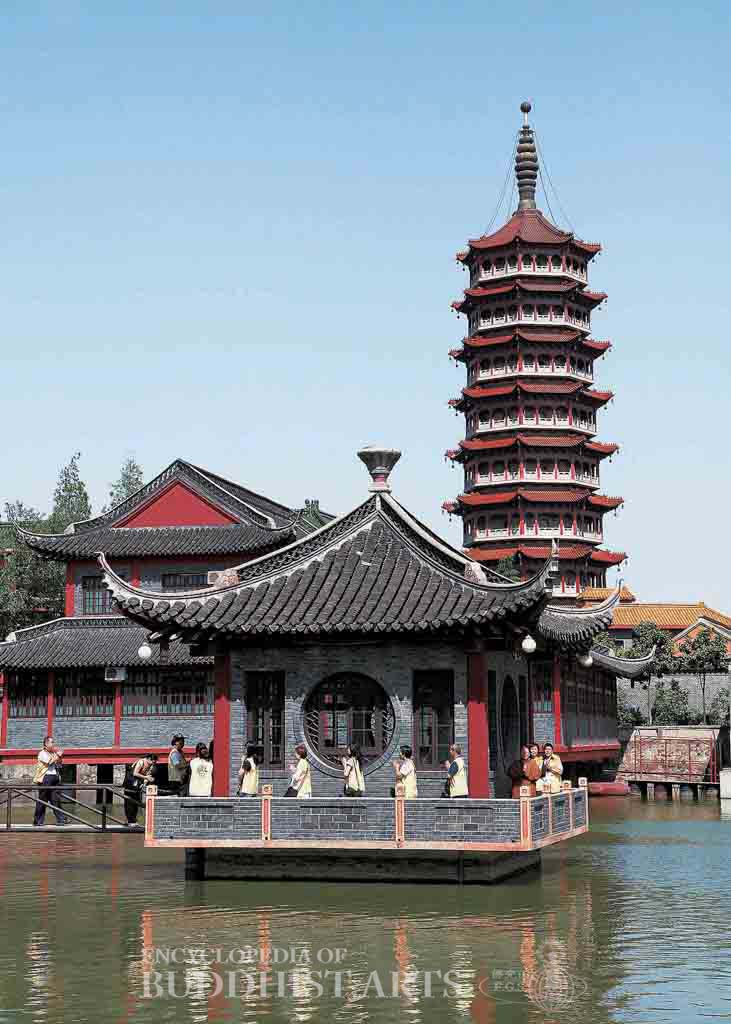
Gaomin Temple: Tianzhong Pagoda
Gaomin Temple
CHINA, Jiangsu, Yangzhou
Gaomin means High Heaven. The temple follows the Linji school of Chan Buddhism and is one of the Eight Major Temples in Yangzhou. It is also one of the Four Major Temples of Chinese Chan Buddhism, along with Jinshan Temple, Tianning Temple, and Tiantong Temple. According to the records, the Tianzhong Pagoda was built in 1651 during the Qing dynasty, and Gaomin Temple was added later. The temple was destroyed by warfare between 1853 and 1856, and was later rebuilt. Chan Master Laiguo became abbot of the temple in 1919. In recent years the temple has undergone a number of restorations. It was listed as a key Buddhist temple in the Han region of China in 1983.
The main temple buildings are the Great Hero Hall, the Tianzhong Pagoda, meditation hall, Dharma Hall, and the Laiguo Memorial Hall. On either side of the Great Hero Hall there are the sutra repository, Hall of the Five Hundred Arhats, and the Heavenly King Hall. The meditation hall is 18 m high and has eight uneven sides making it appear round. The nine-story, octagonal Tianzhong Pagoda is 72 m high.
The temple has preserved the Linji school since its founding. It observes the principles of the Chan school and is famous for its strict adherence to monastic rules.
For more details, go to the Encyclopedia of Buddhist Arts: Architecture G-L, page 366.
Cite this article:
author = Hsingyun and Youheng and Johnson, Peter and Mankuang and Lancaster, Lewis,
booktitle = {Encyclopedia of Buddhist Arts: Architecture G-L},
pages = 366,
title = {{Gaomin Temple}},
volume = 2,
year = {2016}}