
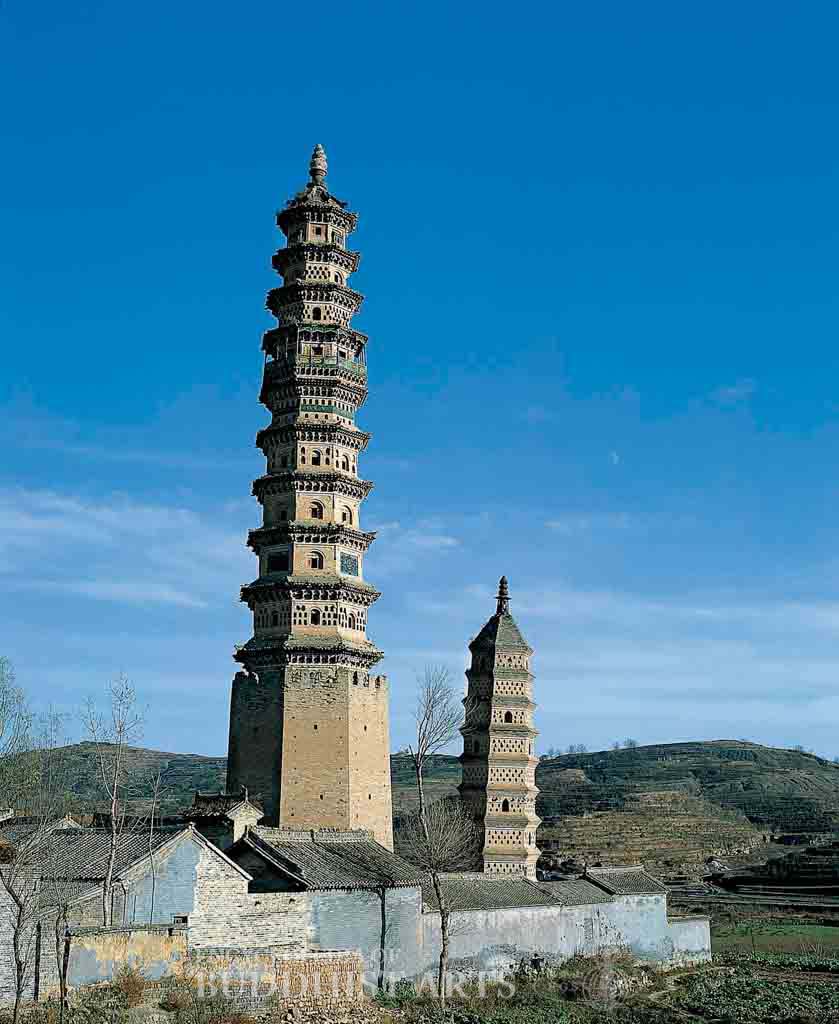
Haihui Temple: Twin Pagodas
Haihui Temple
CHINA, Shanxi, Jincheng
Haihui stands for Ocean Gathering. It was built during the Tang dynasty (618–907). Most of the buildings have been repaired or expanded throughout its history, especially during the Ming (1368–1644) and Qing (1644–1911) dynasties. It was listed as a Heritage Site in 2006.
The temple is separated into three compounds: the main compound, the monastic quarters, and the pagoda compound. The main compound was built to integrate with the terrain of the hill and consists of five courtyards. Along its central axis there are the main temple gate, Heavenly King Hall, Lotus Pond, Medicine Buddha Hall, and the Great Hero Hall. Along either side there are the sutra repository, Reclining Buddha Hall, Avalokitesvara Hall, and the stele passageway. Most of these structures are from the Ming dynasty. The five-bay wide, seven-rafter deep Great Hero Hall is situated on the highest spot of the five courtyards.
The pagoda compound contains the twin pagodas. One is the Relic Pagoda of Chan Master Shunmin built in 922 during the Later Liang dynasty. It is a ten-tier hexagonal brick pagoda and is 20 m high. The exterior is covered with Thousand Buddha niches. The other pagoda was built in 1561 during the Ming dynasty and is called Glazed Hanging Pavilion Pagoda. This 13-story brick pagoda is around 50 m high. There are various glazed decorations on the pagoda.
For more details, go to the Encyclopedia of Buddhist Arts: Architecture G-L, page 425.
Cite this article:
author = Hsingyun and Youheng and Johnson, Peter and Mankuang and Lancaster, Lewis,
booktitle = {Encyclopedia of Buddhist Arts: Architecture G-L},
pages = 425,
title = {{Haihui Temple}},
volume = 2,
year = {2016}}