
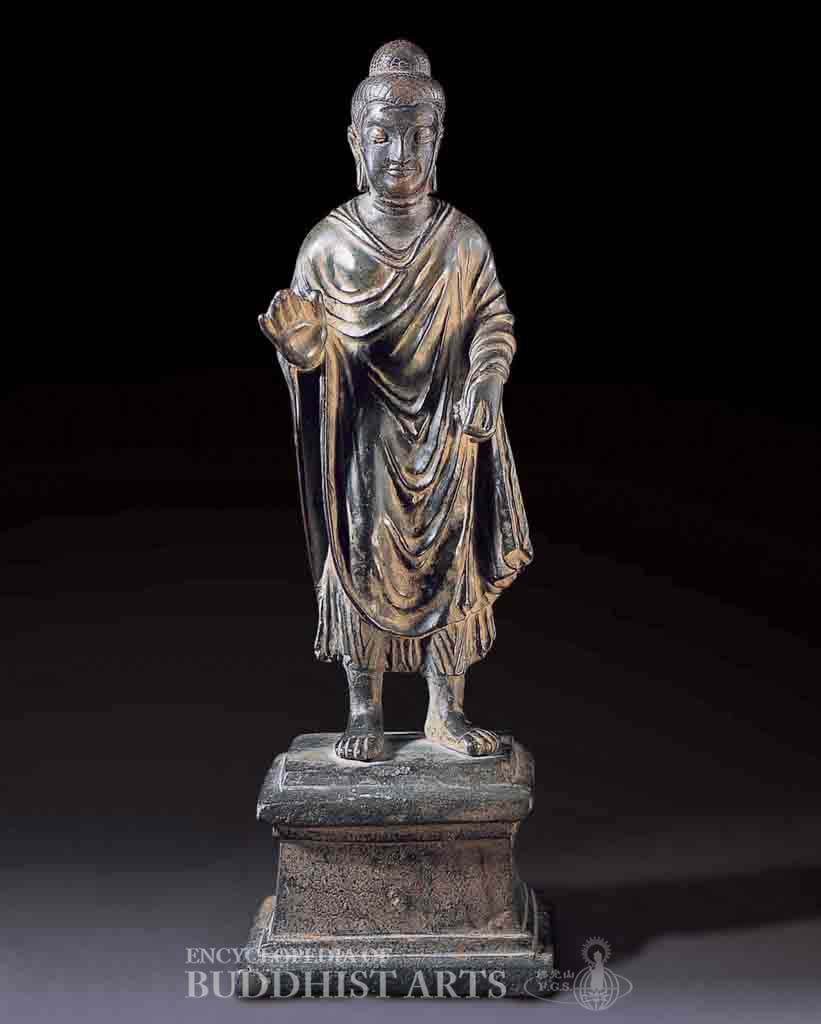
Sakyamuni Buddha
Brass
Sakyamuni Buddha
PAKISTAN
This statue is in the Gandhara style. The figure has a pronounced usnisa. The hair is incised in a style similar to those found in Hadda, Afghanistan. Experts believe that the statue might have originated from the Swat region. The left arm is slightly bent, supporting the fold of the robe, while the right hand is raised to form the abhaya (fearlessness) mudra. The webbing between the fingers, together with the pronounced earlobes, are among the Buddha’s Thirty-Two Marks of Excellence. The statue wears a wide kasaya that covers both shoulders in the style worn by monks outside the monastery. The right foot is slightly advanced, with the weight on the left. The Buddha stands upon a square pedestal. The figure and its base were made separately and later combined. The carving on the reverse side is a good deal coarser, suggesting that the image originally stood in a niche. The majority of existing Gandhara Buddha statues are made from stone, and one cast in metal is extremely rare.
For more details, go to the Encyclopedia of Buddhist Arts: Sculpture N-Sr, page 925.
Cite this article:
author = Hsingyun and Youheng and Lovelock, Yann and Chou, Yuan and Huntington, Susan and Edson, Gary and Neather, Robert,
booktitle = {Encyclopedia of Buddhist Arts: Sculpture N-Sr},
pages = 925,
title = {{Sakyamuni Buddha}},
volume = 12,
year = {2016}}