
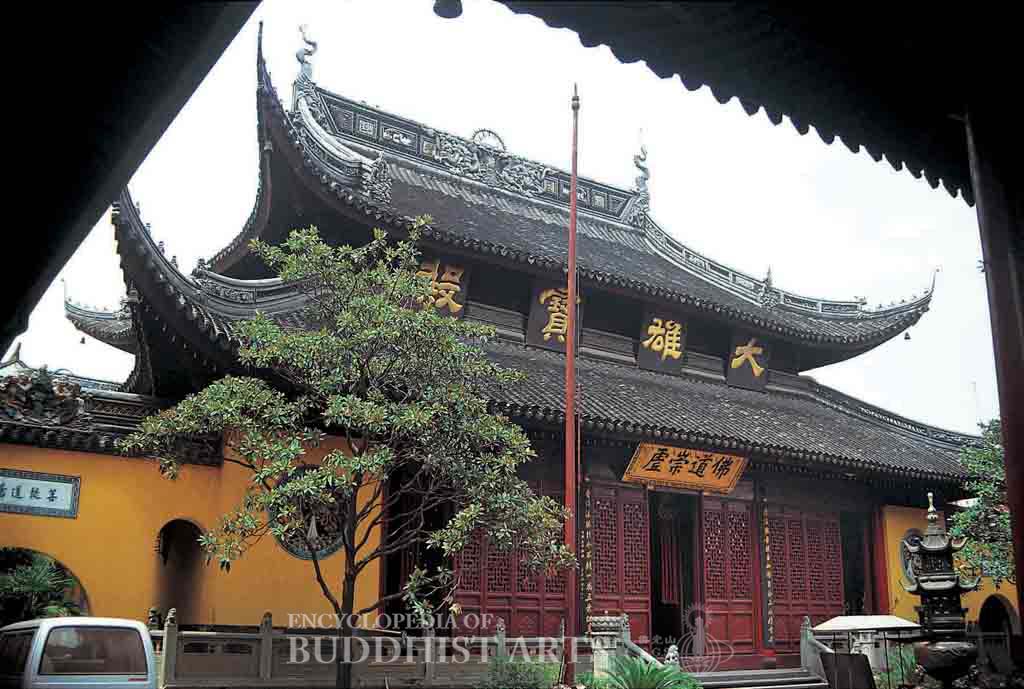
Yufo Temple: Great Hero Hall
Yufo Temple
CHINA, Shanghai
Yufo means Jade Buddha, so the temple is also known as the Jade Buddha Temple. In 1882 during the Qing dynasty, when monk Huigen of Putuoshan (Potalaka Mountain) came back from his visit to India, he passed through Myanmar and brought back five jade Buddha statues. When he passed through Shanghai, he left two of the statues behind: a seated Buddha and a reclining Buddha. This inspired people to build a temple to enshrine them. At first the statues were kept in Jiangwan, but the place was later ransacked by soldiers during wartime. In 1918, Chan Master Kecheng of the Linji school started to build this temple to enshrine the statues. The temple took ten years to complete. It was listed as a key Buddhist temple in the Han region of China in 1983.
The temple consists of three courtyards. Along the central axis there are structures such as the screen wall, main temple gate, Heavenly King Hall, Great Hero Hall, and the Jade Buddha Building. Along the sides there are the Reclining Buddha Hall, Amitabha Hall, Avalokitesvara Hall, meditation hall, and the monastic quarters. The screen wall consists of five sections, each decorated with a brick relief. The relief in the central section is the largest and depicts a dragon spraying water. The other sections depict phoenixes and white elephants. The seven-by-five bay Great Hero Hall houses 4 m high statues of Sakyamuni Buddha, Medicine Buddha, and Amitabha Buddha. The Jade Buddha Building contains the jade seated Buddha, which is 1.9 m high. The Reclining Buddha Hall houses the jade reclining Buddha, which measures 96 cm long.
The temple has a collection of various Buddhist artifacts, including five versions of the Buddhist Canon such as the Qing Tripitaka, Pinjia Tripitaka, and Tibetan Canon, a bronze Sakyamuni statue dating to the Northern Wei dynasty (386–534), a stone Medicine Buddha statue made during the Eastern Wei dynasty (534–550), and sutra manuscript written during the Tang dynasty and discovered in Mogao Cave 17. The temple has also established the Shanghai Buddhist College.
For more details, go to the Encyclopedia of Buddhist Arts: Architecture T-Z, page 1376.
Cite this article:
author = Hsingyun and Youheng and Johnson, Peter and Mankuang and Lancaster, Lewis,
booktitle = {Encyclopedia of Buddhist Arts: Architecture T-Z},
pages = 1376,
title = {{Yufo Temple}},
volume = 4,
year = {2016}}