
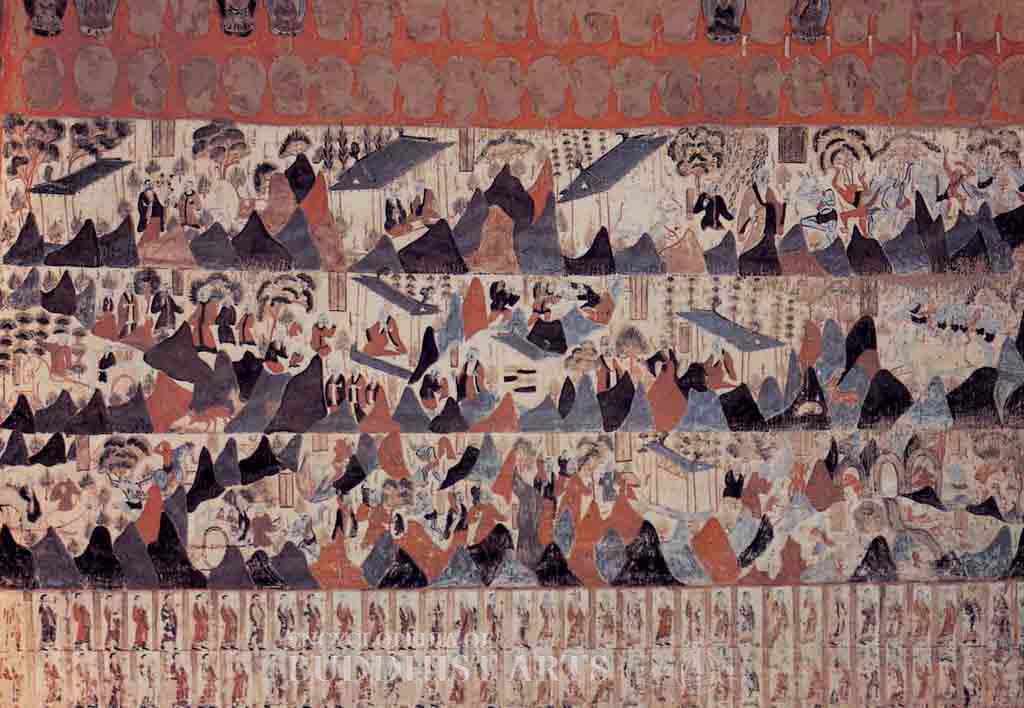
Mogao Cave 428: Prince Sudana Jataka
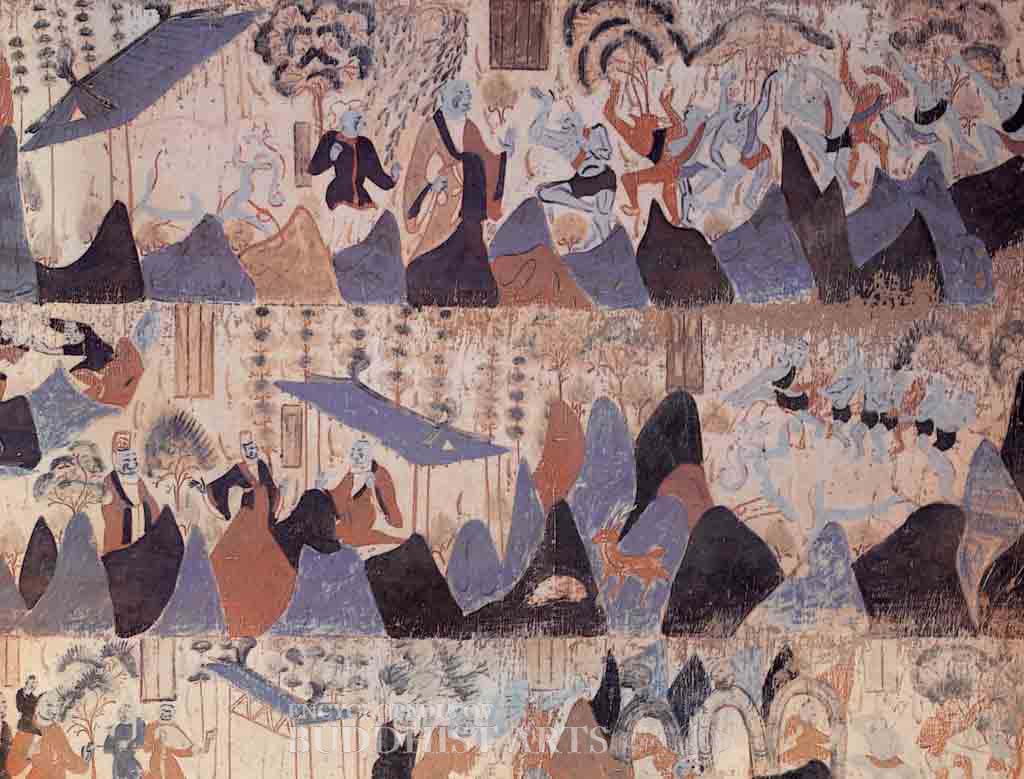
Mogao Cave 428: Prince Sudana Jataka (detail)
Mogao Cave 428: Prince Sudana Jataka
CHINA, Gansu, Dunhuang; Northern Zhou dynasty
Located on the left side of the entrance on the front (east) wall, this illustration is among the earliest illustration of the Sudana Jataka within the Mogao Caves. The painting is divided into three horizontal registers and the narrative follows a “Z” sequence, selectively highlighting the main events of the story.
Starting from the left in the upper register are scenes of: the prince bidding farewell to his father, asking his father to open the treasury to donate to charity, and eight brahmins begging for the white elephant.
Beginning from the right in the middle register are scenes of: brahmins riding away on the white elephant, a minister charging the prince with treason for giving away the elephant, the prince being banished to Mekha-Sanda Hill, his acts of charity before leaving, bidding farewell to his father, the public sending him off, and the prince leaving the city in a chariot.
In the lower register, beginning on the left: a brahmin begging for the prince’s horse and leaving with it, then another for his chariot, then another for his clothes, the prince and princess moving on with their children, Sakra creating a city to persuade the prince to stay, the family reaching Mekha-Sanda Hill and building a house, the prince giving away his children to a brahmin, the children being mistreated and beaten.
The conclusion of the story, in which the children are sold to their grandfather, the king, and the family is reunited, is not included in the mural. The painting uses houses and mountains to divide the scenes and to create a setting rich in the aspects of daily life. The characters, wearing long robes with wide sleeves, reflect the style of the Cao Wei Kingdom (220–265) and Jin dynasty (265–420). The hills and trees are smaller than the human figures, a characteristic of early landscape paintings. The background is white in color, with the characters, trees, mountains, and buildings painted in bright colors such as blue, green, red, and brown.
For more details, go to the Encyclopedia of Buddhist Arts: Caves Mo-S, page 1212.
Cite this article:
author = Hsingyun and Youheng and Johnson, Peter and Mankuang and Huntington, Susan and Edson, Gary and Neather, Robert,
booktitle = {Encyclopedia of Buddhist Arts: Caves Mo-S},
pages = 1212,
title = {{Mogao Cave 428: Prince Sudana Jataka}},
volume = 8,
year = {2016}}