
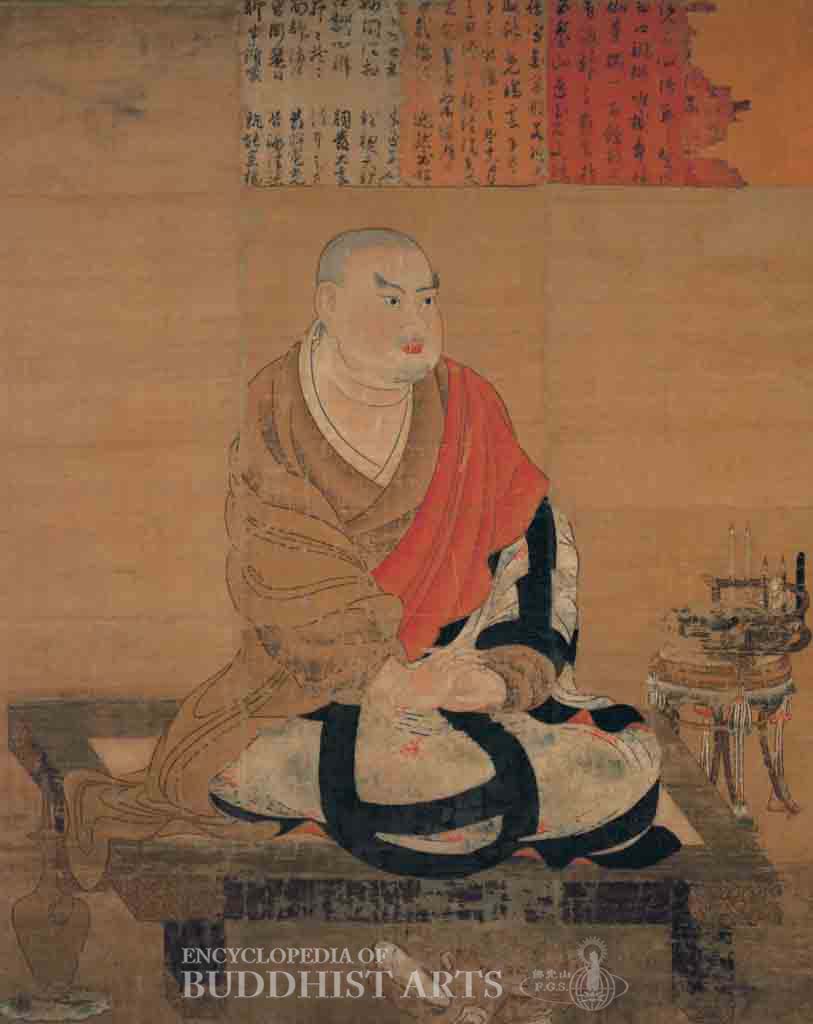
Kuiji; Heian period
Ink and color on silk
Kuiji
CHINA, Shaanxi, Xi’an; Tang dynasty
Master Kuiji was a monk originally named Weizi and also known as Chenji. He renounced in 648 under Master Xuanzang, the renowned translator. As Master Xuanzang’s most intelligent and highly regarded disciple, Master Kuiji assisted in his various translation projects. Together with Master Xuanzang, they compiled the texts written by the ten main critics of the Faxiang school and translated the famed Vijnaptimatratasiddhi, a text that became the most important doctrine of the Faxiang school of Buddhism.
After Master Xuanzang’s passing in 664, Master Kuiji went to Ci’en Temple in Shaanxi where he undertook his own compilation and translation projects in addition to propagating the Dharma and serving as abbot. During this time, he also visited Wutaishan, where he carved a jade statue of Manjusri Bodhisattva and copied the Prajnaparamita Sutra.
Master Kuiji was known for the numerous written works he produced throughout his life. In addition to the co-writing and translating of various texts alongside Master Xuanzang, Master Kuiji’s own body of works include Commentaries on the Demonstration of Consciousness-Only, Commentary on the Nyayapravesa, and Essays on the Forest of Meanings in the Mahayana Dharma Garden. His teachings as a master were passed through generations of several eminent monks, and later served as the foundation for the establishment of the Hosso school of Buddhism in Japan.
His image is enshrined today in the form of a sculpture housed inside a pagoda located within the compounds of Xingjiao Temple in his hometown of Xi’an, Shaanxi. The pagoda was erected in his honor.
For more details, go to the Encyclopedia of Buddhist Arts: People, page 145.
Cite this article:
author = Hsingyun and Youheng and Youlu and Pokorski, Stefanie and Yichao and Mankuang and Miaohsi,
booktitle = {Encyclopedia of Buddhist Arts: People },
pages = 145,
title = {{Kuiji}},
volume = 19,
year = {2016}}