
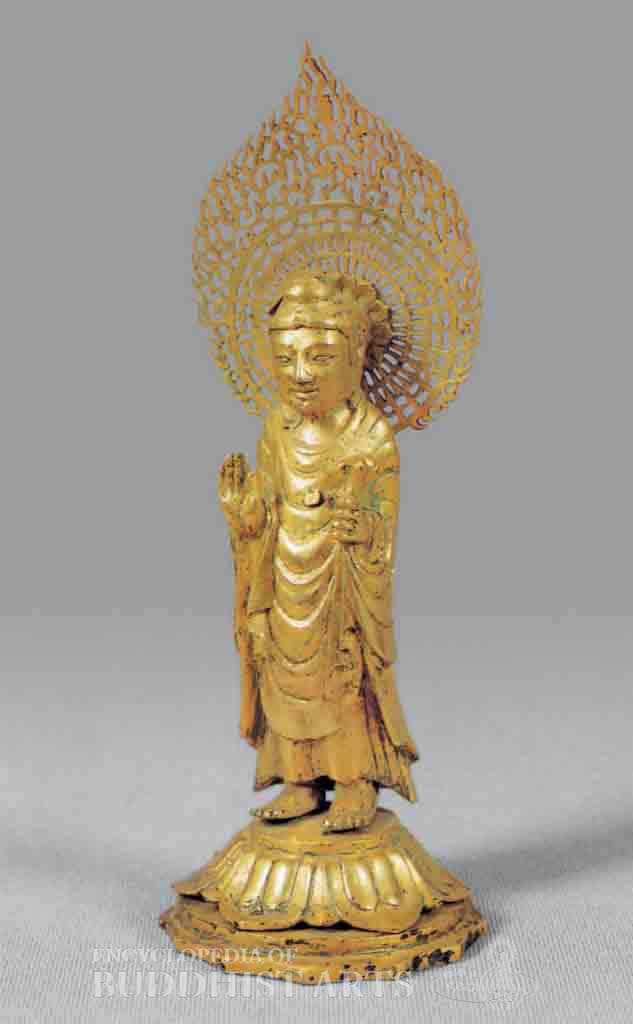
Guhwangri Three-Tier Pagoda: Standing Buddha
Gilt bronze
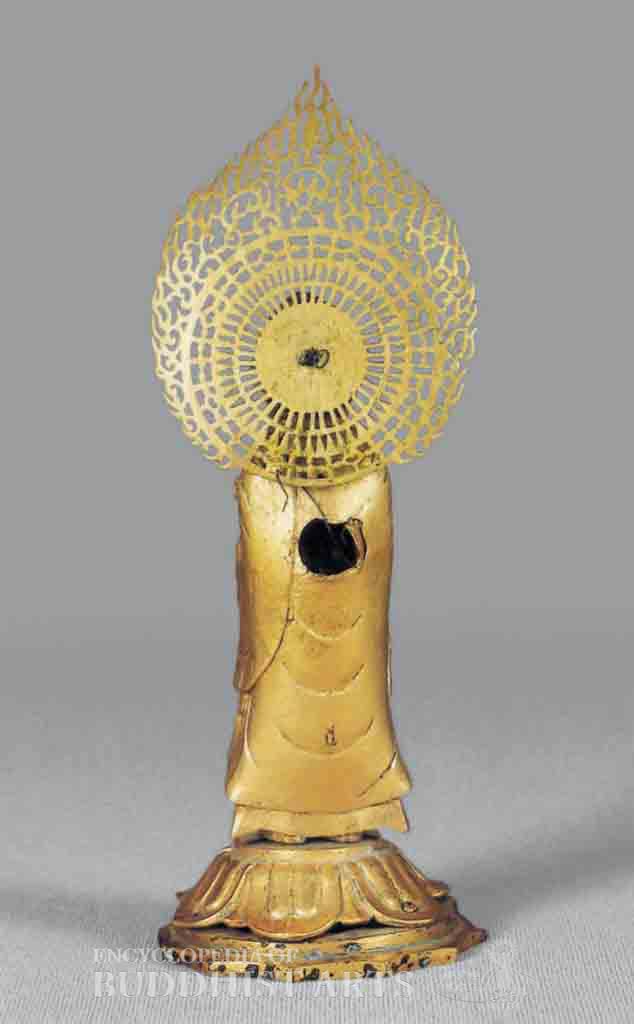
Guhwangri Three-Tier Pagoda: Standing Buddha (back)
Guhwangri Three-Tier Pagoda: Standing Buddha
SOUTH KOREA, North Gyeongsang, Gyeongju; Unified Silla dynasty
The standing Buddha was discovered in a reliquary within the Three-Tier Pagoda at Guhwangri. An inscription on the lid records that the pagoda was erected in 692 by King Hyoso (reigned 692–701), and that this Buddha was placed inside the reliquary. The reliquary was opened in 706 by King Seongdeok (reigned 702–736) who ordered another golden Buddha to be placed inside. When comparing the two, the style of this statue was older, so experts believe this was the original statue. It was listed as National Treasure No. 80 in 1962. The Buddha stands on an inverted lotus dressed in monastic robes with the right hand in abhaya (fearlessness) mudra while the left hand holds up a corner of the robe. A large openwork nimbus radiates outwards in three circles before elongating into an openwork design of towering flames. The piece illustrates the transitional style of the late Three Kingdoms period (57 BCE–668) into the early Unified Silla dynasty (668–935).
For more details, go to the Encyclopedia of Buddhist Arts: Sculpture G-M, page 399.
Cite this article:
author = Hsingyun and Youheng and Lovelock, Yann and Chou, Yuan and Huntington, Susan and Edson, Gary and Neather, Robert,
booktitle = {Encyclopedia of Buddhist Arts: Sculpture G-M},
pages = 399,
title = {{Guhwangri Three-Tier Pagoda: Standing Buddha}},
volume = 11,
year = {2016}}