
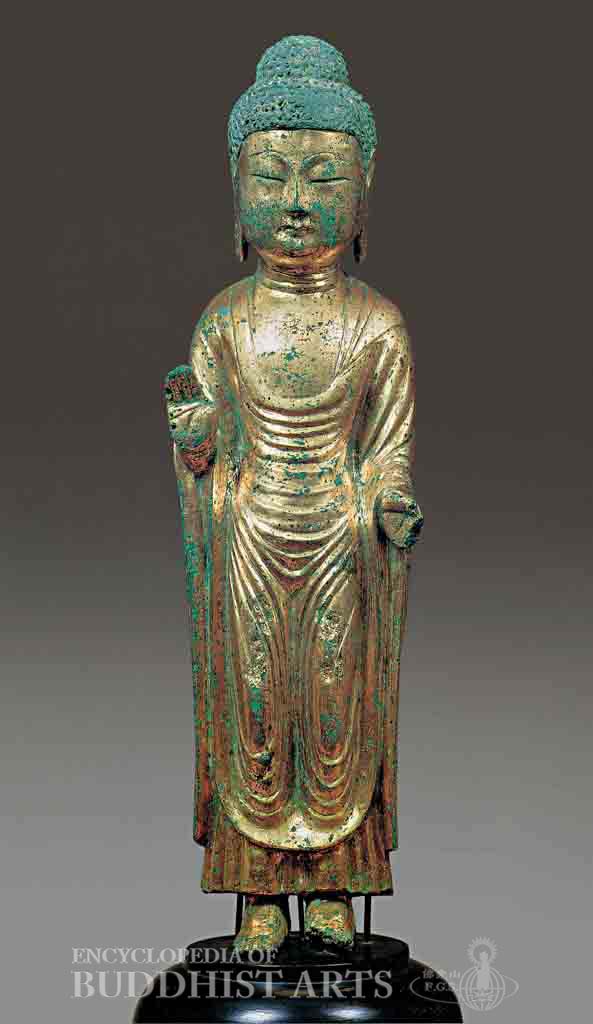
Seonsan: Standing Buddha
Gilt bronze
Seonsan: Standing Buddha
SOUTH KOREA, North Gyeongsang, Gumi; Unified Silla dynasty
Most Korean sculptures from the Three Kingdoms period (57 BCE–668 CE) until the early Unified Silla dynasty (668–935) are single standing Buddhas. This figure was probably cast by local artisans, and therefore, displays more diverse and secular features. This statue was listed as National Treasure No. 182 in 1976.
The Buddha’s head is out of proportion to the narrow body. The usnisa is high, the eyebrows are incised, and the eyes closed. The neck shows the three lines of a great person. The folds of the monastic robe ripple horizontally to the waist and then divide vertically over the thighs. Though the hands are damaged, they are probably held in the abhaya (fearlessness) and varada (wish-granting) mudras.
For more details, go to the Encyclopedia of Buddhist Arts: Sculpture N-Sr, page 1041.
Cite this article:
author = Hsingyun and Youheng and Lovelock, Yann and Chou, Yuan and Huntington, Susan and Edson, Gary and Neather, Robert,
booktitle = {Encyclopedia of Buddhist Arts: Sculpture N-Sr},
pages = 1041,
title = {{Seonsan: Standing Buddha}},
volume = 12,
year = {2016}}