
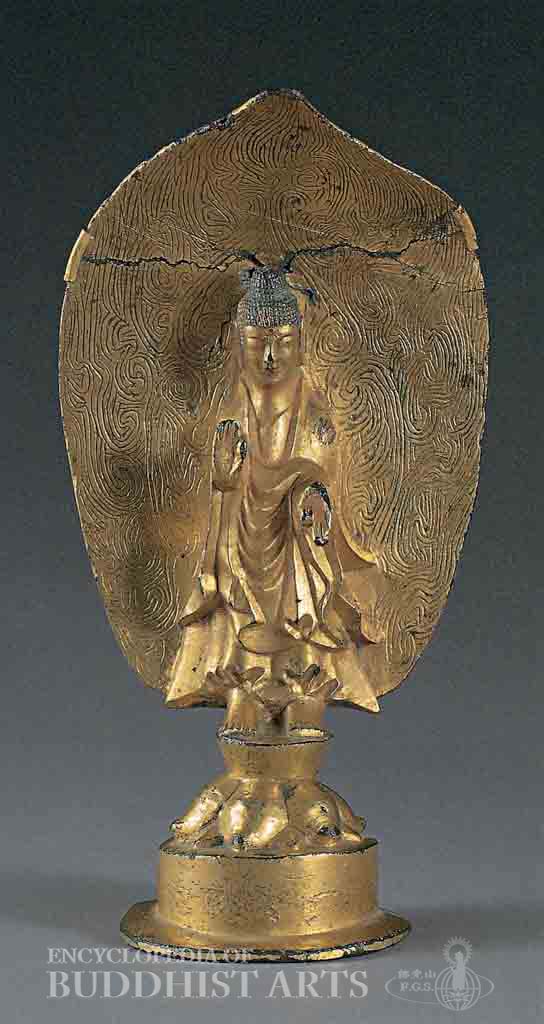
Uiryeong: Standing Buddha
Gilt bronze
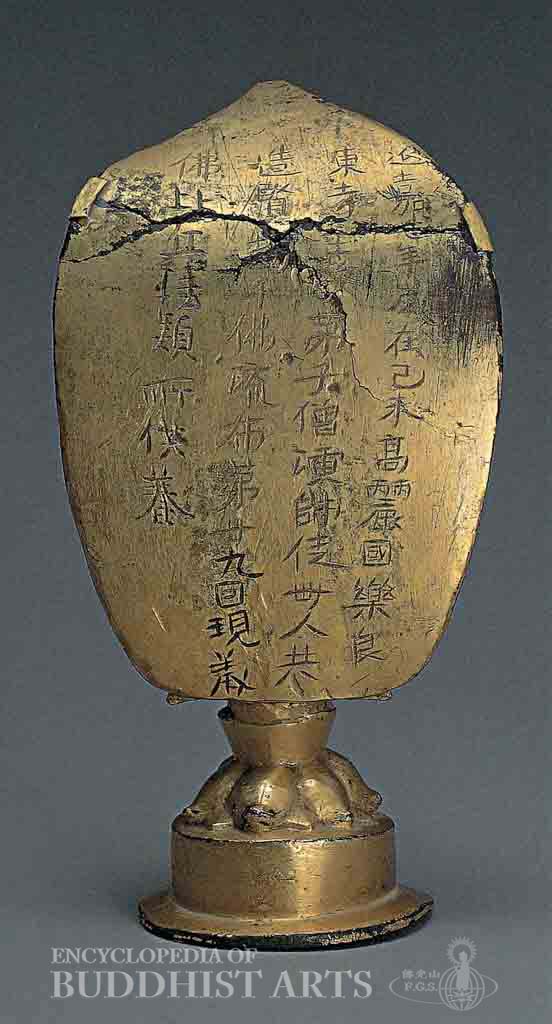
Uiryeong: Standing Buddha (back)
Uiryeong: Standing Buddha
SOUTH KOREA, South Gyeongsang, Uiryeong; Goguryeo dynasty
The statue was unearthed in 1963 and was listed as National Treasure No. 119 in 1964. The inscription on the back dates it to 539 and identifies it as “the 29th of the Thousand Buddhas of the Present Kalpa,” making it the earliest known dated Buddha statue in Korea.
The figure stands on an inverted lotus pedestal that is supported on a cylindrical base. A striking flame patterned mandorla curves inwards, pushing the figure’s head forward. The robes fall in billowing folds and the right hand is held in abhaya (fearlessness) mudra while the left is in a mudra in which the third and fourth fingers are bent. The statue displays a strong Chinese Northern Wei dynasty (386–534) influence in its style and design.
For more details, go to the Encyclopedia of Buddhist Arts: Sculpture St-Z, page 1273.
Cite this article:
author = Hsingyun and Youheng and Lovelock, Yann and Chou, Yuan and Huntington, Susan and Edson, Gary and Neather, Robert,
booktitle = {Encyclopedia of Buddhist Arts: Sculpture St-Z},
pages = 1273,
title = {{Uiryeong: Standing Buddha}},
volume = 13,
year = {2016}}