
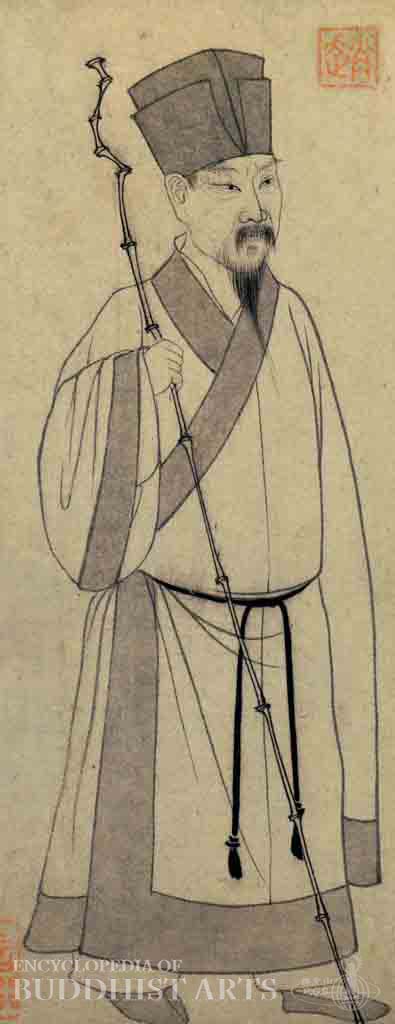
Su Shi; Yuan dynasty
Ink on paper
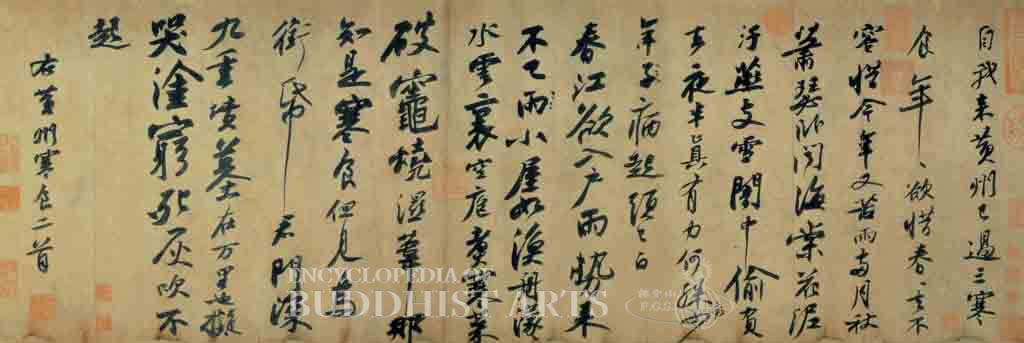
Huangzhou Cold Food Observance by Su Shi; Northern Song dynasty. dated 1082
Ink on paper
Su Shi
CHINA, Sichuan, Meishan; Northern Song dynasty
Su Shi, also known as Su Dongpo or Zizhan, was a poet and calligrapher born in Meizhou (present day Meishan, Sichuan). He became an Imperial Scholar in 1057 after passing the imperial examination, but his career as an official was not the most successful. Although he was exiled several times, to different parts of the country, he was able to adapt and became an important figure in the development of art and culture in Southern China. Su was known to be a devout Buddhist and studied under Master Zhaojue Changzong of the Linji school of Chan Buddhism. An avid practitioner of both the Pure Land and Chan schools of Buddhism, he also received teachings from Chan masters Foyin and Chenghao.
Regarded as one of the Eight Great Prose Masters of the Tang and Song Dynasties, Su’s poetry is still well-known today and consists of several collections. His poems are considered to be bold, realistic, and influential. Su, alongside his father, Su Xun, and his brother, Su Zhe, was a part of a famous literati group known as The Three Su’s. Also highly skilled in calligraphy, he was proficient in both regular and running scripts. He learned the calligraphic styles of Yen Zhenqing, Li Yong, Xu Hao, and Yang Ning, and created the Song script, in which the characters are compacted and strokes are fluent and elegant. Su, together with Mi Fu, Cai Xiang, and Huang Tingjian was renowned as one of the Four Calligraphy Masters of the Song dynasty. In addition, he was skilled in painting Buddhist statues as well as landscapes of bamboo, trees, and rocks. He also started the trend of penning red ink inscriptions on bamboo.
Extant calligraphy by Su includes Precious Moon, Journey to the North, Record of the Night, Huangzhou Cold Food Observance, Letter from Su Shi in Response to Yu Ji’s Poems, and Red Cliffs, all of which are currently kept at the National Palace Museum in Taipei, Taiwan. Eulogy of Huang Jidao and Letter of Appreciation are on display at the Shanghai Museum, and other works include Collection of Stele Inscription of Asoka Temple, in addition to calligraphy of various sutras, such as the Heart Sutra, Avatamsaka Sutra, Sutra of Perfect Enlightenment, and Lankavatara Sutra.
For more details, go to the Encyclopedia of Buddhist Arts: People, page 246.
Cite this article:
author = Hsingyun and Youheng and Youlu and Pokorski, Stefanie and Yichao and Mankuang and Miaohsi,
booktitle = {Encyclopedia of Buddhist Arts: People },
pages = 246,
title = {{Su Shi}},
volume = 19,
year = {2016}}