
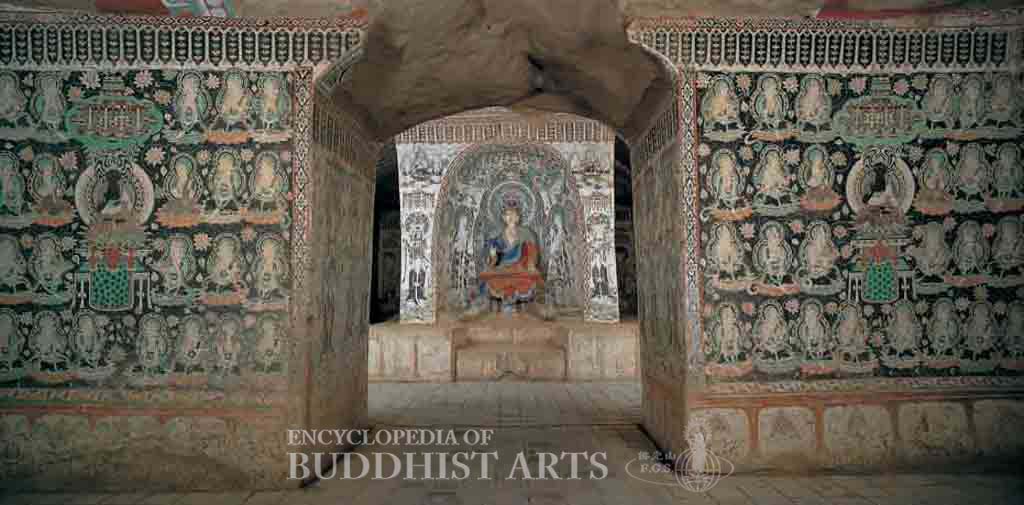
Yulin Cave 17
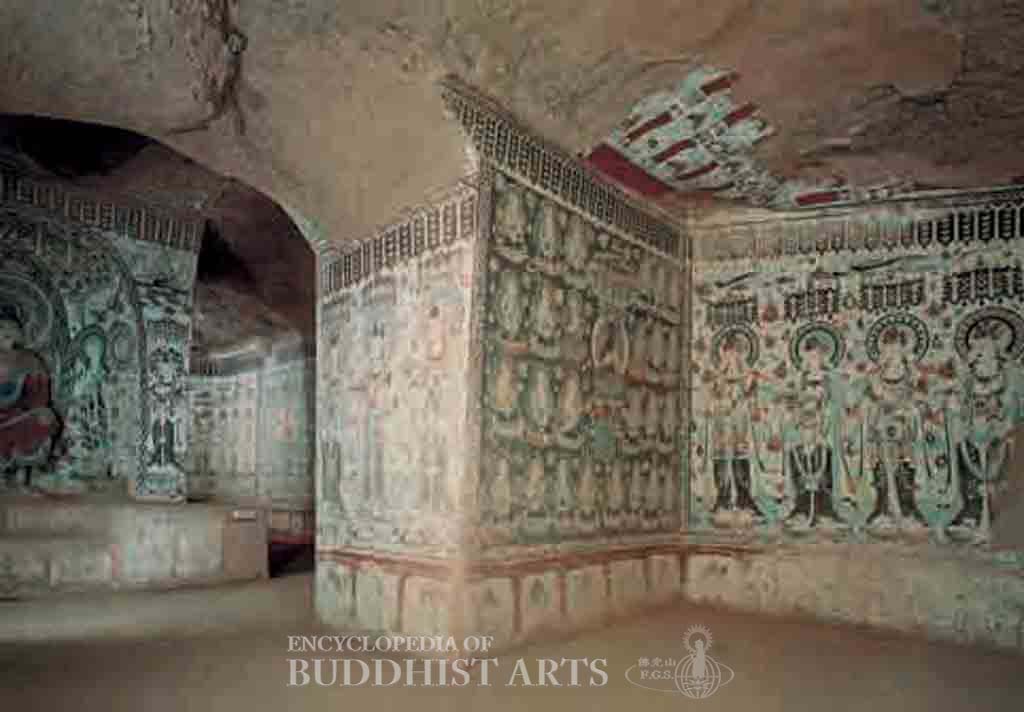
Yulin Cave 17
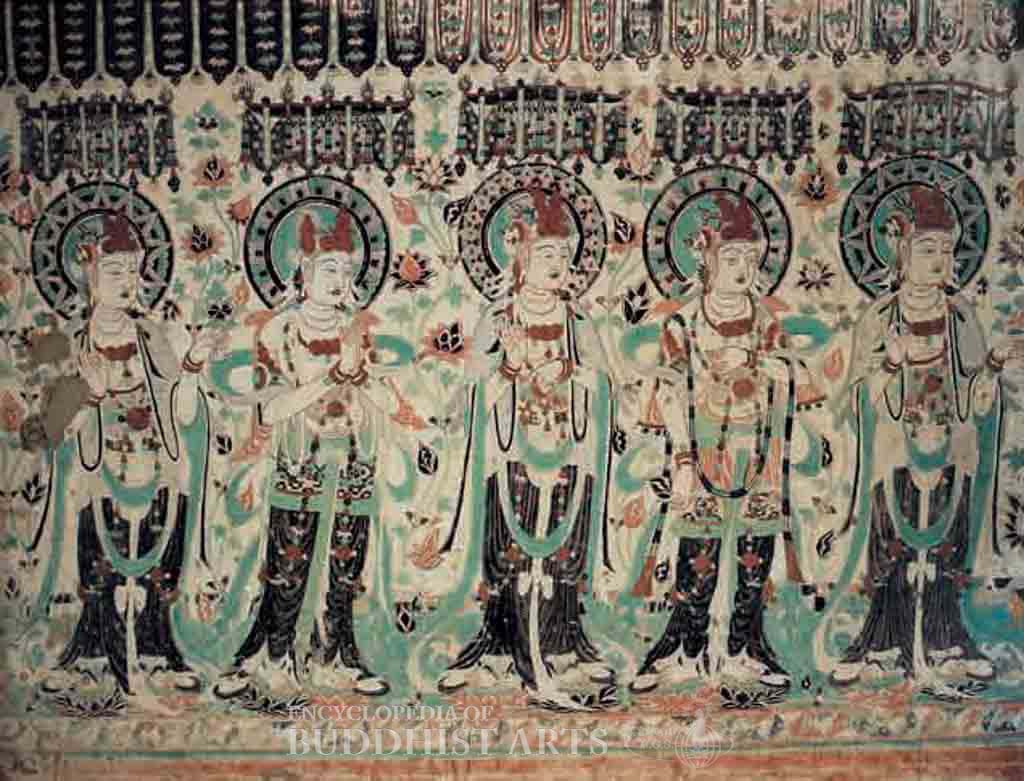
Yulin Cave 17: Gathering of Bodhisattvas
Yulin Cave 17
CHINA, Gansu, Guazhou
This cave is located on the lower level of the east cliff. It is one of the three largest remaining central pillar caves at the site and was constructed between the Northern Dynasties (386–581) and the Tang dynasty (618–907). The cave consists of a front passageway leading to an antechamber, and a short corridor between the antechamber and the main chamber. This layout is particularly characteristic of the Yulin Caves. One of the major themes in this cave is the gathering of Bodhisattvas, a popular subject in Song dynasty (960–1279) artwork. These Bodhisattvas are all depicted in a similar fashion, painted with the line drawing technique and colored with ocher and mineral green paint.
The antechamber is decorated with gatherings of Bodhisattvas on the north, south, and front (west) walls. Illustrations depicting the Pure Land are found on either side of the doorway leading into the main chamber. The corridor between the antechamber and main chamber depicts the gatherings of Bodhisattvas on the side walls. The main chamber measures 9.3 m wide, 5.4 m high, and 11.6 m deep, with the ceiling sloping towards the central pillar. Arched niches are cut into all four sides of the pillar, each containing a Buddha statue created during the Tang dynasty and repaired in the Qing dynasty (1644–1911). Gatherings of Bodhisattvas are painted on the back (east) wall and the eastern parts of the north and south walls. The western sections of the north and south walls feature illustrations of the Pure Land. Additional illustrations depicting the Pure Land are found on both sides of the doorway on the front wall.
For more details, go to the Encyclopedia of Buddhist Arts: Caves T-Z, page 1592.
Cite this article:
author = Hsingyun and Youheng and Johnson, Peter and Mankuang and Huntington, Susan and Edson, Gary and Neather, Robert,
booktitle = {Encyclopedia of Buddhist Arts: Caves T-Z},
pages = 1592,
title = {{Yulin Cave 17}},
volume = 9,
year = {2016}}