
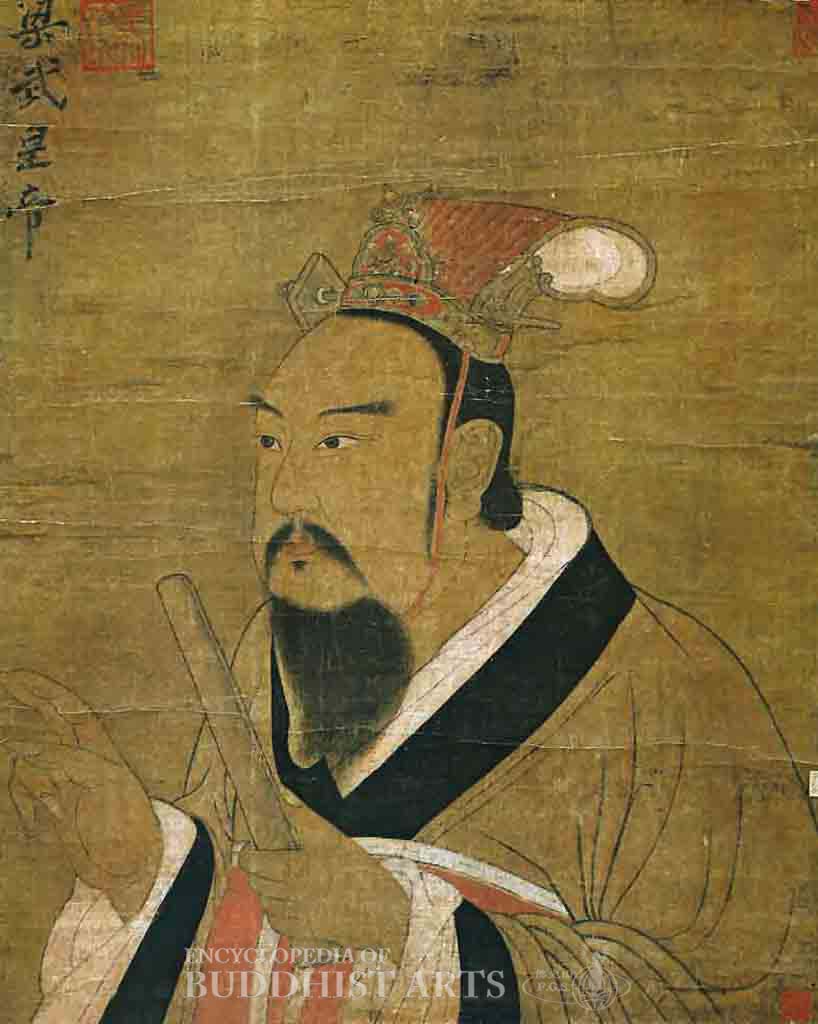
Emperor Wu of Liang
Ink and color on paper
Emperor Wu of Liang
CHINA, Jiangsu, Wujin; Southern Liang dynasty
Emperor Wu (reigned 502–549) was the founding emperor of the Southern Liang dynasty (502–557). His original name was Xiao Yan, and he was also known as Shu Da or Lian Er. As a follower of Confucianism and a devout Buddhist practitioner, he is known to have constructed several temples during his reign, in addition to writing commentaries on various sutras. Often referred to as the Bodhisattva Emperor due to his strict vegetarianism and reverence for Buddhism, Emperor Wu later abdicated the throne in order to renounce as a monk at Jiming Temple in Jiangsu.
The emperor was a skilled musician, poet, and artist. Among his poetry, many of his famous works featured Buddhist themes. Furthermore, he was known to send convoys to India to bring back statues of the Buddha, which in turn yielded a vast influence on the style of Buddhist statues created in China during the Liang dynasty.
An avid calligrapher who studied seal and cursive script styles, Emperor Wu created several works of calligraphy that were recorded in A Collection of Calligraphy, compiled during the Northern Song dynasty (960–1127). Also during his reign, the emperor collected, restored, and organized an extensive collection of calligraphy. He later compiled Liang Catalog of Calligraphy and Painting, which was the first catalog of its kind in Chinese history. Moreover, the commentaries he published in Reviews of Calligraphers from the Past and Present are considered among the finest.
For more details, go to the Encyclopedia of Buddhist Arts: People, page 59.
Cite this article:
author = Hsingyun and Youheng and Youlu and Pokorski, Stefanie and Yichao and Mankuang and Miaohsi,
booktitle = {Encyclopedia of Buddhist Arts: People },
pages = 59,
title = {{Emperor Wu of Liang}},
volume = 19,
year = {2016}}