
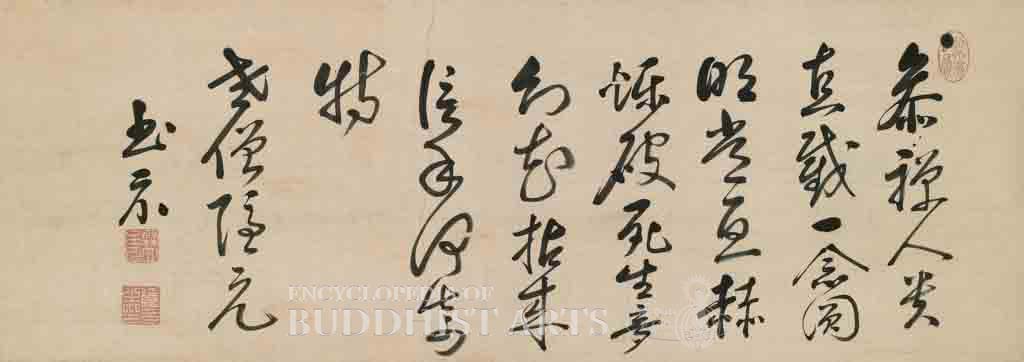
On Chan Meditation
Ink on paper
On Chan Meditation
CHINA; Ming to Qing dynasty
In this Dharma verse, Chan Master Yinyuan Longqi explains that the essentials of Chan meditation should be simple and clear; each thought should be conscious and justified. In following these ideals, it is believed that one could be rid of all defilements and eventually attain enlightenment.
Yinyuan Longqi, also known as Ingen Ryuki in Japan, was a master of the Linji school of Chan Buddhism during the late Ming (1368–1644) and the early Qing (1644–1911) dynasties. When he was the abbot of Wanfu Temple in Fujian, he revitalized the Linji school and expanded the temple. He also founded the Obaku school in Japan, which imparted a significant influence on modern Japanese Buddhism. Yinyuan was known to be a strict mentor, and such characteristics are expressed in his calligraphy. The brushstrokes in this work, for example, are said to be executed quick like wind and lightning. The calligraphy is written quickly in center tip with full strokes, smooth turns, and sturdy, powerful lines. It resembles the Chan principles of peaceful restraint and an unfettered mind.
For more details, go to the Encyclopedia of Buddhist Arts: Calligraphy, page 172.
Cite this article:
author = Hsingyun and Youheng and Youlu and Pokorski, Stefanie and Mankuang and Edson, Gary,
booktitle = {Encyclopedia of Buddhist Arts: Calligraphy },
pages = 172,
title = {{On Chan Meditation}},
volume = 17,
year = {2016}}