
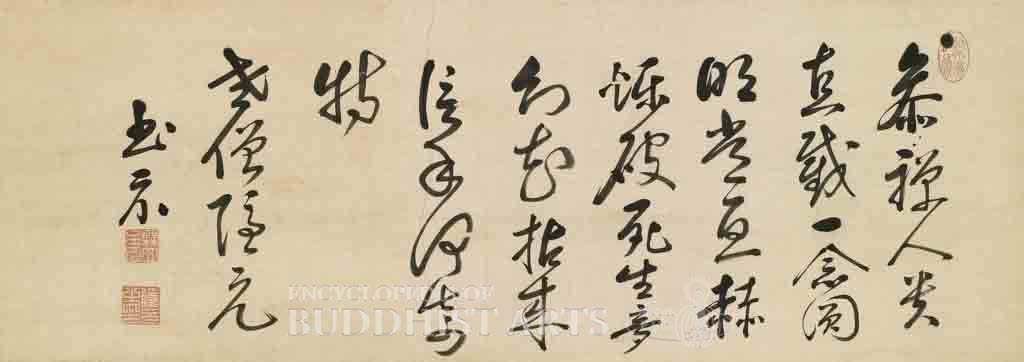
On Chan Meditation by Yinyuan Longqi; Ming to Qing dynasty
Ink on paper
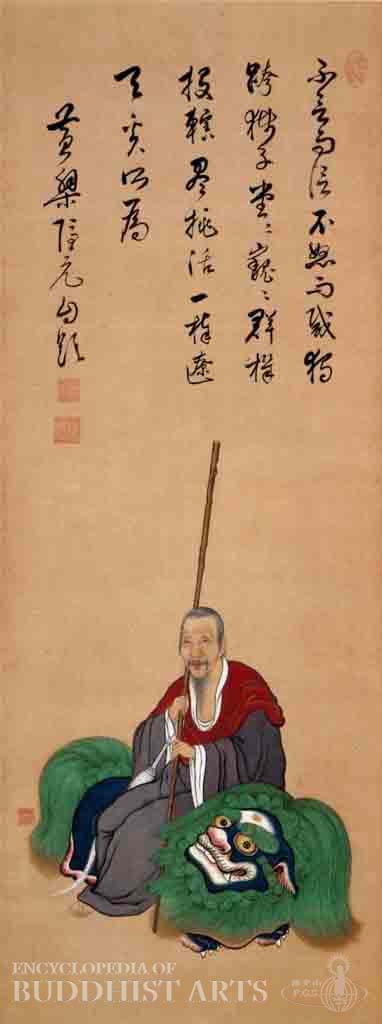
Yinyuan Longqi
Yinyuan Longqi
CHINA, Fujian, Fuzhou; Ming to Qing dynasty
Yinyuan Longqi had an original name of Lin Zengbing and was also known in Japan as Ingen Ryuki. He was a master of the Linji school of Chan Buddhism who renounced in 1620 at Wanfu Temple in Fujian. Master Yinyuan traveled extensively to receive teachings from various masters and eventually became the Dharma heir of Chan Master Feiyin Tongrong in 1633 while serving as the abbot of Wanfu Temple in Zhejiang. He was known to have revitalized the lineage and expanded the temple, making it one of the most famous temples in southeastern China. Master Yinyuan was bestowed the posthumous title of National Master Daiko Fusho (Great Radiance, Universal Illumination) by the retired Emperor Go-Mizunoo (reigned 1611–1629) of the Edo period.
In 1654, after repeated invitations from abbot Yiran Xingrong of Kofukuji Temple in Nagasaki, Master Yinyuan led a group of 30 monks and laymen to propagate the Dharma in Japan. He was offered land for the construction of a new temple in Kyoto by the imperial family of Japan, and established the founding temple of the Japanese Obaku school of Zen Buddhism, Manpukuji Temple, in 1661. Master Yinyuan brought with him to Japan several examples of Chinese sculptures, calligraphy, seal engravings, woodblock prints, medicine, and music. These items, in addition to his Chan teachings, were vastly influential on Japanese culture and were equally significant in the progression of modern Japanese Buddhism, much of which fueled the development of the Obaku school of which Yinyuan is regarded as the founding patriarch.
Master Yinyuan was also renowned as a skilled poet and calligrapher. Many of the horizontal inscribed boards and couplets in Manpukuji Temple were penned by him and his disciples Mu’an Xingtao and Jifei Ruyi; together, they are reputed as the Three Brushes of Obaku. His calligraphic works include On Chan Meditation, kept at Ho’s Calligraphy Foundation in Taipei, Taiwan; and Seven-Character Quatrain, engraved onto the Stele Wall at Fo Guang Shan Monastery in Kaohsiung, Taiwan.
For more details, go to the Encyclopedia of Buddhist Arts: People, page 323.
Cite this article:
author = Hsingyun and Youheng and Youlu and Pokorski, Stefanie and Yichao and Mankuang and Miaohsi,
booktitle = {Encyclopedia of Buddhist Arts: People },
pages = 323,
title = {{Yinyuan Longqi}},
volume = 19,
year = {2016}}