
Kumgangsan
Ink and color on paper
Kumgangsan
KOREA; Joseon dynasty
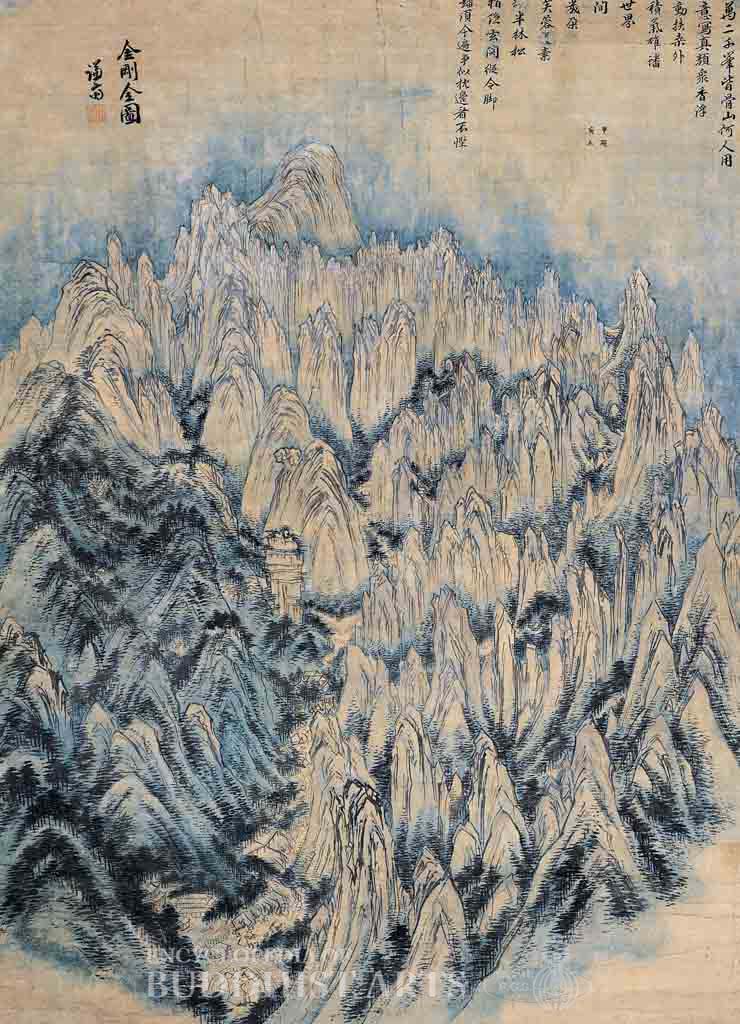
When the painter of this painting, Jeong Seon, was young, he was inspired by the landscape paintings of the early Qing dynasty (1644–1911). He became an artist, and traveled the country painting what he saw, developing his own distinct style. Kumgangsan or “Diamond Mountain” in Kangwon became an important Buddhist site during the Goryeo dynasty (918–1392), when several temples were constructed there. In 1984, this painting was listed as National Treasure No. 217.
The painting depicts Kumgangsan during the winter. The mountain peaks are covered in snow. Within the gorges, Jangansa Temple, Pyohunsa Temple, and Jeongyangsa Temple are visible. There are inscriptions at the top of the painting. The one on the left says “Aerial View of Kumgangsan,” with the signature of writer, Gyeomjae. The inscription on the right is a verse praising the magnificence of the mountain.
For more details, go to the Encyclopedia of Buddhist Arts: Painting I-O, page 467.
Cite this article:
author = Hsingyun and Youheng and Youlu and Wilson, Graham and Manho and Mankuang and Huntington, Susan,
booktitle = {Encyclopedia of Buddhist Arts: Painting I-O},
pages = 467,
title = {{Kumgangsan}},
volume = 15,
year = {2016}}