
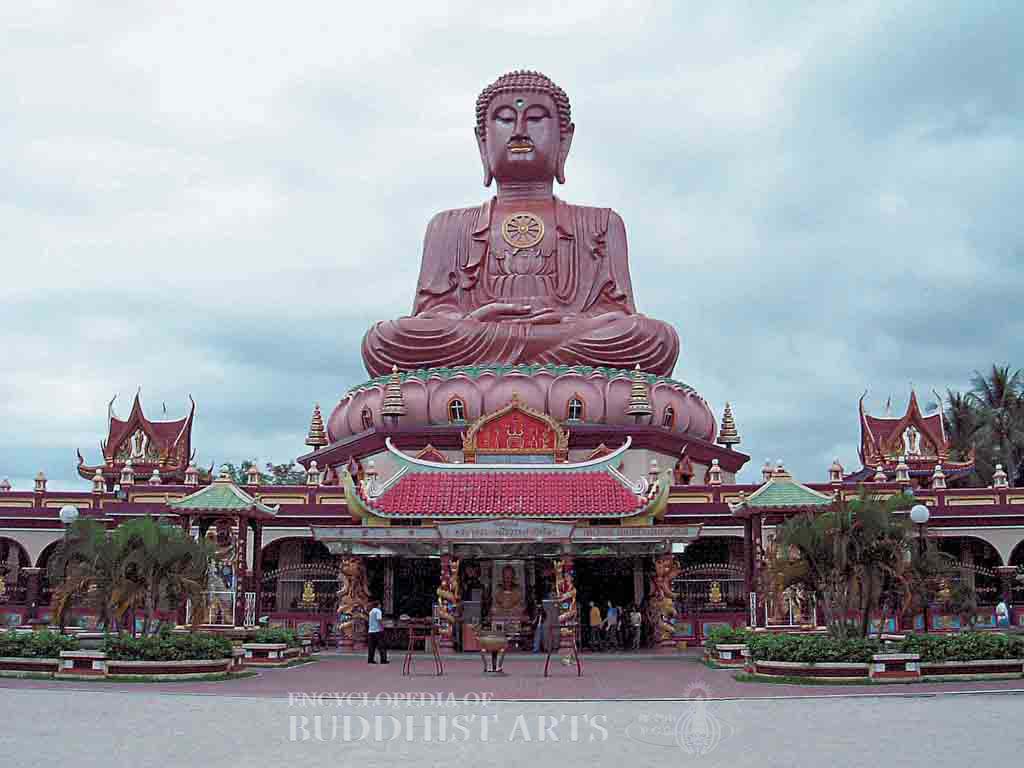
Wat Machimmaram
Wat Machimmaram
MALAYSIA, Kelantan, Tumpat
Wat Machimmaram means Central Temple in Pali. The construction date of the temple is unknown but it is thought to be over 500 years old. The temple earned its name because it was situated in the middle of three other Thai Buddhist temples. By 1950 all that remained were a few houses on stilts built with plastered brick walls. The temple was gradually reconstructed and expanded to its present scale through the efforts of subsequent abbots. A Thai school was established in 1969. The temple was awarded the Best Architectural Design for a Non-Muslim Place of Worship by the state of Kelantan in 2002.
The temple occupies 2.6 ha and consists primarily of the main hall and assembly hall. To the left of the main hall there is the Thai school, and to the right there is a four-faced Buddha and a Maitreya Buddha pond. In front of the assembly hall there is also a Free Life Pond. In 2001 the largest seated Buddha in Southeast Asia was installed at the temple. The 30 m high statue sits in full lotus position on an upright lotus base, and the forehead is inlaid with a large crystal urna that is 15 cm long and 23 cm wide. The lips and Dharma wheel on the figure’s chest are gilded. The Buddha wears a robe covering both shoulders. The Buddha’s hands are held in the dhyana (meditation) mudra. Below the upright lotus there is a hexagonal hall in the form of Mount Sumeru. The temple has six sandalwood Buddha statues, one of which predates the temple and is considered to be its most valuable treasure.
For more details, go to the Encyclopedia of Buddhist Arts: Architecture T-Z, page 1200.
Cite this article:
author = Hsingyun and Youheng and Johnson, Peter and Mankuang and Lancaster, Lewis,
booktitle = {Encyclopedia of Buddhist Arts: Architecture T-Z},
pages = 1200,
title = {{Wat Machimmaram}},
volume = 4,
year = {2016}}