
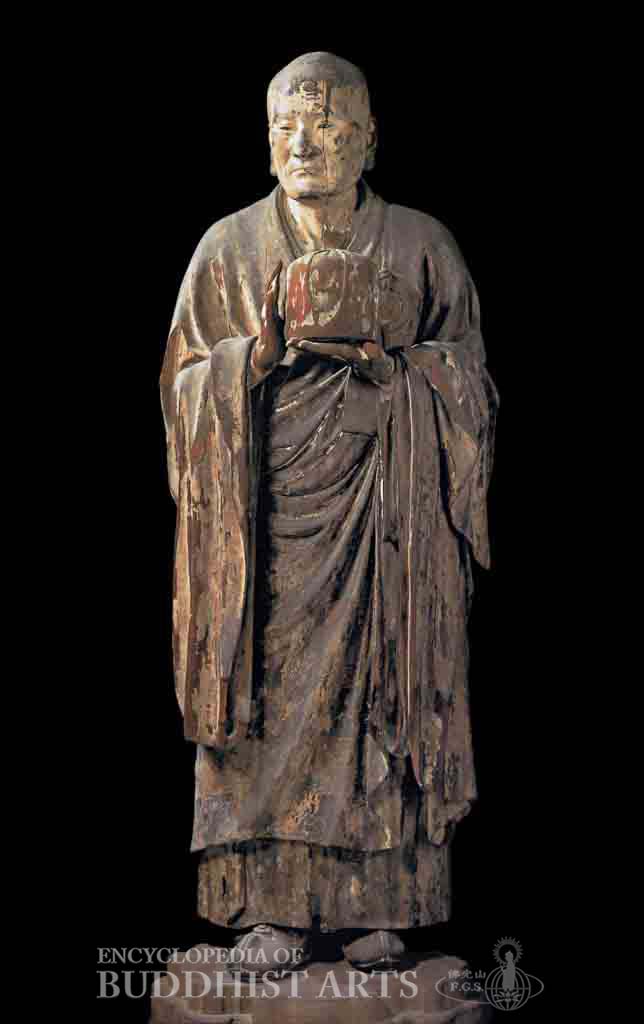
Kofukuji Temple North Octagonal Hall: Asanga
Laurel wood
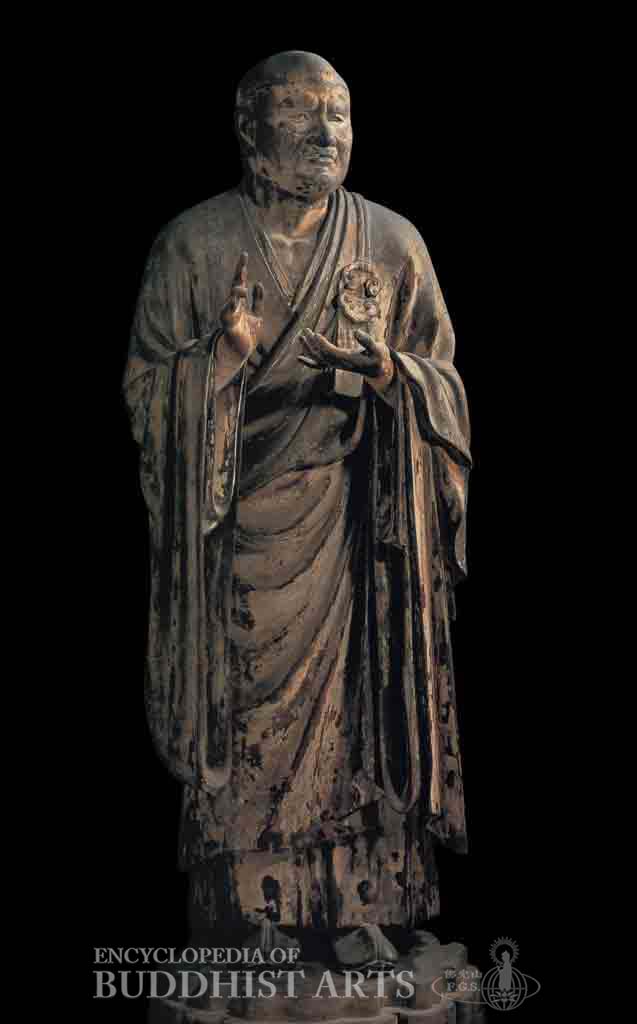
Kofukuji Temple North Octagonal Hall: Vasubandhu
Kofukuji Temple North Octagonal Hall: Asanga and Vasubandhu
JAPAN, Nara; Kamakura period
The figures stand on either side of a seated Maitreya Buddha in the hall. Asanga and Vasubandhu are the founding patriarchs of the Yogacara school in India, and are considered the early patriarchs of the Hosso school in Japan. According to the inscription on the base of the leading figure, the works were sculpted by the apprentices Unga and Unjo under the guidance of the great sculptor Unkei. They were listed as National Treasures in 1951.
The two figures lean toward Maitreya, with the foot nearest him slightly advanced. The face of Asanga is thin and peaceful, as of an old man who has endured hardship. The facial contour of Vasubandhu, on the other hand, is rounded, with knit eyebrows and eyes that stare ahead intently. The sturdy bodies are dressed in monastic robes buckled at the left shoulder. The long sleeves fall down the length of the body and are deeply carved. Asanga is holding up a sutra case, while the one formerly in Vasubandhu’s hand has been lost.
The bodies of the statues are assembled from four and six pieces of laurel wood respectively, while portions of their wrists were later attached by pieces of cypress wood. This combination of two different kinds of wood is characteristic of the early sculptors of the Kei school. The bodies are pigmented and have eyes inlaid with jade.
For more details, go to the Encyclopedia of Buddhist Arts: Sculpture G-M, page 547.
Cite this article:
author = Hsingyun and Youheng and Lovelock, Yann and Chou, Yuan and Huntington, Susan and Edson, Gary and Neather, Robert,
booktitle = {Encyclopedia of Buddhist Arts: Sculpture G-M},
pages = 547,
title = {{Kofukuji Temple North Octagonal Hall: Asanga and Vasubandhu}},
volume = 11,
year = {2016}}