
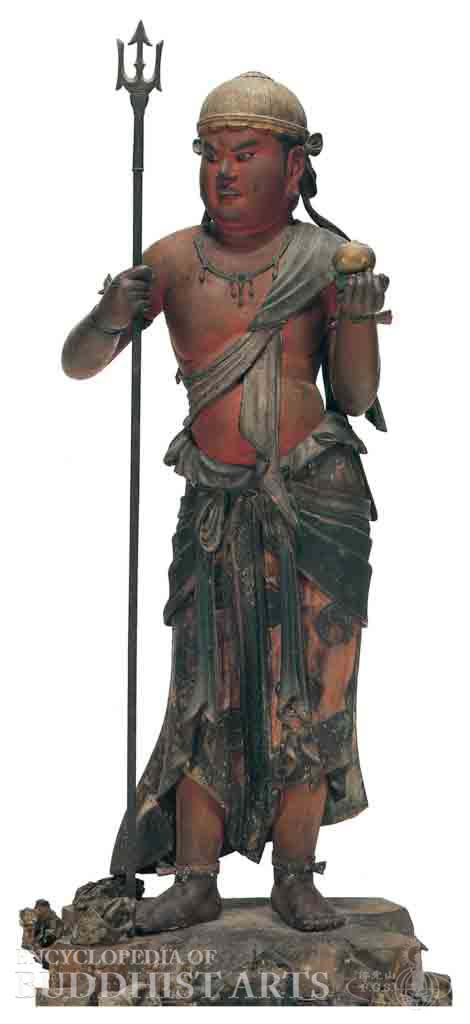
Eight Attendants - Eki by Unkei; Kamakura period
Cypress wood
Unkei
JAPAN, Kyoto; Heian to Kamakura period
Unkei was a Buddhist sculptor of the Kei school in Nara. The son of Kokei, he began learning the art of sculpting from his father during his teenage years and became one of his disciples. His oldest work is the seated Vairocana Buddha at Enjoji Temple in Nara, completed in 1176.
Works by Unkei include the wooden statues at Todaiji Temple in Nara, which he began in 1194. In the following year, he was granted the title of Hogen (Dharma Eye). Unkei then worked alongside his father in 1196 to create the Attendant Bodhisattvas and Four Heavenly Kings in the Golden Hall. A year or two later, he restored the Buddha statues of the lecture hall at Kyoogokokuji Temple in Kyoto, and sculpted Buddha statues for Jingoji Temple in Kyoto. He led his disciples in 1203 in the creation of the Narayana and Guhyapada on both sides of Todaiji Temple’s south gate; as a result of this accomplishment, his title was promoted to the level of Hoin (Dharma Seal).
Between 1208 and 1212, Unkei again worked with his disciples in the sculpting of the Maitreya Buddha, Asanga, Vasubandhu, and Four Heavenly Kings in the North Octagonal Hall at Kofukuji Temple in Nara.
The Buddha images sculpted by Unkei are characterized by stout bodies and a lively look. His style of carving is powerful and skillful and results in natural and flowing lines and folds. This form of heavy and powerful presentation became the mainstream ideal for sculptures created during the Kamakura period (1185–1333). Unkei is renowned as the patriarch of the Kamakura sculptors. His sons, Tankei, Koun, Koben, Kosho, Unga and Unjo succeeded his legacy.
Other prominent sculptures by Unkei include the Eight Attendants at Kongobuji Temple in Wakayama, six of which have survived to become National Treasures. In addition, and among his numerous other works, the statues of Brahma and Sakra that he created with his son Tankei are listed as Important Cultural Properties and are kept at Takisanji Temple in Aichi.
For more details, go to the Encyclopedia of Buddhist Arts: People, page 273.
Cite this article:
author = Hsingyun and Youheng and Youlu and Pokorski, Stefanie and Yichao and Mankuang and Miaohsi,
booktitle = {Encyclopedia of Buddhist Arts: People },
pages = 273,
title = {{Unkei}},
volume = 19,
year = {2016}}