
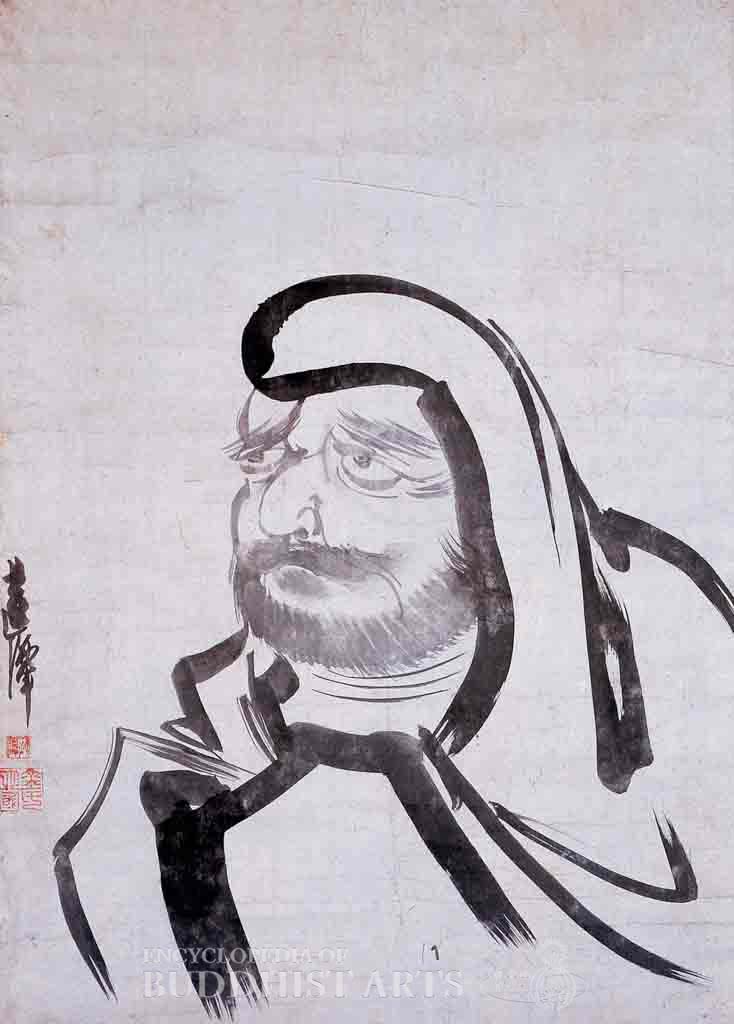
Bodhidharma
Ink on paper
Bodhidharma
KOREA; Joseon dynasty
This painting is an example of the Seon Buddhist paintings that became popular during the mid-Joseon dynasty. Considered to be Kim Myeongkuk’s masterpiece, it was painted in 1643 during his visit to Japan as a member of the fifth Korean court delegation. The artwork remained in Japan until it was acquired by the National Museum of Korea. Thick, forceful strokes are used to outline Bodhidharma’s hood and robe, symbolizing his unshakable concentration during meditation. He appears contemplative and wise, with thick eyebrows and drooping eyes. The individualistic nature of Kim’s artistic style is reflected in his Seon paintings. According to Nam Tae-eung, a prominent art critic of the mid-Joseon dynasty, Kim opened a new chapter in Korean Buddhist painting where formality is transcended through unrestrained strokes painted with a carefree spirit.
For more details, go to the Encyclopedia of Buddhist Arts: Painting A-H, page 111.
Cite this article:
author = Hsingyun and Youheng and Youlu and Wilson, Graham and Manho and Mankuang and Huntington, Susan,
booktitle = {Encyclopedia of Buddhist Arts: Painting A-H},
pages = 111,
title = {{Bodhidharma}},
volume = 14,
year = {2016}}