
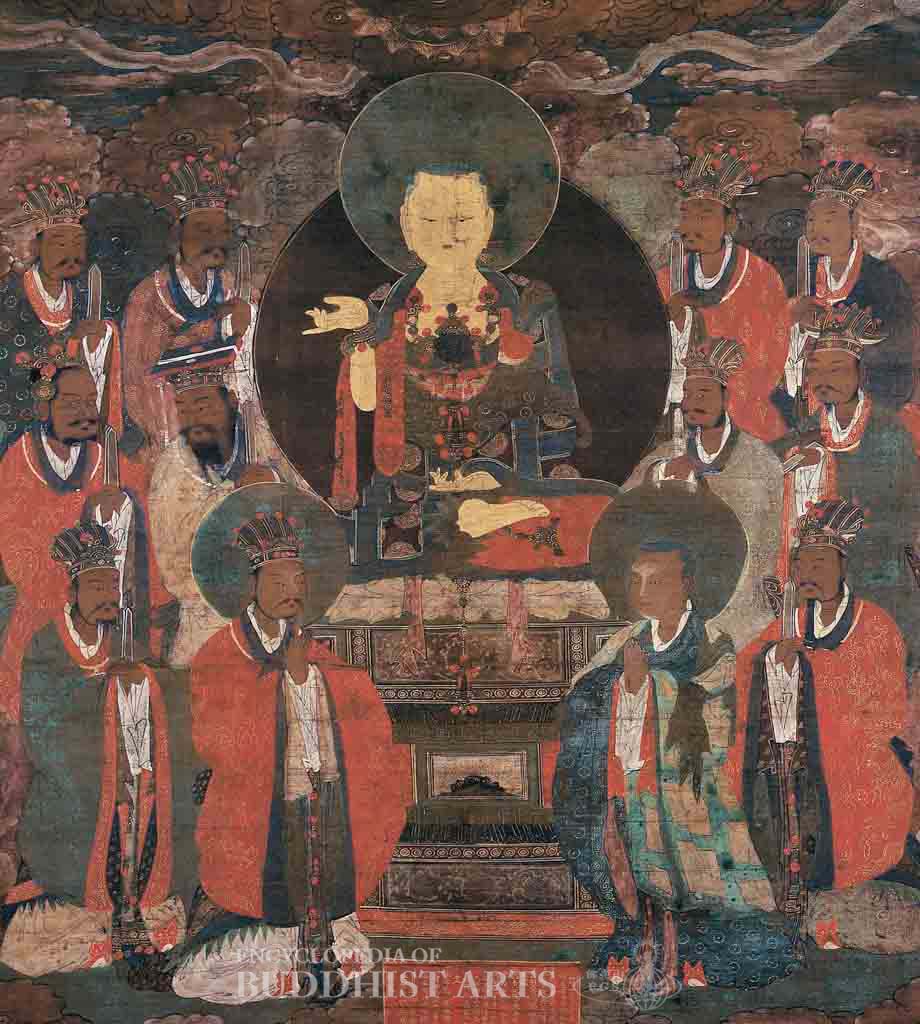
Ksitigarbha Bodhisattva and the Ten Kings of Hell
Ink and color on silk
Ksitigarbha Bodhisattva and the Ten Kings of Hell
KOREA; Joseon dynasty
An inscription within a cartouche at the bottom of this painting depicting Ksitigarbha Bodhisattva presiding over the Ten Kings of Hell dates it to 1562. According to the inscription, this painting was commissioned by Master Naam Pou as a dedication to the longevity of King Myeongjong (reigned 1546–1567) and his five consorts.
Ksitigarbha is seated in lotus position on a throne in the middle of the picture. The Bodhisattva has a bare head and a dark nimbus and aureole. A large ornament hangs in front of the chest. The two figures standing at the base of the throne are the monk Daoming and Poisonless Ghost King. The Ten Kings of Hell are depicted on either side of Ksitigarbha. The painting’s predominant earthy colors give a somewhat dark impression, making the bright gilded body of Ksitigarbha stand out. The patterns on the robes of the figures are unique to paintings commissioned by Korean royalty during the 16th century.
For more details, go to the Encyclopedia of Buddhist Arts: Painting I-O, page 461.
Cite this article:
author = Hsingyun and Youheng and Youlu and Wilson, Graham and Manho and Mankuang and Huntington, Susan,
booktitle = {Encyclopedia of Buddhist Arts: Painting I-O},
pages = 461,
title = {{Ksitigarbha Bodhisattva and the Ten Kings of Hell}},
volume = 15,
year = {2016}}