
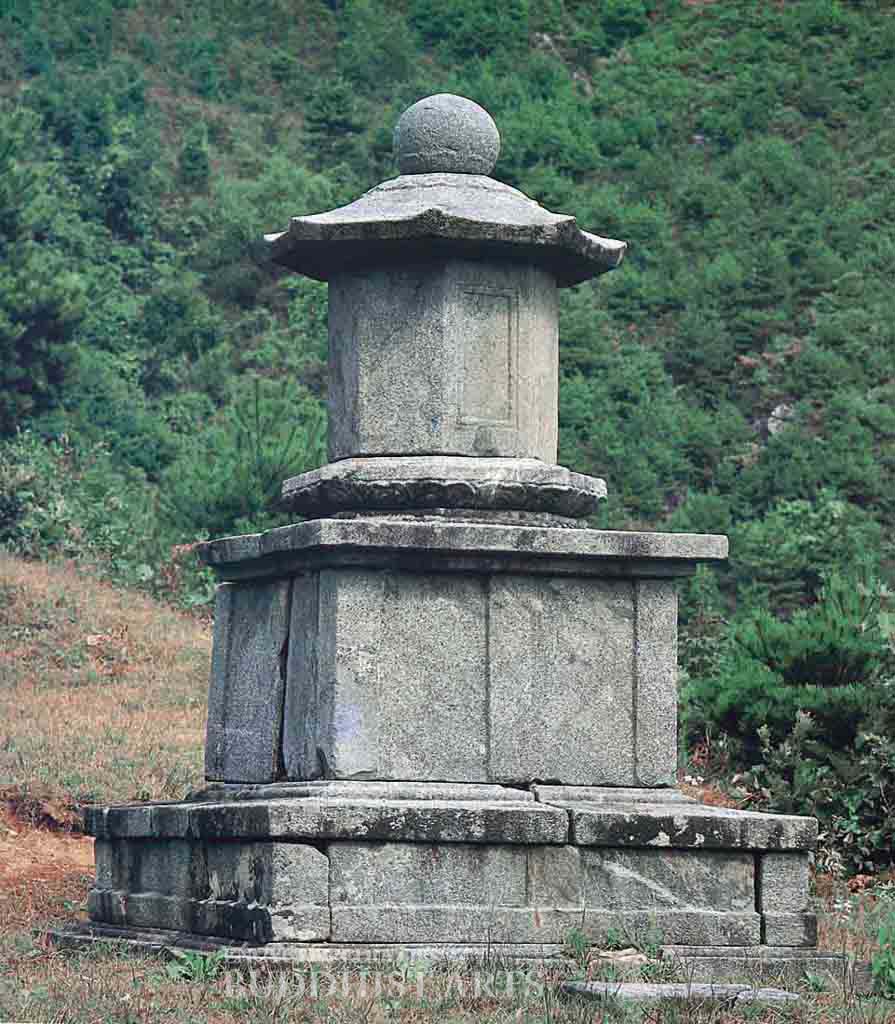
Jinjeonsa Temple Stupa
Jinjeonsa Temple Stupa
SOUTH KOREA, Gangwon, Yangyang
The stupa was built during the Unified Silla dynasty (668–935). It is said to be the memorial stupa of Seon (Chan) Master Doui and it is believed to be the first stone stupa built in the country. The stupa was listed as Treasure No. 439 in 1966.
The 3.2 m high granite stupa has a two-layer base. Both layers are square and are carved with central and corner pilasters. The base of the stupa body consists of an upright lotus. The octagonal body is unadorned, except for the depiction of a door carved on the front. The octagonal pyramidal roof curves upwards at the ridge ends. The finial consists of a jewel. Although the two-layer square base is similar to that of other stone stupas, the octagonal body is different.
Seon Master Myeongjeok Doui visited Tang dynasty China in 784 and received teachings on meditation from eminent Master Zhizang, who renamed him Doui or Path of Righteousness. He also studied under Master Baizhang. In 821 he returned to Silla to teach the Dharma according to the Southern school of Chan Buddhism. However, his teachings were not widely accepted at that time and he retired to Jinjeonsa Temple, where he had a number of disciples, including Master Yeomgeo, who passed the teachings to Master Chejing. Master Doui’s teachings eventually became the foundation for the Gajisan school, one of the Nine Mountain Seon schools of the Goryeo period.
For more details, go to the Encyclopedia of Buddhist Arts: Architecture G-L, page 533.
Cite this article:
author = Hsingyun and Youheng and Johnson, Peter and Mankuang and Lancaster, Lewis,
booktitle = {Encyclopedia of Buddhist Arts: Architecture G-L},
pages = 533,
title = {{Jinjeonsa Temple Stupa}},
volume = 2,
year = {2016}}