
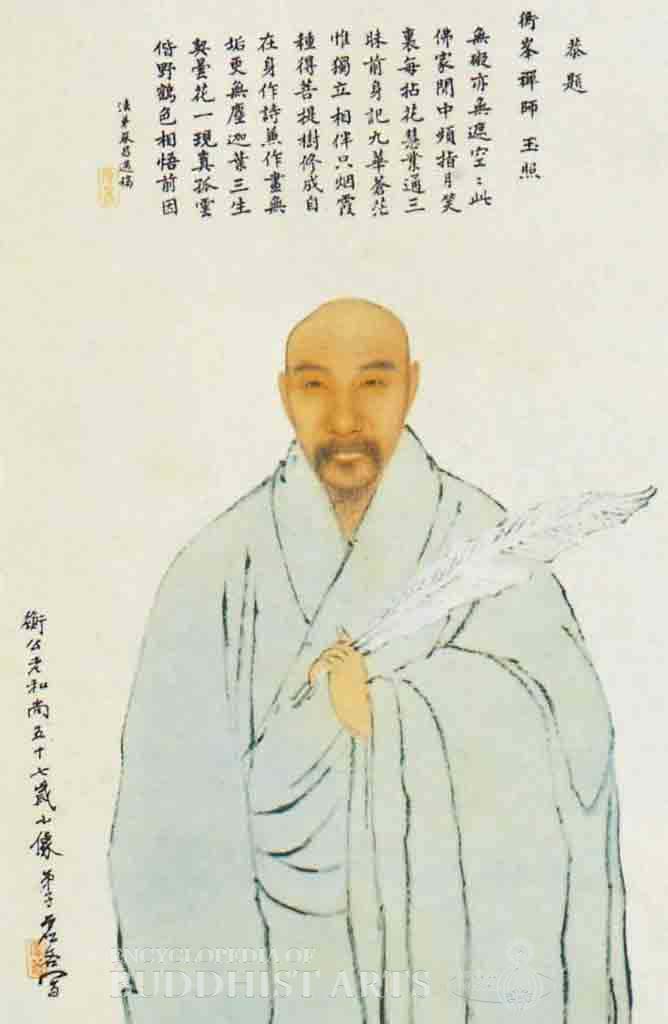
Master Hengfeng by Xugu; Qing dynasty
Ink and color on paper
Xugu
CHINA, Anhui, Huangshan; Qing dynasty
Xugu, originally named Zhu Huairen, was a monk, calligrapher, and painter from Shexian county in Huangshan. In his early years, he served as an army commander responsible for suppressing rebellions. Disillusioned by the persistent fights and plights of the defeated, he decided to become a monk. He traveled around Jiangsu, Zhejiang, and Anhui, and enjoyed calligraphy and painting.
He focused his artistic efforts on ruled-line architectural paintings before he shifted to depicting landscape, flowers, birds, fruits, and animals. Xugu deployed a technique using “broken brush” and “dry paint,” where the bristles of the brushes are purposely damaged and dipped into relatively dry paint. With clever use of colors and pale washes, he created compositions that convey the subject with a modern impressionistic touch. Aside from painting, Xugu was a skilled calligrapher and poet. He was adept in clerical, running, and cursive scripts, and his poems are compiled into Xugu Collection of Poems.
Xugu’s collection of artworks include Buddha’s Hands at the Tianjin Museum; Landscape, Flowers, and Amitabha Buddha at the Shanghai Museum; Cats and Butterflies at the Palace Museum in Beijing; and Pine Trees and Cranes and Master Hengfeng at the Suzhou Museum.
For more details, go to the Encyclopedia of Buddhist Arts: People, page 311.
Cite this article:
author = Hsingyun and Youheng and Youlu and Pokorski, Stefanie and Yichao and Mankuang and Miaohsi,
booktitle = {Encyclopedia of Buddhist Arts: People },
pages = 311,
title = {{Xugu}},
volume = 19,
year = {2016}}