
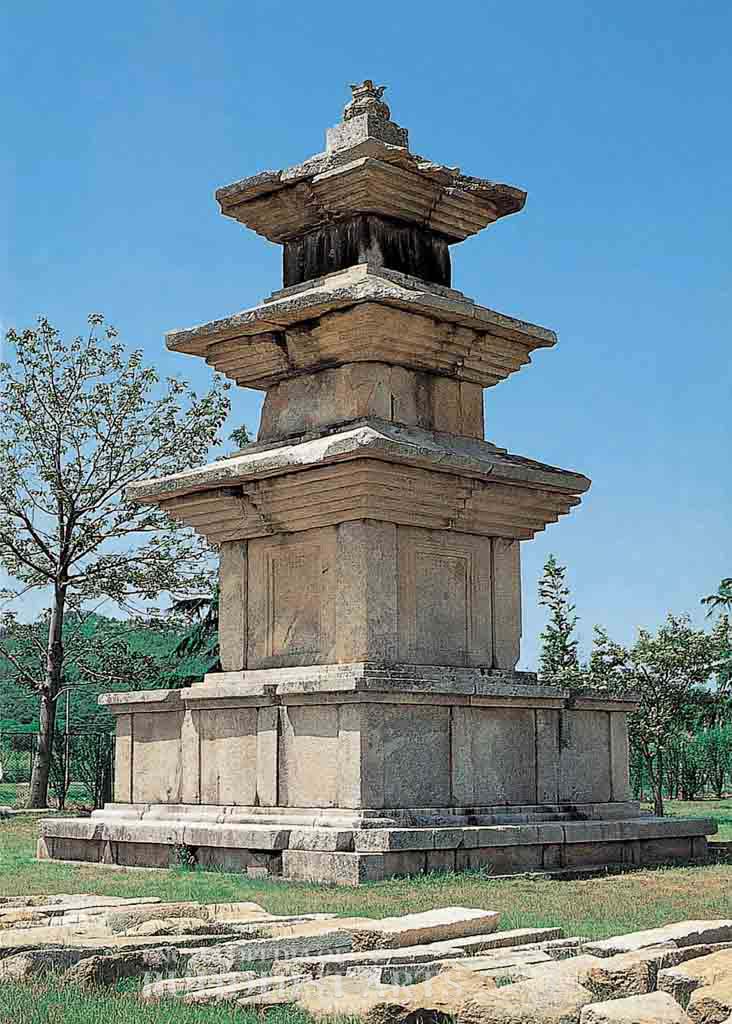
Goseonsa Temple Three-Tier Pagoda
Goseonsa Temple Three-Tier Pagoda
SOUTH KOREA, North Gyeongsang, Gyeongju
This pagoda, was originally situated at the site of Goseonsa Temple, but it is now located within the Gyeongju National Museum. The pagoda was built in the late 7th century during the early Unified Silla dynasty (668–935) by Master Wonhyo. It was listed as National Treasure No. 38 in 1962.
The pagoda is 9 m high and is made from granite. The pagoda base consists of two layers: a low base platform made of stone slabs; and a higher upper base made of twelve stone slabs with square pillars at the corners and two intermediate pillars on each side. The first level of the pagoda body is supported by square corner pillars with a stone slab placed in between them. On all four sides there are imitation doors with nail holes just visible, suggesting that they may have been decorated. The second level is made up of four stone blocks, while the third level consists of a single stone block. Each eave is composed of eight stone slabs while the corbeling is made of four blocks of stone. The spire, which is still in good condition, consists of a harmika, an inverted bowl, and an upright lotus.
For more details, go to the Encyclopedia of Buddhist Arts: Architecture G-L, page 381.
Cite this article:
author = Hsingyun and Youheng and Johnson, Peter and Mankuang and Lancaster, Lewis,
booktitle = {Encyclopedia of Buddhist Arts: Architecture G-L},
pages = 381,
title = {{Goseonsa Temple Three-Tier Pagoda}},
volume = 2,
year = {2016}}