
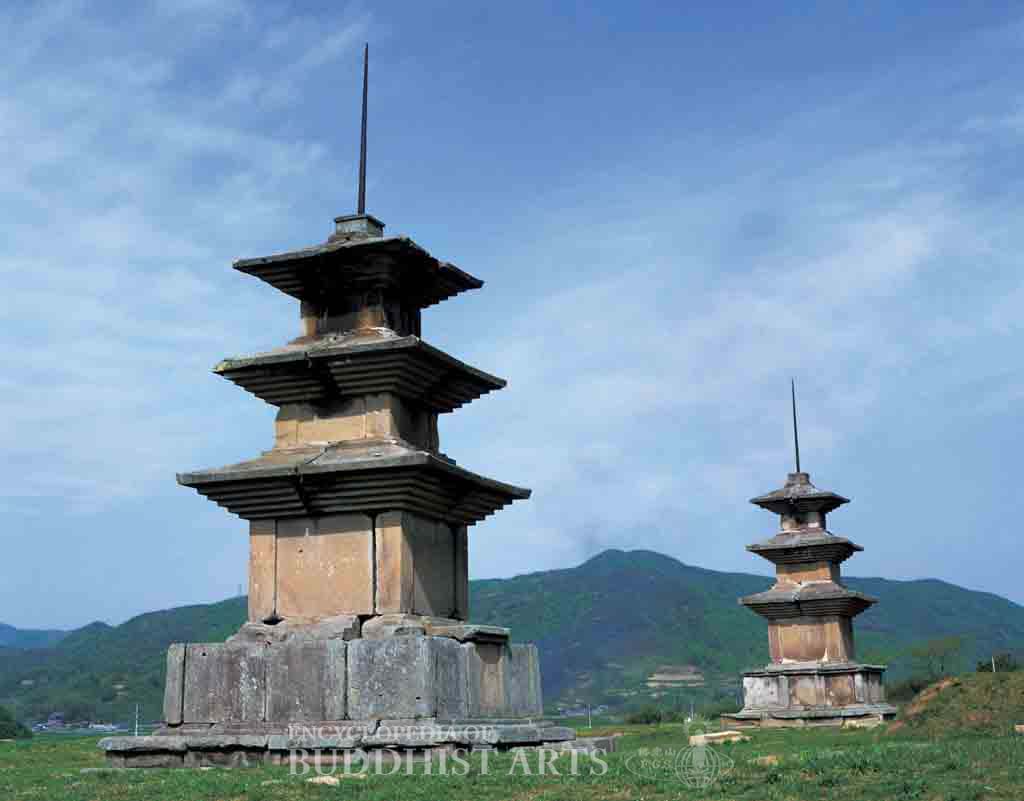
Gameunsa Temple Twin Pagodas
Gameunsa Temple Twin Pagodas
SOUTH KOREA, North Gyeongsang, Gyeongju
This pair of pagodas is located at Gameunsa (Temple of Gratitude). They are the largest among various pairs of pagodas in Gyeongju. Construction of Gameunsa Temple was begun by King Munmu (reigned 661–680) and completed by his son King Shinmun (reigned 681–691) in 682. The twin pagodas are believed to have been constructed during the Unified Silla dynasty (668–935). They were listed as National Treasure No. 112 in 1962.
The twin pagodas are identical in scale: both are 13.4 m high and have a square plan. Each base of the pagodas stands on a low base platform. The pagoda bases have square pillars at the corners, as well as pillars in between. On each level of the pagoda body there are pillars at the corners. Under each eave there are five layers of corbeling. All that remains of the spires is a square harmika and a 5 m high unadorned pole.
During the renovation work on the west pagoda in 1960, some treasures were found dating back to the time when the pagodas were first built. These treasures included a gilt copper alloy reliquary and images of the Four Heavenly Kings. A gilt copper alloy reliquary pagoda was also found in the east pagoda in 1997. All these treasures are currently in the collection of the National Museum of Korea in Seoul. These two pagodas are shaped in the style of the Unified Silla dynasty, a style developed from the fusion of Baekje dynasty (18 BCE–663 CE) wooden pagodas and Silla dynasty (57 BCE–935 CE) brick pagodas.
For more details, go to the Encyclopedia of Buddhist Arts: Architecture G-L, page 352.
Cite this article:
author = Hsingyun and Youheng and Johnson, Peter and Mankuang and Lancaster, Lewis,
booktitle = {Encyclopedia of Buddhist Arts: Architecture G-L},
pages = 352,
title = {{Gameunsa Temple Twin Pagodas}},
volume = 2,
year = {2016}}