
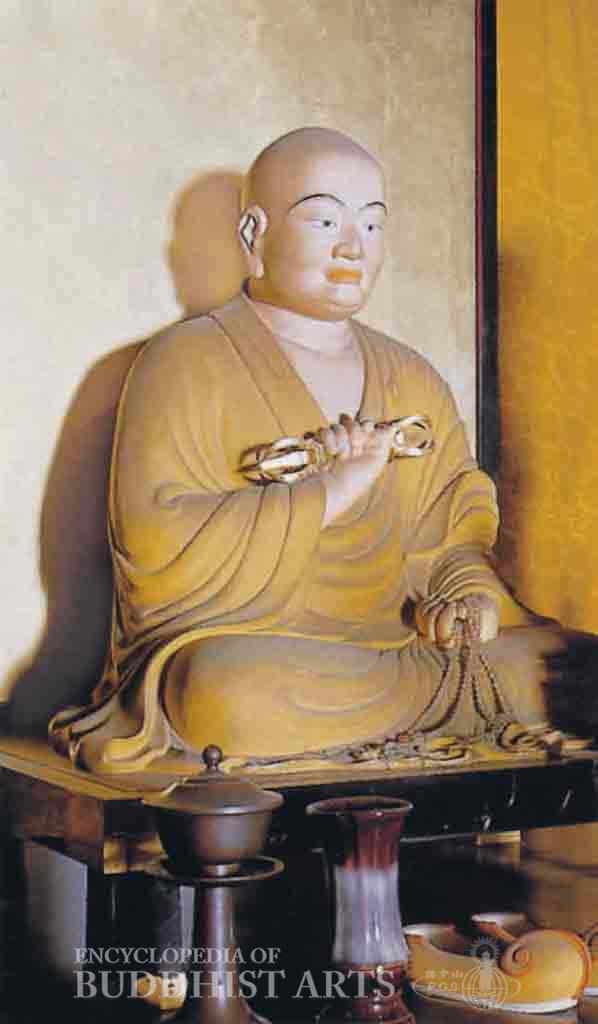
Huiguo; 20th century
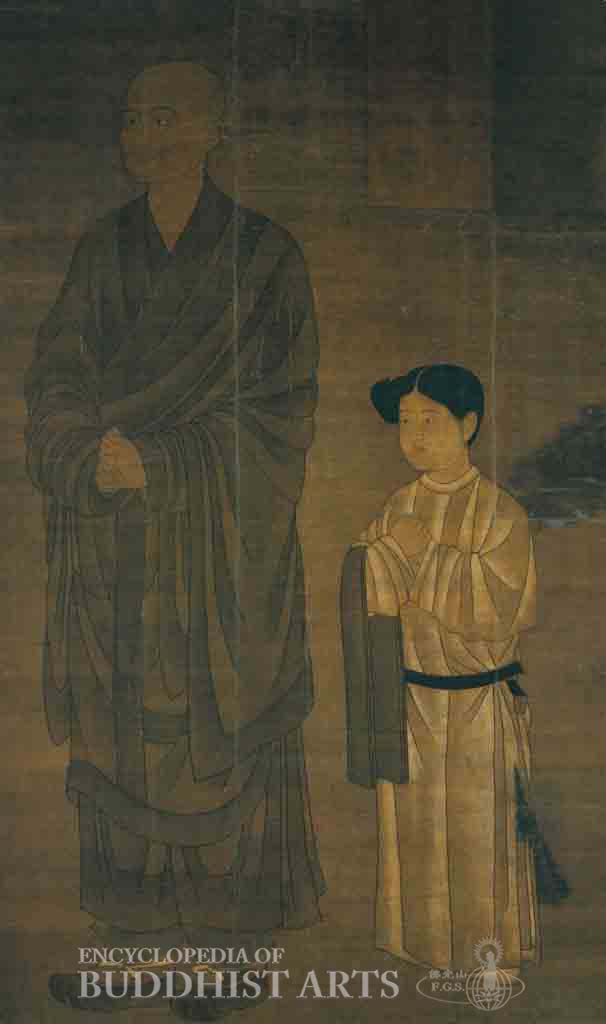
Master Huiguo; Kamakura period
Ink and color on silk
Huiguo
CHINA, Shaanxi, Xi'an; Tang dynasty
Huiguo, whose original family name was Ma, was a Vajrayana Buddhist monk born in Zhaoyin, Jingzhaofu (present day Lintong county in Xi’an). He renounced under Master Tanchen at the age of nine, and at age twenty, he was fully initiated into the Vajrayana order under Master Amoghavajra. After he succeeded his teacher, he stayed at Qinglong Temple in Shaanxi, educating monastics and lay disciples from all over the world. Greatly respected by emperors of the Tang dynasty (618–907) for his dedication and abilities, Master Huiguo is often considered the second most influential person, after Master Amoghavajra, in propagating the teachings of Vajrayana Buddhism.
An adept painter, Huiguo created a variety of mandalas, most notably concentrating on interpretations of both the Diamond Realm Mandala and the Womb Realm Mandala. He is also known to have instructed Li Zhen and other well-known painters to illustrate several mandalas within the grounds of Qinglong Temple.
Huiguo personally transmitted the teachings of Vajrayana Buddhism to the famous Japanese Master Kukai. Upon Kukai’s arrival in China, Huiguo is said to have commissioned the painting of 11 mandalas, the scripting of various sutras, and the creation of a variety of Dharma instruments, all to give as gifts to Kukai. According to Huiguo’s instructions, Kukai later disseminated the Vajrayana teachings in Japan, and subsequently became the founding patriarch of the Shingon school of Japanese Buddhism. Huiguo’s influence was vast, and although he never went to Japan himself, he is regarded as one of the eight patriarchs of the Shingon school.
For more details, go to the Encyclopedia of Buddhist Arts: People, page 105.
Cite this article:
author = Hsingyun and Youheng and Youlu and Pokorski, Stefanie and Yichao and Mankuang and Miaohsi,
booktitle = {Encyclopedia of Buddhist Arts: People },
pages = 105,
title = {{Huiguo}},
volume = 19,
year = {2016}}