
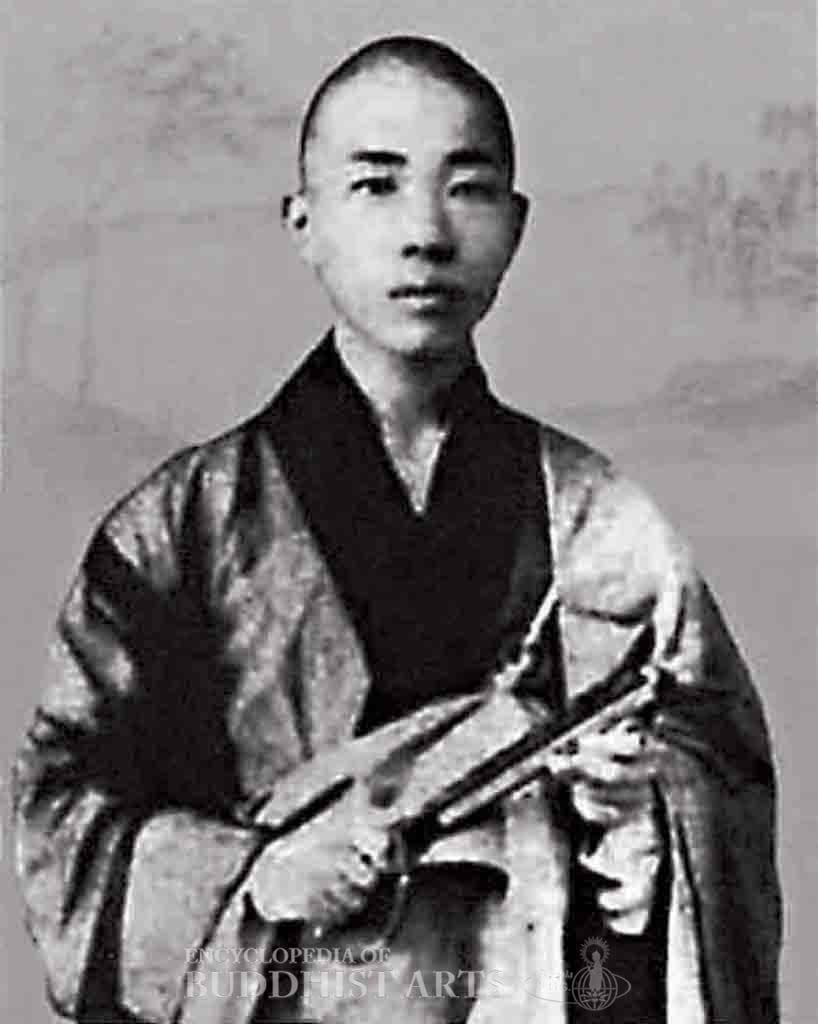
Su Manshu
Su Manshu
JAPAN, Kanagawa, Yokohama
Su Manshu was a monk and artist whose ancestors were from Zhongshan, Guangdong in China but born in Yokohama, Japan with a birth name of Su Jian. After renunciation, he took the Dharma name Bojing. Su showed a strong affinity for Buddhism at a very early age, and by age 4, he began painting pictures of Buddhist monks. He entered Changshou Temple in Guangdong at the age of 12 as a novice, later fully ordained. Su studied the Caodong school of Chan Buddhism and became one of the school’s succeeding masters. Although he left China to study in Japan at the age of 15, Su was a deeply patriotic Chinese citizen who loved his country and strongly believed in democracy. He followed Sun Yat-Sen, a revolutionist, to fight for the democracy of China.
Su was adept in writing poems and novels and painting. He was also proficient in several languages including English, Japanese, French, and Sanskrit, and had worked as a translator on a variety of projects such as the translation of the famous French book, Les Miserables. Aside from translation work, he authored many books including Relationship with Literature, Three Hundred Untitled Poems, Burning Sword, Falling Veils, and the Complete Works of Su Manshu, and edited several others such as Dictionary of Sanskrit, Siddham Alphabet, Examining Ancient Egyptian Teachings, and English-Chinese Dictionary.
Su’s artistic style is unique and uninhibited by traditions. Many people have described his painting style as unorthodox. The majority of his compositions are paintings of monks in deep meditation or revolutionary monks, all appended with beautifully poetic inscriptions.
For more details, go to the Encyclopedia of Buddhist Arts: People, page 246.
Cite this article:
author = Hsingyun and Youheng and Youlu and Pokorski, Stefanie and Yichao and Mankuang and Miaohsi,
booktitle = {Encyclopedia of Buddhist Arts: People },
pages = 246,
title = {{Su Manshu}},
volume = 19,
year = {2016}}