
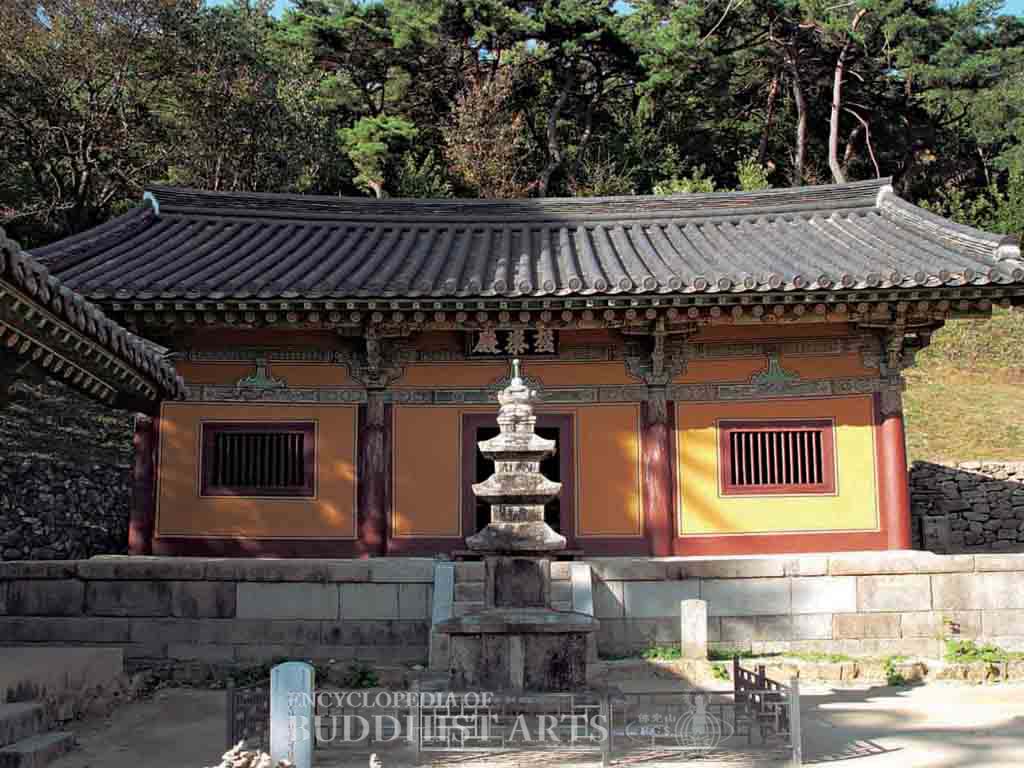
Bongjeongsa Temple Ultimate Bliss Hall
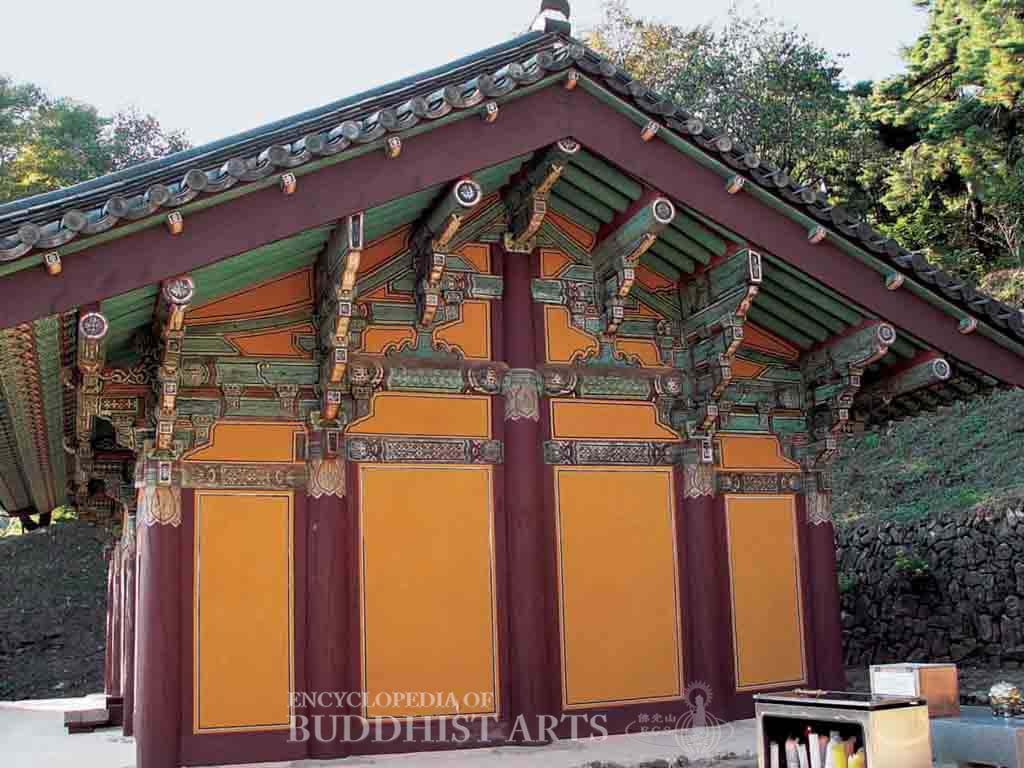
Bongjeongsa Temple Ultimate Bliss Hall
Bongjeongsa Temple Ultimate Bliss Hall
SOUTH KOREA, North Gyeongsang, Andong
The hall is reputed to be one of the oldest wooden structures in Korea. According to the records found during its reconstruction in 1972, this building was repaired in 1363 during the Goryeo dynasty and again in 1625 during the Joseon dynasty. As most wooden structures are repaired between 100 and 150 years after they were built, this hall is estimated to have been built between the 12th and 13th centuries. It was listed as National Treasure No. 15 in 1962.
The three-by-four bay hall has an overhanging gable roof. At the front and rear the column-head bracket system is used: the bracket sets rest only on column capitals with no intermediate bracket sets. At the sides there are additional bracket sets on either side of the central column. The hall contains an Amitabha Buddha statue with a colorful painting at the back, depicting the Western Pure Land. Although the building was constructed during the Goryeo dynasty (918–1392), it is representative of the architectural style of the Unified Silla dynasty (668–935).
For more details, go to the Encyclopedia of Buddhist Arts: Architecture A-F, page 90.
Cite this article:
author = Hsingyun and Youheng and Johnson, Peter and Mankuang and Lancaster, Lewis,
booktitle = {Encyclopedia of Buddhist Arts: Architecture A-F},
pages = 90,
title = {{Bongjeongsa Temple Ultimate Bliss Hall}},
volume = 1,
year = {2016}}