
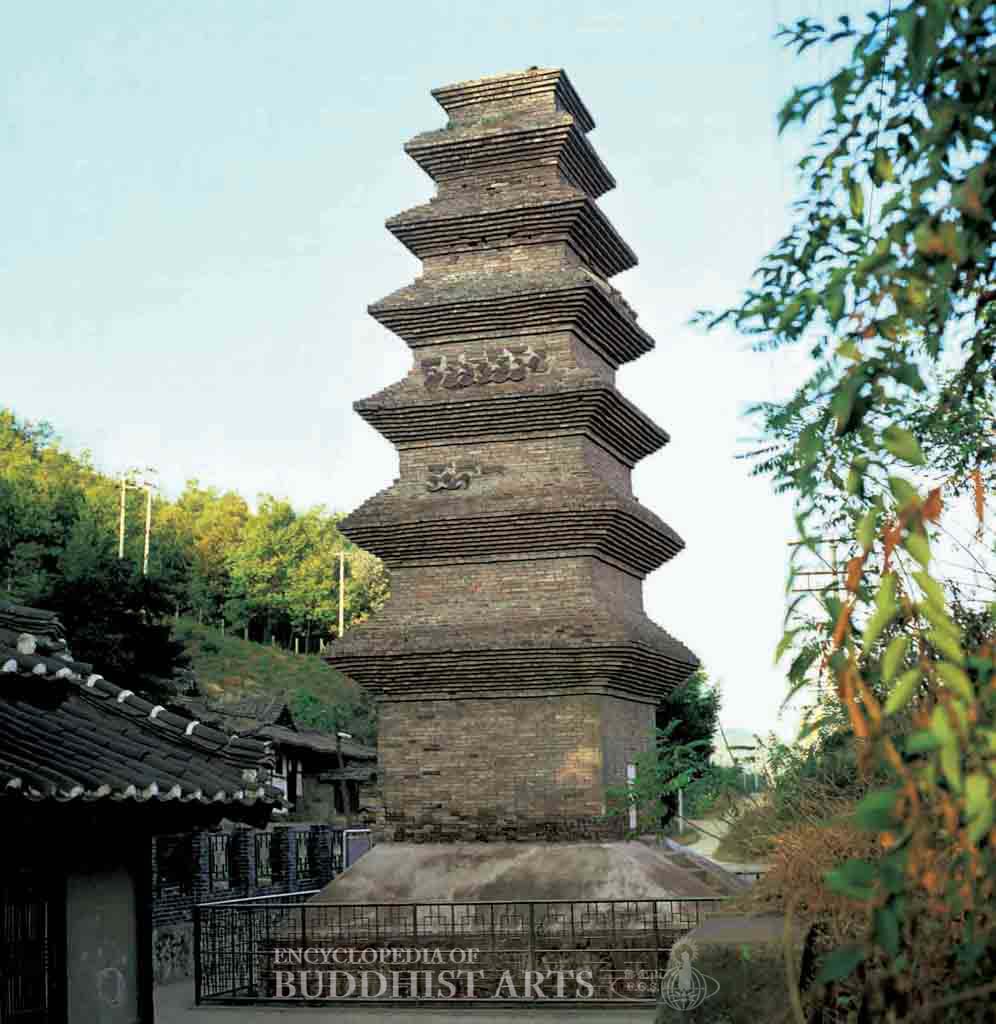
Sinsedong Seven-Tier Pagoda
Sinsedong Seven-Tier Pagoda
SOUTH KOREA, North Gyeongsang, Andong
The pagoda is situated in Sinsedong on the outskirts of Andong. It is the oldest and tallest brick pagoda in South Korea. Built during the Unified Silla dynasty (668–935), it was originally located within Beopheungsa Temple, which no longer exists. According to a historical record from the Andong area, there were only three structures left at Beopheungsa when this pagoda was repaired in 1487 during the Joseon dynasty. The pagoda was listed as National Treasure No. 16 in 1962.
This brick pagoda has a 7.8 m square base and stands 17 m high. The base has carvings of the Eight Classes of Dharma Protectors and the Four Heavenly Kings. Based on its dimensions and craftsmanship, the base could originally have belonged to another stone pagoda. Unlike most stone pagodas, the upper part of the base has a trapezoidal shape and is made of cement, which results from a later modification. In the center of the south side there are a few steps leading up to the door of the chamber on the first tier. The height of the second tier is just a quarter of that of the first tier, and the height of subsequent tier decreases slowly. The eaves are supported by corbeling and imitate those of a wooden pagoda. Only the base of the spire remains.
For more details, go to the Encyclopedia of Buddhist Arts: Architecture M-S, page 1031.
Cite this article:
author = Hsingyun and Youheng and Johnson, Peter and Mankuang and Lancaster, Lewis,
booktitle = {Encyclopedia of Buddhist Arts: Architecture M-S},
pages = 1031,
title = {{Sinsedong Seven-Tier Pagoda}},
volume = 3,
year = {2016}}