
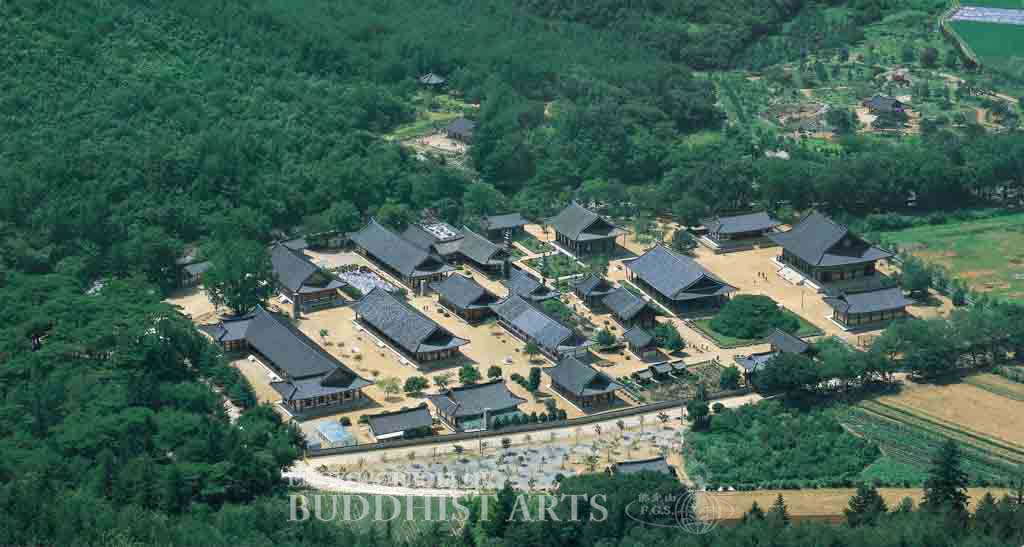
Unmunsa Temple
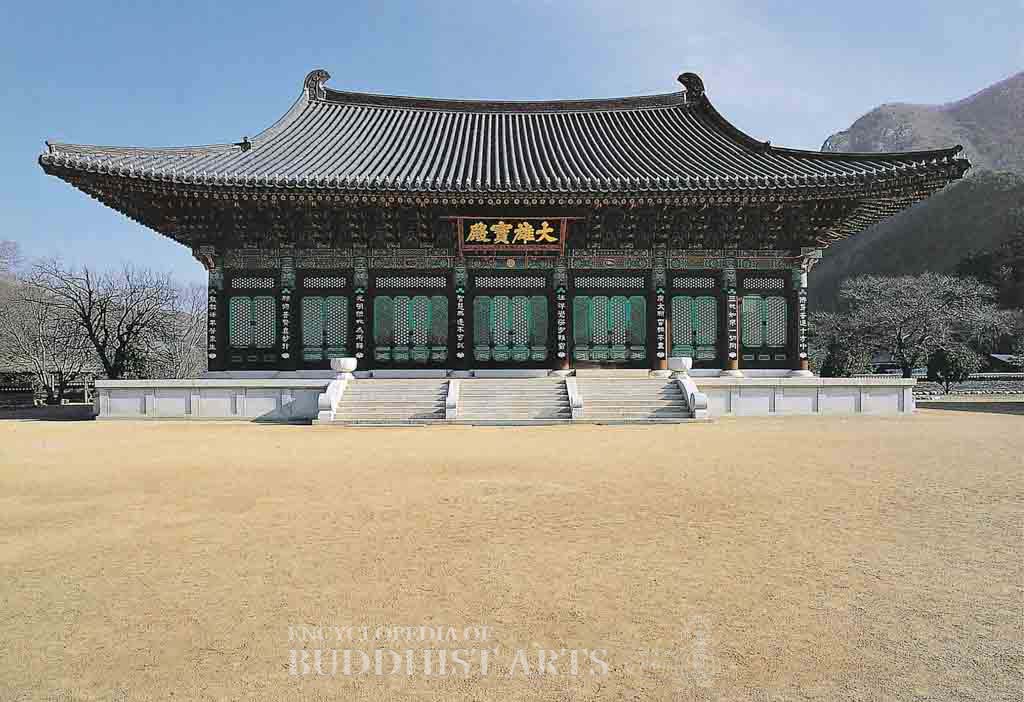
Unmunsa Temple: Great Hero Hall
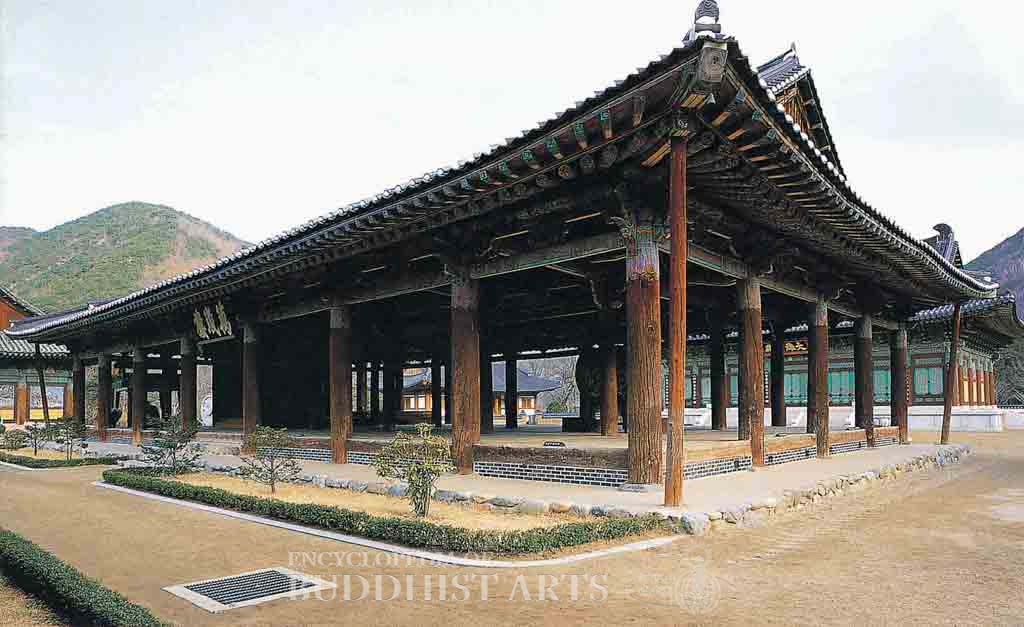
Unmunsa Temple: Hall of Ten Thousand Years
Unmunsa Temple
SOUTH KOREA, North Gyeongsang, Cheongdo
Unmunsa means Cloud Gate Temple, and is located on Hogeosan (Tiger Mountain). It is a branch temple of Donghwasa Temple, the Head Temple for the 9th district of the Jogye order of Korean Seon Buddhism. Unmunsa Temple was built in 560 during the Silla dynasty and has undergone repair and reconstruction at various times. In 1958, Master Geumgwang became the first abbess of the temple and established a school for Buddhist nuns, later renamed Unmun Sangha College. The temple is currently the largest training center for the Female Monastic Order in Korea.
The temple occupies 400 ha and consists of 33 buildings. The major structures include the Great Hero Hall, Vairocana Hall, Five Hundred Hall, Avalokitesvara Hall, Magpie Valley Hall, Judgment Hall, bell tower, and Hall of Ten Thousand Years.
The seven-by-five bay Great Hero Hall is now the main hall and has a single-eave hip-and-gable roof. There are unique paintings depicting the life of monks on the exterior walls of the hall. The three-by-three bay Vairocana Hall with a single-eave hip-and-gable roof was formerly the main hall and is the oldest building. It was built in 1105 during the Goryeo dynasty and was rebuilt in 1653 during the Joseon dynasty. The central bay is wider than normal and it has five doors instead of four. The exterior walls are decorated with paintings of the Eight Great Events from the Life of the Buddha. The hall houses a statue of Vairocana Buddha. The rear wall is painted with the Trikaya: the Three Bodies of the Buddha. Its intricately patterned caisson ceiling is supported by beautifully carved bracket sets. With its exquisite craftsmanship, the hall was listed as Treasure No. 835 in 1985. The Hall of Ten Thousand Years, with an area of over 7,000 sq m, was originally the lecture hall of National Master Woneung.
There are six other state-recognized treasures at Unmunsa Temple: a three-story stone pagoda, a stele for National Master Woneung, stone pillars of the Four Heavenly Kings, a seated stone Buddha statue, and a bronze jar. Within the temple grounds there are also two weeping red pine trees that are more than 500 years old.
For more details, go to the Encyclopedia of Buddhist Arts: Architecture T-Z, page 1161.
Cite this article:
author = Hsingyun and Youheng and Johnson, Peter and Mankuang and Lancaster, Lewis,
booktitle = {Encyclopedia of Buddhist Arts: Architecture T-Z},
pages = 1161,
title = {{Unmunsa Temple}},
volume = 4,
year = {2016}}