
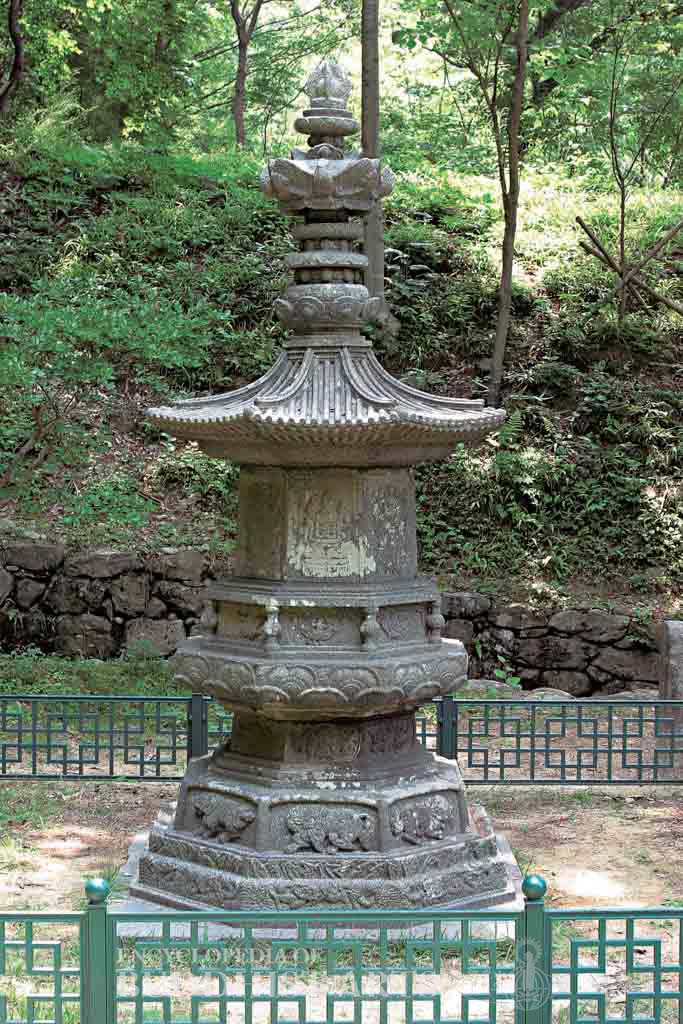
Yeongoksa Temple East and North Stupas – East Stupa
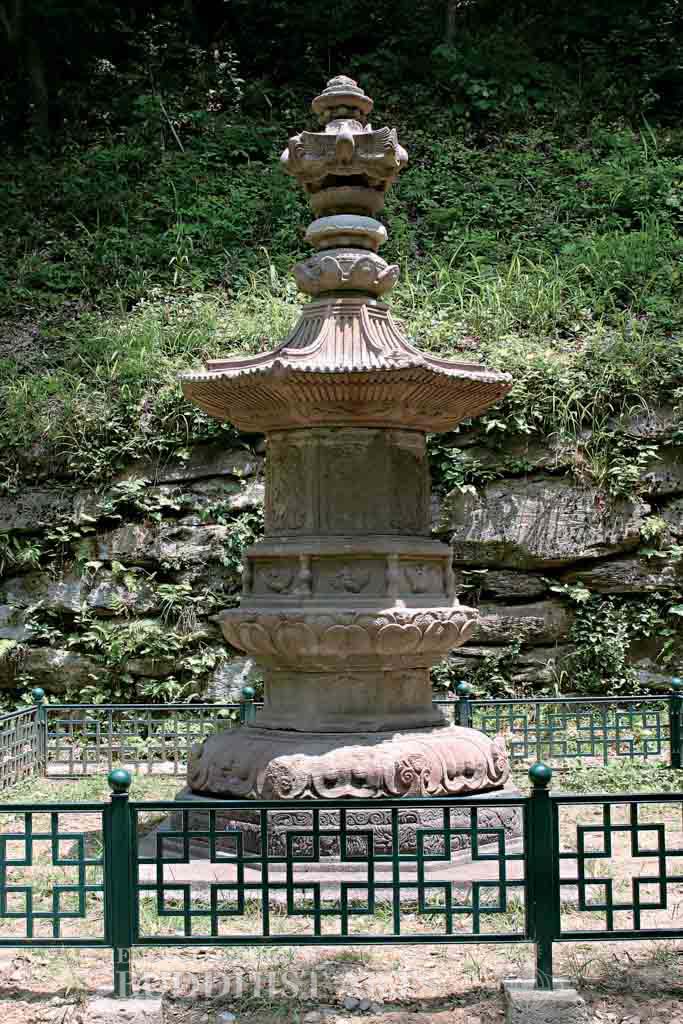
Yeongoksa Temple East and North Stupas – North Stupa
Yeongoksa Temple East and North Stupas
SOUTH KOREA, South Jeolla, Gurye
These two stupas serve to house the relics of eminent monks. The two exquisitely sculpted stupas are considered masterpieces of Korean funerary stupas. The east stupa and the north stupa were built in the late Unified Silla dynasty (668–935) and the early Goryeo dynasty (918–1392), respectively, and they were listed as National Treasures No. 53 and No. 54 in 1962.
Both stupas are 3 m high and are made of granite. The octagonal east stupa stands on a square base platform supporting a three-layer base. The lower layer consists of two sections, which are carved with dragons shrouded in clouds at the bottom and lions at the top. The short indented middle layer is carved with ogee arched doors and the Eight Classes of Dharma Protectors. The two-section upper layer is carved with multi-petal lotuses on the lower section and pilasters in the upper section. In between the pilasters there are panels, each containing a kalavinka, a creature with a human head and a bird’s body. On each side of the stupa body there is a panel carved with either an incense burner or one of the Four Heavenly Kings. The octagonal pyramidal roof turns upwards at the edges and is covered in corrugated tiles. Beneath the roof there are two sets of eaves. The spire includes an upright lotus, an inverted lotus, stacked rings, and a canopy carved in the shape of a phoenix with wings spread. This stupa is believed to house the relics of National Master Doseon.
The octagonal north stupa, an imitation of the east stupa, stands on a similar base formed of three layers. Except for the lower layer which has carvings of clouds under inverted lotuses supporting the middle layer, the other two layers are the same as those of the east stupa. The stupa body and spire are similar in design to those of the east stupa, except for the eaves which have depictions of apsaras.
For more details, go to the Encyclopedia of Buddhist Arts: Architecture T-Z, page 1350.
Cite this article:
author = Hsingyun and Youheng and Johnson, Peter and Mankuang and Lancaster, Lewis,
booktitle = {Encyclopedia of Buddhist Arts: Architecture T-Z},
pages = 1350,
title = {{Yeongoksa Temple East and North Stupas}},
volume = 4,
year = {2016}}