
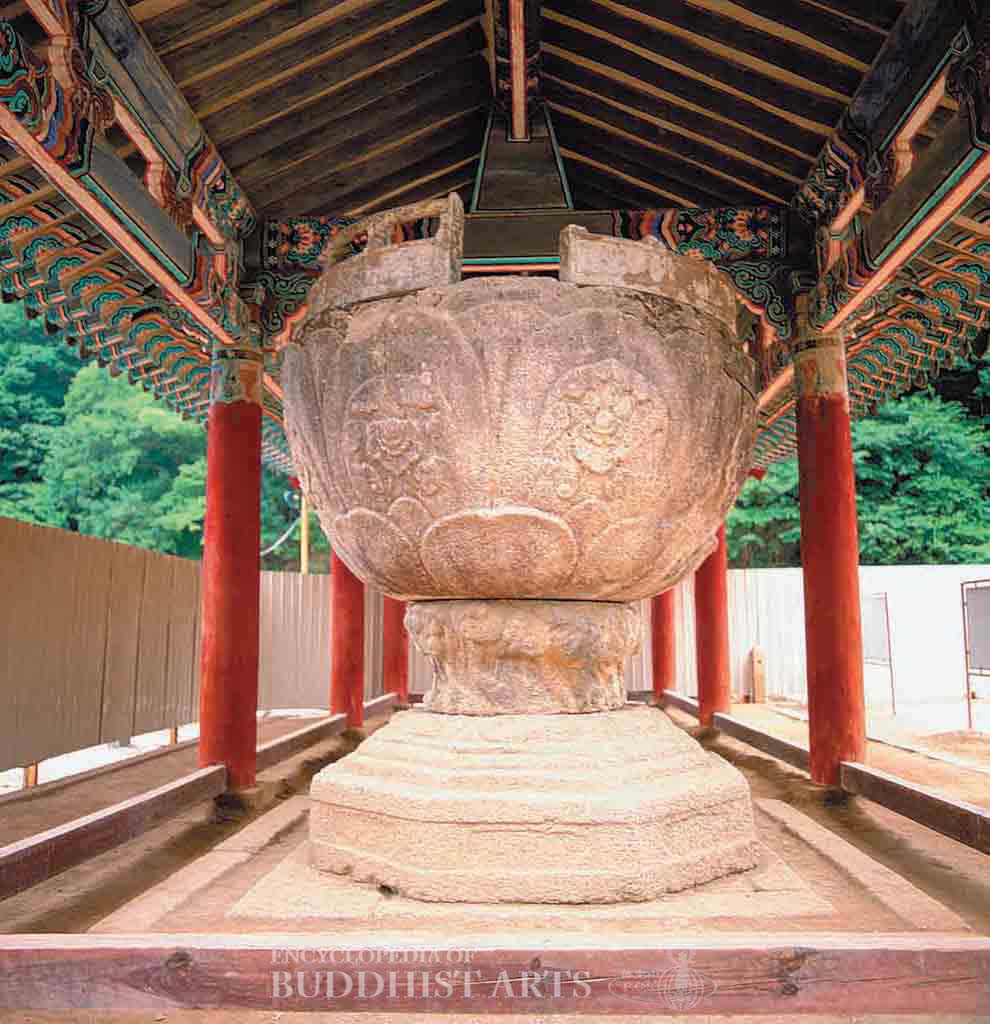
Beopjusa Temple Stone Basin
Beopjusa Temple Stone Basin
SOUTH KOREA, North Chungcheong, Boeun
The stone basin is located within Beopjusa (Residence of the Dharma Temple). It is a miniature version of a lotus pond and is the only one of its kind in the country. Made in the 8th century during the Unified Silla dynasty (668–935), the basin contains lotuses which are used as offerings to the Buddhas and Bodhisattvas. It was listed as National Treasure No. 64 in 1962.
The lotus basin, which is made from granite, has a height of 1.9 m and a circumference of 6.7 m. It has an octagonal three-layer base carved with shallow counter-reliefs on the bottom layer and inverted lotuses at the top of the middle layer. The third layer is carved with images of clouds. There are reliefs of large upright lotuses on the surface of the basin, with floral patterns within the lotus petals. Surrounding the rim there are miniature balustrades exquisitely carved with images of Bodhisattvas and heavenly beings. The basin represents the Western Pure Land with beings born from lotuses. The basin is shaped like a half-opened lotus bud.
For more details, go to the Encyclopedia of Buddhist Arts: Architecture A-F, page 73.
Cite this article:
author = Hsingyun and Youheng and Johnson, Peter and Mankuang and Lancaster, Lewis,
booktitle = {Encyclopedia of Buddhist Arts: Architecture A-F},
pages = 73,
title = {{Beopjusa Temple Stone Basin}},
volume = 1,
year = {2016}}