
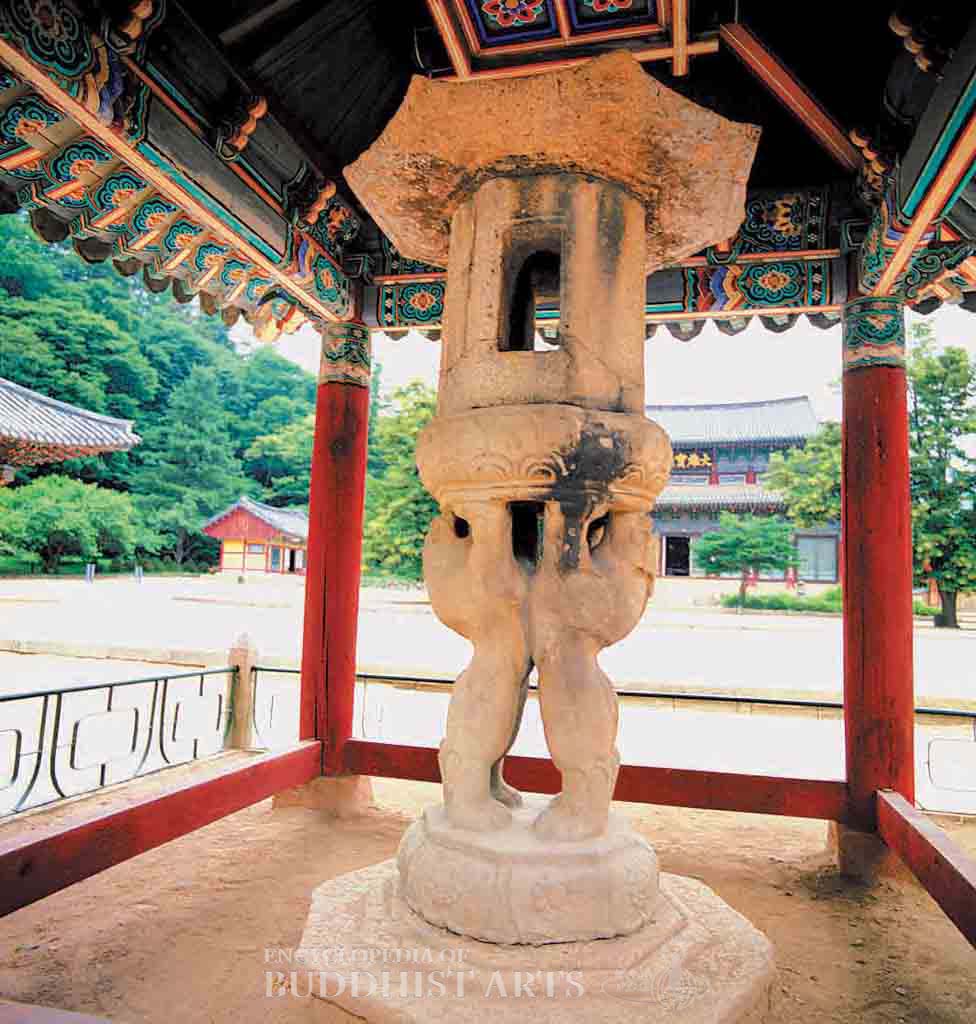
Beopjusa Temple Stone Lantern
Beopjusa Temple Stone Lantern
SOUTH KOREA, North Chungcheong, Boeun
The lantern is located between the Great Hero Hall and the Hall of Eight Pictures at Beopjusa Temple. Stone lanterns represent the light of the Buddha and therefore are also known as Light Lanterns. They are usually placed in front of an important structure, such as a main hall or a pagoda. Built in 720 during the Unified Silla dynasty, this lantern is the oldest existing structure of the temple. It was listed as National Treasure No. 5 in 1962.
The stone lantern is sculpted from granite and is 3.3 m high. It stands on an octagonal base platform, upon which there is a pedestal adorned with inverted lotus patterns. The stone pillars are in the form of two lions facing each other and standing on their hind legs. The lions are carved realistically, with their front paws and mouths, one open and one closed, supporting the lotus-shaped base of the body. The lantern body is octagonal and has four openings to let the light out. The octagonal roof curves upwards and the spire consists of a jewel. The entire lantern, except for the base platform and the roof, is carved from a single stone.
The lion is one of the most common Buddhist symbols and is used in many Buddhist structures. This use of two lions to support the lantern body constitutes an important creative development in contrast to the usual plain octagonal pillars of stone lanterns of the Unified Silla dynasty (668–935).
For more details, go to the Encyclopedia of Buddhist Arts: Architecture A-F, page 73.
Cite this article:
author = Hsingyun and Youheng and Johnson, Peter and Mankuang and Lancaster, Lewis,
booktitle = {Encyclopedia of Buddhist Arts: Architecture A-F},
pages = 73,
title = {{Beopjusa Temple Stone Lantern}},
volume = 1,
year = {2016}}