
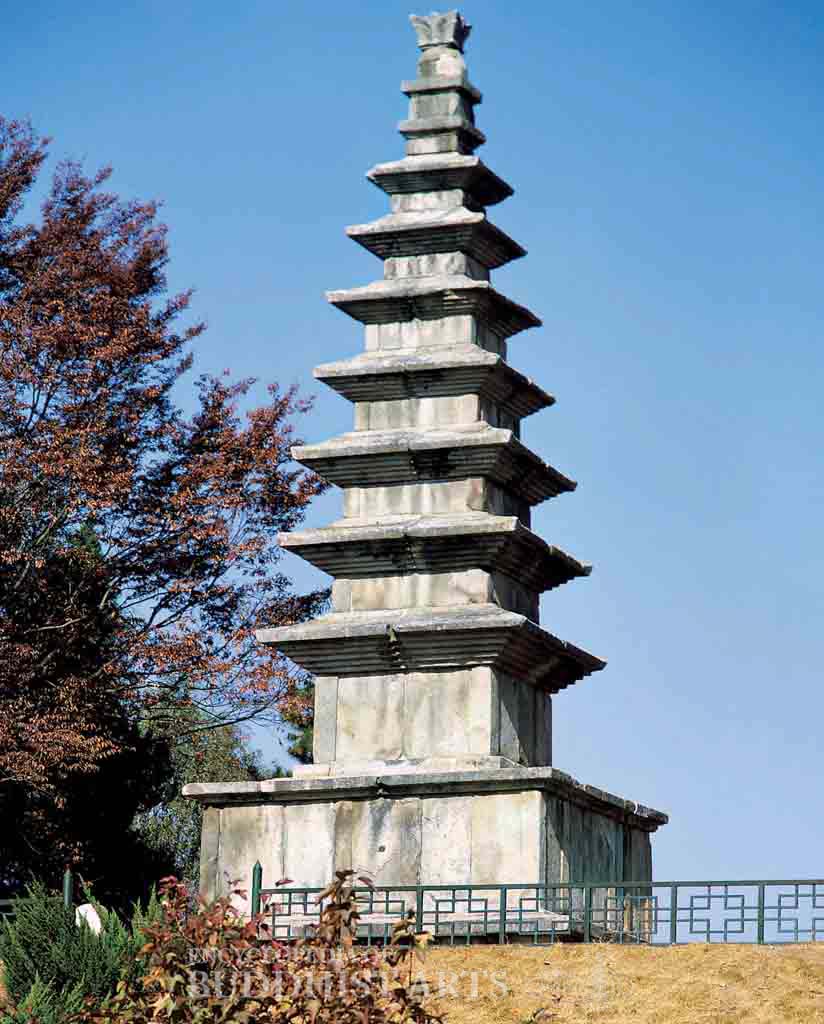
Tappyeongri Seven-Tier Pagoda
Tappyeongri Seven-Tier Pagoda
SOUTH KOREA, North Chungcheong, Chungju
It is also known as Central Pagoda because it is located at the center of the Korean peninsula. It is the highest standing stone pagoda of the Unified Silla dynasty (668–935). The pagoda was built in the late 8th century and was reconstructed in 1917. In 1992 the area surrounding the pagoda was enclosed and was named Central Pagoda Park. The pagoda was listed as National Treasure No. 6 in 1962.
The 14.5 m high pagoda consists of a base, body, and spire. The base is formed of large stone slabs and is carved with pilasters at intervals. The size of each level of the pagoda body decreases with height. Each level also has pilasters. The eaves are supported by five layers of corbeling in decreasing sizes. The first five levels are formed of several stone slabs, while the sixth and seventh levels are made of single stones. The spire consists of a distinctive double-layer dew receiver, an inverted bowl and an upright lotus. During its reconstruction in 1917, reliquaries and artifacts from the Unified Silla and Goryeo (918–1392) dynasties were found at the base and under the eaves of the sixth level.
For more details, go to the Encyclopedia of Buddhist Arts: Architecture T-Z, page 1092.
Cite this article:
author = Hsingyun and Youheng and Johnson, Peter and Mankuang and Lancaster, Lewis,
booktitle = {Encyclopedia of Buddhist Arts: Architecture T-Z},
pages = 1092,
title = {{Tappyeongri Seven-Tier Pagoda}},
volume = 4,
year = {2016}}