
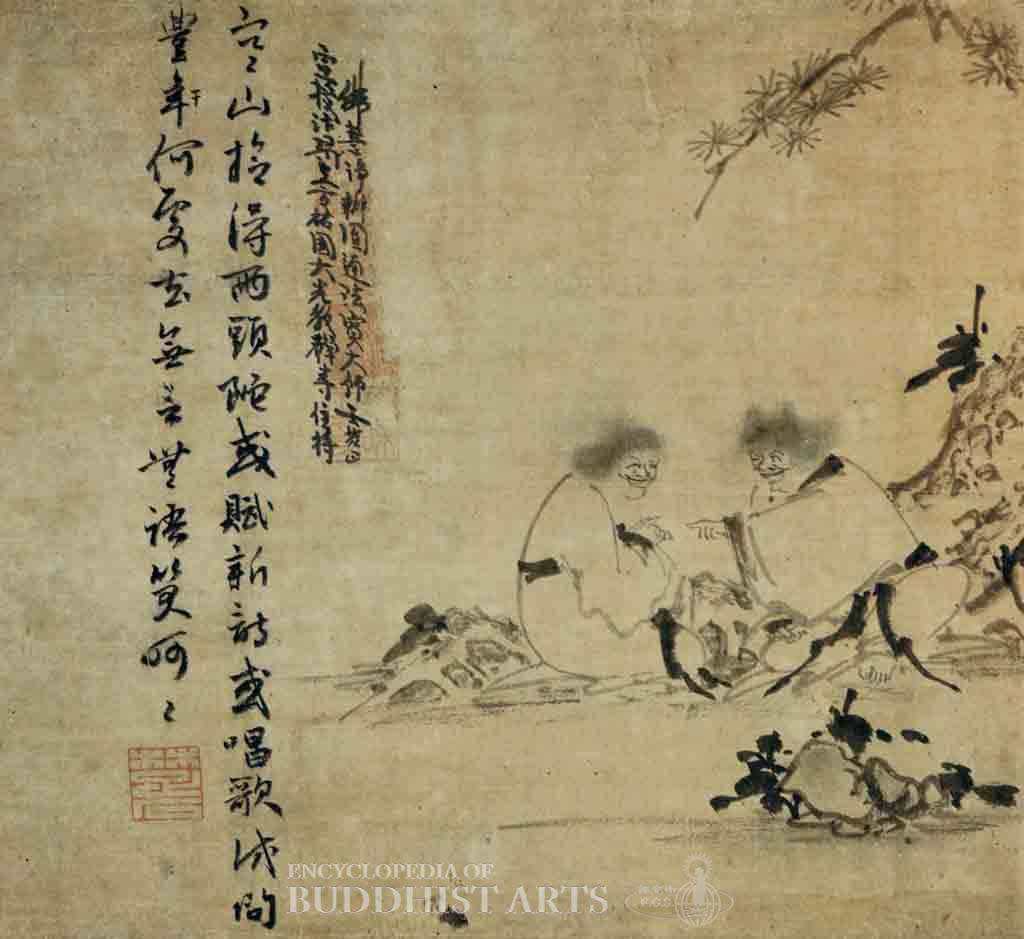
Hanshan and Shide by Indara; Yuan dynasty
Ink on paper
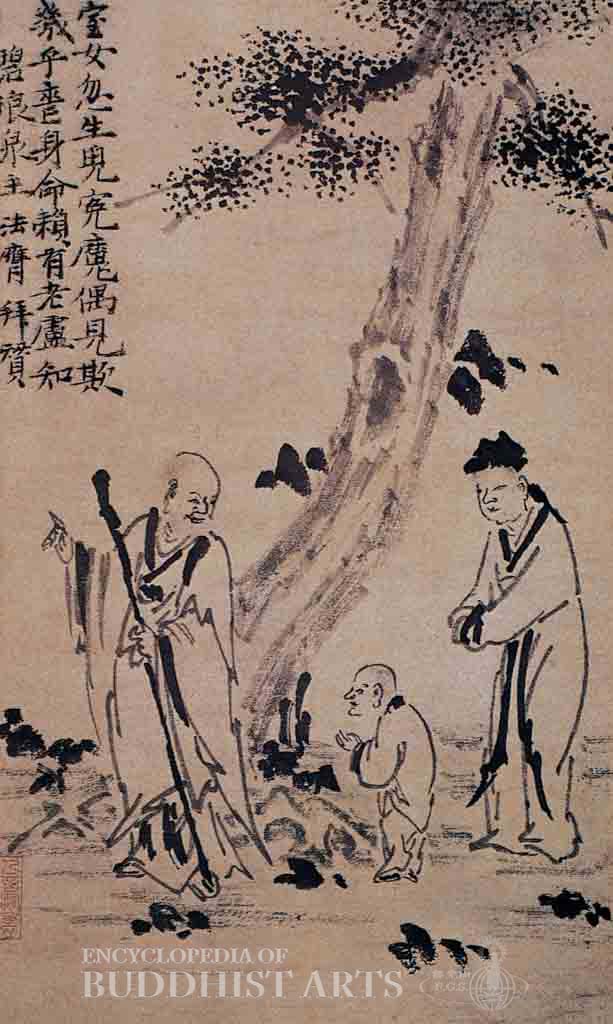
Return of the Fifth Patriarch by Indara; Yuan dynasty
Ink on paper
Indara
INDIA
Indara, or Yintuoluo in Chinese, was also known as Ren Fanyin. Originally from India, he was a well-known painter and monk who served as the abbot of Daguangjiao Chan Monastery in Henan, and also stayed at Zhongtianzhu Temple in Zhejiang.
Indara was known for his frequent use of the dry-brush painting method. His creations were bold and unique in style, and showed resemblance to those of Liang Kai. Rich in the spirit of Chan, his works were praised in the inscriptions penned by Chan Master Chushi Fanqi.
Several of Indara’s extant works have been listed as National Treasures of Japan; these paintings include Chan Encounter - Budai and Jiang Mohe, kept at the Nezu Museum in Tokyo; Master Zhichang and Zhang Shuibu, kept at the Seikado Bunko Art Museum in Tokyo; Hanshan and Shide, at the Tokyo National Museum; Master Danxia Burning Wooden Buddha Statues, at the Ishibashi Museum of Art in Fukuoka; and Master Zhichang and Li Bo, retained at the Hatakeyama Memorial Museum of Fine Art in Tokyo. Other artworks in Japan include Masters Daoxin and Hongren and Return of the Fifth Patriarch, at Daitokuji Temple in Kyoto, and Vimalakirti, at the Kosetsu Museum of Art in Kobe.
For more details, go to the Encyclopedia of Buddhist Arts: People, page 109.
Cite this article:
author = Hsingyun and Youheng and Youlu and Pokorski, Stefanie and Yichao and Mankuang and Miaohsi,
booktitle = {Encyclopedia of Buddhist Arts: People },
pages = 109,
title = {{Indara}},
volume = 19,
year = {2016}}