

Woljeongsa Temple
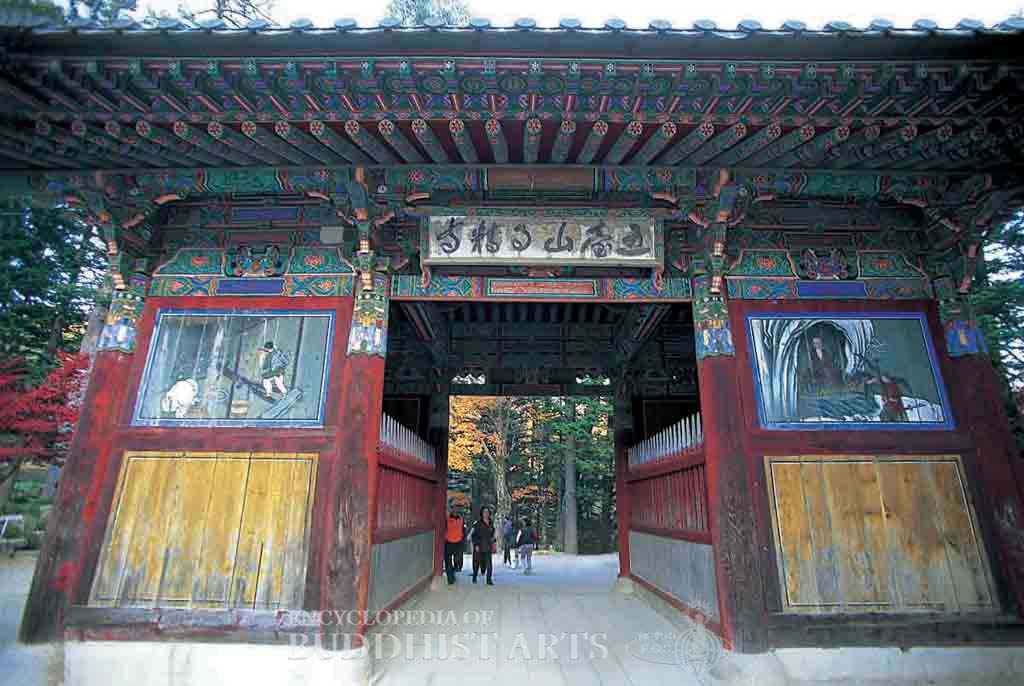
Woljeongsa Temple: Heavenly King Gate
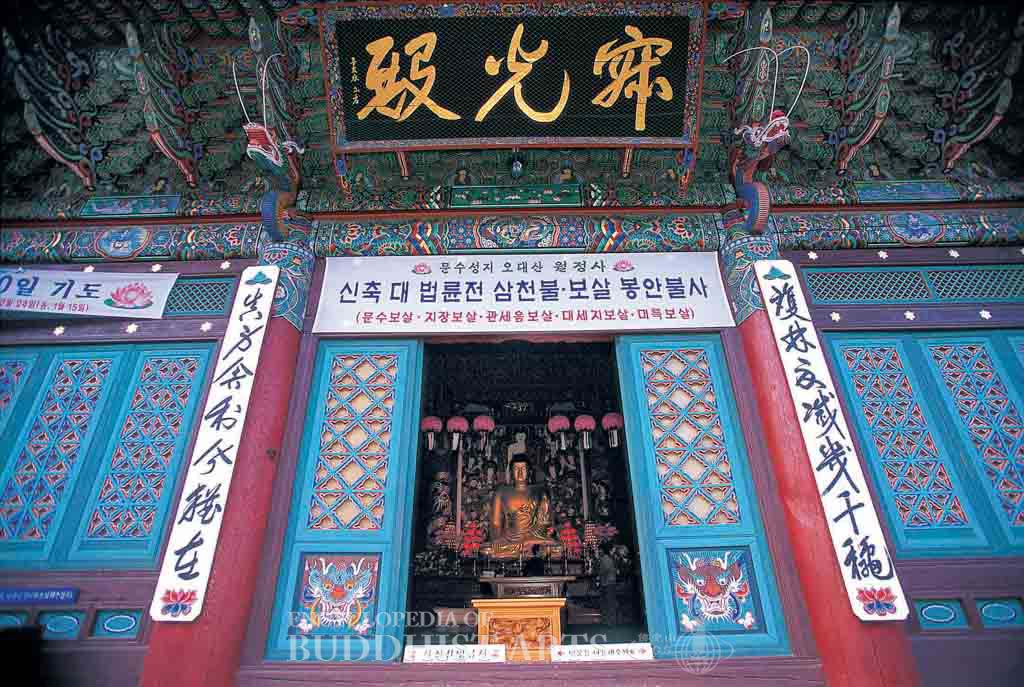
Woljeongsa Temple: Hall of Silence and Light
Woljeongsa Temple
SOUTH KOREA, Gangwon, Pyeongchang
Woljeongsa means Essence of Moonlight Temple. It is located on Odaesan (Five Plateau Mountain) in the northeast region of South Korea. It is the head temple for the 4th district of the Jogye order of Korean Seon Buddhism. The temple bases its teachings on the Avatamsaka philosophy and the belief in Manjusri Bodhisattva. It was founded in 643 during the Silla dynasty by Master Jajang. According to Memorabilia of the Three Kingdoms, Master Jajang witnessed a manifestation of Manjusri at Wutaishan when he was making a pilgrimage to China during the Tang dynasty (618–907). He brought back relics to Korea and wished to house them appropriately. Recognizing that Wutaishan was the residence of Manjusri Bodhisattva, he initially built a grass hut at Odaesan Mountain, which has the same name as Wutaishan. A temple was then built and a pagoda to house the relics was subsequently built next to it. The temple was burned down and restored in the 14th and 19th centuries. Many buildings were burned down during the Korean War in the 1950s, but they were rebuilt by masters Tanheo, Manhwa, and Hyeonhae.
The principal buildings include One Pillar Gate, Heavenly King Gate, Nirvana Hall, Hall of Silence and Light, Longevity Light Hall, Ksitigarbha Hall, Great Dharma Wheel Hall, Mind Sharpening Hall, Hall of the Three Sages, meditation hall, nine-tier pagoda, and a museum. Other structures in the temple include the Upper Temple, where an old bronze bell is kept. The Heavenly King Gate is three bays wide and two bays deep. The central bay is a walkway, and the two side bays enshrines the Four Heavenly Kings. The three-by-three bay Nirvana Hall houses the Buddha’s bone relic.
The Hall of Silence and Light stands in the center of the temple. It is five bays wide and has a single-eave hip-and-gable roof. It contains a seated statue of Sakyamuni Buddha, instead of Vairocana Buddha, who is usually enshrined in halls with this name. In front of the hall are the octagonal nine-tier stone pagoda, which is listed as National Treasure No. 48, and a kneeling Bodhisattva statue, listed as Treasure No. 139.
For more details, go to the Encyclopedia of Buddhist Arts: Architecture T-Z, page 1273.
Cite this article:
author = Hsingyun and Youheng and Johnson, Peter and Mankuang and Lancaster, Lewis,
booktitle = {Encyclopedia of Buddhist Arts: Architecture T-Z},
pages = 1273,
title = {{Woljeongsa Temple}},
volume = 4,
year = {2016}}