
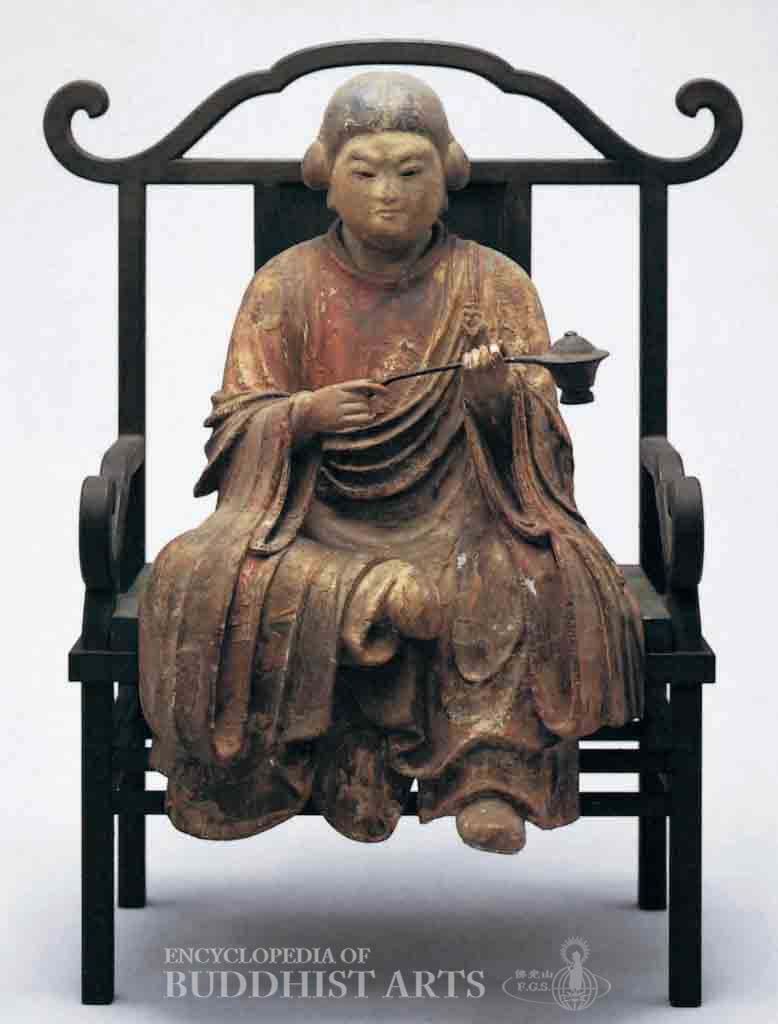
Prince Shotoku; Kamakura period
Wood
Prince Shotoku
JAPAN; Asuka period
Prince Shotoku, also known as Prince Umayado or Prince Kamitsumiyao, was the second son of Emperor Yomei (reigned 585–587) of Asuka. Since young, he was highly intelligent, being well-versed in Confucianism, Buddhism, astrology, and geography. He was so highly-regarded that Empress Suiko (reigned 593–628) appointed him regent and heir apparent in place of her own sons.
The prince began studying Buddhism under a Korean monk, Hyeja, in 595. There, he composed commentaries on the Lotus Sutra, the Srimala Sutra, and the Vimalakirti Sutra. Prince Shotoku established a new ranking system in the court in 603, and later promulgated a new constitution in which he adopted Buddhist teachings as the basis of his political philosophy. During his thirty years as regent, he commissioned the construction of Shitennoji Temple, Horyuji Temple, and Koryuji Temple, which served as the grounds for the propagation of Buddhism in Japan. Prince Shotoku was revered by his people, some of whom even considered him to be a manifestation of Avalokitesvara Bodhisattva. Between the Heian (794–1185) and Kamakura (1185–1333) periods, paintings and sculptures of the prince were popular.
His artworks include the manuscript of his Annotated Commentary on the Lotus Sutra, written in cursive script. This manuscript is the earliest and one of the most important calligraphic works in Japanese history. It is now kept at the Imperial Household Agency in Tokyo.
For more details, go to the Encyclopedia of Buddhist Arts: People, page 211.
Cite this article:
author = Hsingyun and Youheng and Youlu and Pokorski, Stefanie and Yichao and Mankuang and Miaohsi,
booktitle = {Encyclopedia of Buddhist Arts: People },
pages = 211,
title = {{Prince Shotoku}},
volume = 19,
year = {2016}}